A rare natural wonder is unfolding in Delhi’s Lodhi Garden
The Oriental Pied Hornbill, a bird usually found in the lower Himalayas, is displaying an unusual behaviour: one female is feeding the chicks of another. The puzzling sight has left bird lovers and researchers searching for answers.
Nature plays countless games in remote forests that human civilisation may never discover, but there are moments when rare coincidences occur amidst human settlements, as is being witnessed these days in Delhi’s Lodhi Garden.
Every morning, around 5 am, birdwatchers, photographers, and ornithologists from across the city and surrounding areas gather here and stare at a hole-like nest built in a silk cotton tree.
In this nest, a female Indian Grey Hornbill is raising her chicks. As happens during nesting, the female seals the nest with mud from within, leaving a small slit open. The male brings her food, and she relies on him for her and her chicks’ survival.
Everything in this story was normal until here. The twist came when an Oriental Pied Hornbill arrived at the nest and began feeding the female and her chicks.
Two facts make this story thrilling. First, the Oriental Pied Hornbill is a bird found in the lower regions of the Himalayas (the Terai) and is not seen in Delhi. Second, this hornbill is female, not male. Why is one female hornbill feeding the chicks of another female?
These questions are troubling bird lovers and curious researchers here.
Birdwatcher and photographer Nikhil Dewasar, who arrives here every morning, says, “We’re baffled as to how a bird we’ve been visiting in the Terai region of Kumaon and Garhwal to see has ended up here. Now we’ve learned that there are two Oriental Pied Hornbills in Delhi: the one you see here and the one reported in the Jamia area. Incidentally, both are females.”
“It seems that someone nearby must have kept this bird in his farmhouse and it has escaped from there,” he adds.
But more surprising than its presence is the behaviour of the Oriental Pied Hornbill. From day one, it has been bringing berries, curry leaves, eggs, snails, and many other things to the nest. The female Indian Grey Hornbill didn’t accept everything it offered, but a significant portion of this supply became food for her and her chicks.
Last Friday, a remarkable sight was witnessed when this hornbill brought a small bird to the nest and, with great effort, pushed it inside. Wildlife photographer Vijay Bedi, who captured the scene, found the behaviour “very iconic and incredible between two different hornbill species”.
“This is an amazing event. Have you ever seen a tigress bringing food to leopard cubs? Even if she did, it would be big news, but what we saw here was like a once-in-a-lifetime moment. The long wait of mine was worth it. I saw her carefully place an entire chick in the nest,” Bedi said.
The saga began when Anuradha Mathur, a retired school principal turned birder from Delhi, spotted an Oriental Pied Hornbill with two male Indian Grey Hornbills at this nest on May 12. She posted the picture on social media and birders’ WhatsApp groups.
“The camera I used to take that photo is unfortunately broken now, but a new story has been discovered in the avian world,” Mathur told me laughingly.
The female Indian Grey Hornbill has now emerged from the nest, but her chicks will take time to grow and come out.
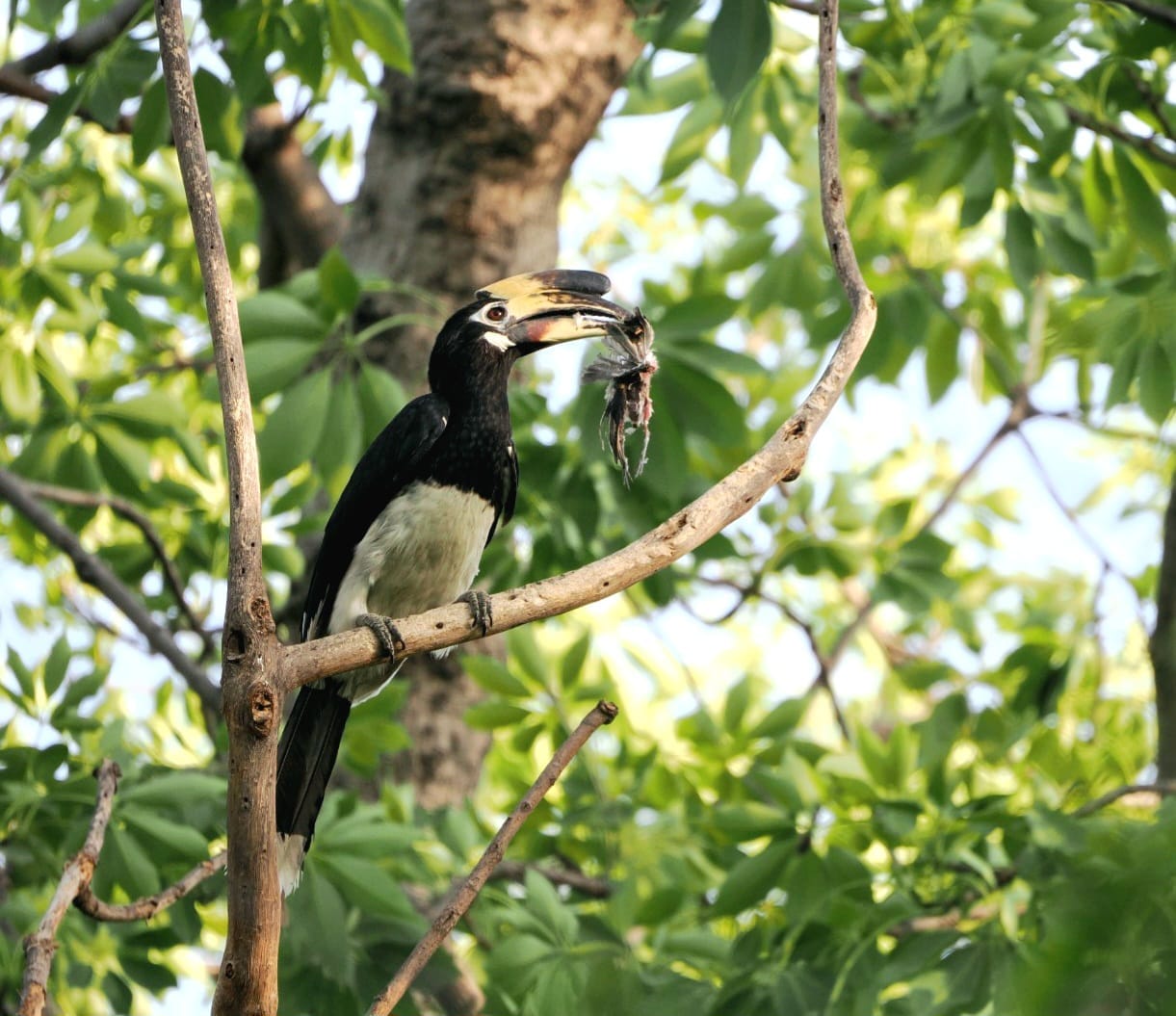
Shaila Chhabra, who has been studying bird behaviour for nearly 30 years, explains why the Oriental Pied Hornbill is raising these chicks as if they were her own children. “She is so possessive that she has even started chasing away the male Grey Hornbill and not allowing him near the nest,” Chhabra says.
The suspense has deepened, and a slight fear is also growing. Bird lovers murmur about why the Oriental Pied Hornbill is not leaving when the mother is out and the whole Grey Hornbill family is there to feed the chicks.
Had the pied bird been waiting for its meal all this time? Could it chase away the parents and eat the chicks once they come out?
“You can’t say anything. We know this has happened at least once in Punjab. We know these aren’t her own chicks. Nobody wants the big bird to kill innocent newborns. But nature plays strange games, and we can’t interfere in it. You should wait here to see the finale of the story,” says Chhabra.
Complaining about the media is easy. Why not do something to make it better? Support independent media and subscribe to Newslaundry today.