Jadavpur University students confront misreporting in mainstream media
Following an online petition, prominent Bengali daily Ananda Bazaar Patrika had to admit its mistake.

Stifling dissent and unpopular opinion on campus has become a convenient and commonplace means of control. It is in this context that we need to look at the protest that occurred in Jadavpur University (JU) last week. JU has a history of protesting against imperialist forces who have tried to choke and throttle our country for over two centuries. Perhaps, it is this spirit which brings together students from all backgrounds whenever the university is deemed under attack. And the students have, time and again, shown an unprecedented level of solidarity.
The protest rally held on the JU campus on the afternoon of August 10 was in support of a call by students to join the fight to preserve one of the very few spaces left for us to practice our freedoms of debate, dissent, and deliberation.
The march to the office of Vice-Chancellor Suranjan Das was a firm reminder about the power of the university’s spirit. More than 2,500 students, from all faculties, irrespective of their political affiliations united under one banner to march to Aurobindo Bhavan, the JU administrative headquarters. Meanwhile, an Executive Council (EC) meeting was under way in response to the legislation passed by the state government – the West Bengal Universities and Colleges Act 2017– dictating a new system of student body administration.
The West Bengal Universities and Colleges Act 2017 proposes to do away with the current students’ union structure in all state-affiliated universities and colleges and replace it with a nominated student-teacher body. According to the government order which explains the guidelines for forming a student ‘council’, as against a student ‘union’, the ‘council’ would essentially be a student body, stripped of its powers of being a union, and, thereby, stripped of any influence in the administrative functioning of an institution famed for its autonomy. Consequently, students protested against this legislation on the ground of it being undemocratic and unjust to the autonomy of the students’ union.
After a 35-hour sit-in demonstration by students on the night of August 11, the JU EC agreed to forward the students’ request to the state government. While the initial attempt for a more autonomous campus had been won, the media backlash faced by the students was tremendous. Well-known dailies of the city such as Ananda Bazaar Patrika and TV channels like Republic TV chose to misconstrue the situation and distort the facts. Jadavpur University once again became a hotbed of “political hooliganism”, where its students “choose the downfall of the academic atmosphere of the university over its upliftment”.
On August 12, Ananda Bazaar Patrika reported that studies were suspended due to the protest and the VC was gheraoed. What ABP failed to report was that despite all the protest demonstrations, the majority of classes scheduled during the protest had been attended by a regular number of students and nobody was gheraoed! Misreporting the protest, especially with Jadavpur University in the headline, might work well in clickbait journalism. But, to see a well-known, large circulation Bengali daily resort to such means is truly saddening. Reporting and slandering are separate exercises. Journalism comprises the former.
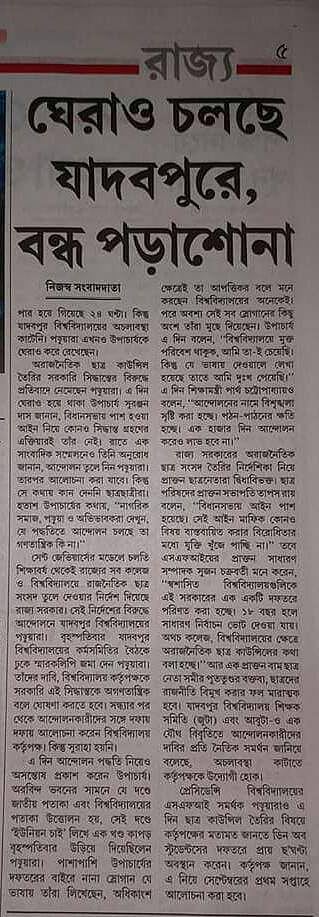
It didn’t take much time for the students to stir up against this. Saturday witnessed a massive online campaign against the skewed reporting of the event. The JU Journal emailed the editor of the Ananda Bazaar Patrika demanding a public apology for defaming both the institution and its students, and a retraction. On Sunday morning, the Bengali daily conceded to pressure and admitted its mistake. However, the daily did not retract its statement about the VC being gheraoed, adding a violent spin to an event that was far from it.
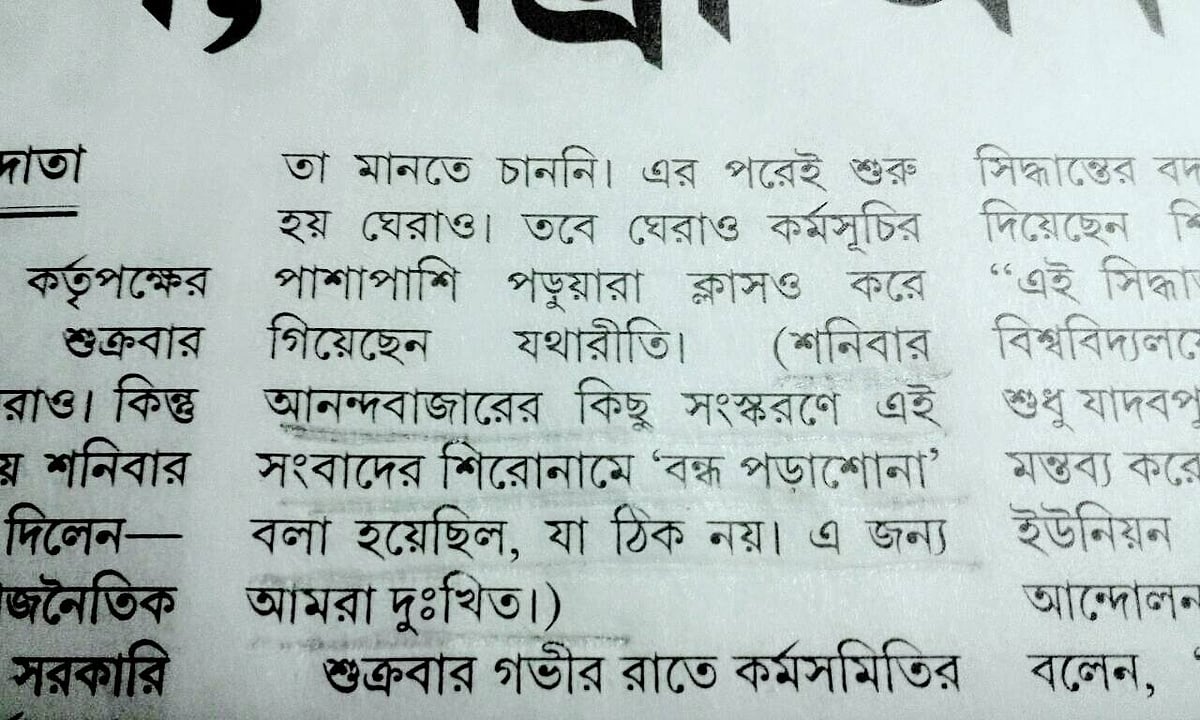
And it wasn’t just ABP that misreported the story, other national media houses were just as guilty. Buoyed by their struggle with the Patrika, the students hope to confront the rest of these institutions as well until the truth is made clear.