The politics of gender in the Hyderabad University polls
While GSCASH open debate has been introduced this year, the grand alliance faces flak for absence of female candidates in their central panel.

The campus and hostel corridors of University of Hyderabad (UoH) have been witness to charged political campaigning over the last one week with student union elections scheduled for September 21.
The two major parties in the fray are Akhil Bharatiya Vidyarthi Parishad (ABVP) and Alliance for Social Justice (ASJ). The latter comprises Ambedkar Students’ Association, Muslim Students’ Federation, Students Islamic Organisation, Students’ Federation of India, Dalit Students’ Union, Tribal Students’ Federation, Bahujan Students’ Front and the Telangana Vidyarthi Vedika. The National Students’ Union of India (NSUI) has fielded their candidate, G Anju Rao, only for the presidential post.
This year’s election in UoH assumes importance primarily because of the coming together of the Dalit-Muslim-Left-Adivasi parties. In addition, the decision to hold a presidential debate, which is a first in University’s election history adds to the significance of the event.
Taking cue from other universities like JNU, UoH election commission has decided to hold a public presidential debate where all three presidential candidates and two general secretary candidates will be given a platform to present their manifestos. Following which, they will be questioned by opposition candidates, nominees and students.
Apart from these democratic and transparent measures, a concern about the under-representation of female candidates in both the panels has been raised by supporters of respective panels.
Another issue that surfaced over the last two days is the lack of public space for the candidates of Gender Sensitisation Committee Against Sexual Harassment (GSCASH) to discuss and debate their agendas. GSCASH is an autonomous body which is neither an extension nor a part of the students’ union. Firdaus Soni, the GSCASH representative during 2016-2017 period wrote a letter to the election commission demanding that GSCASH nominees should have a similar public debate format as part of GSCASH elections.
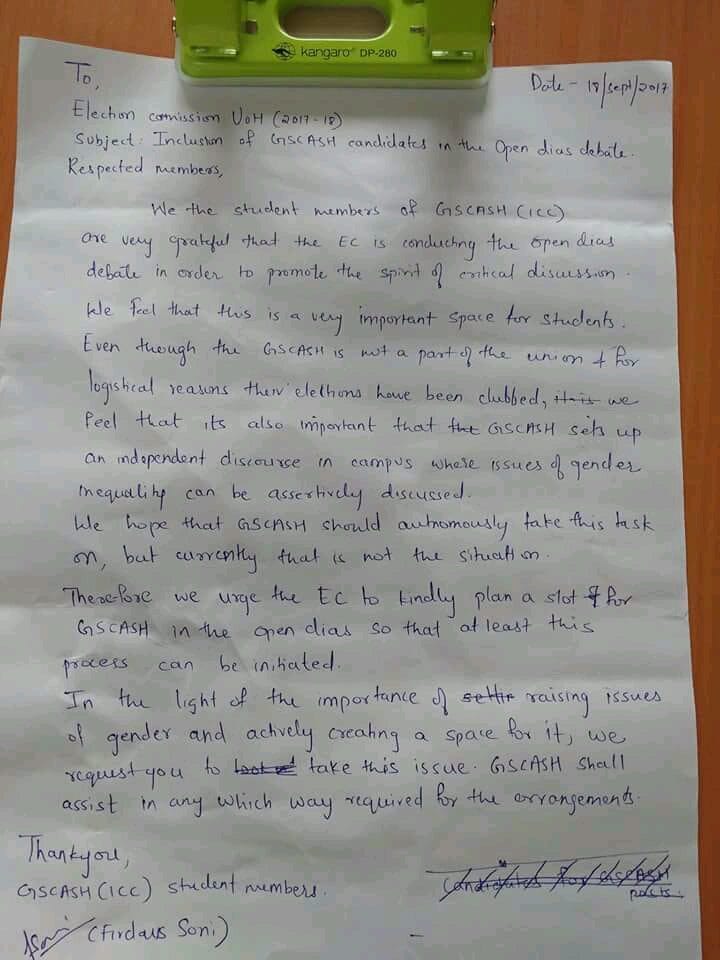
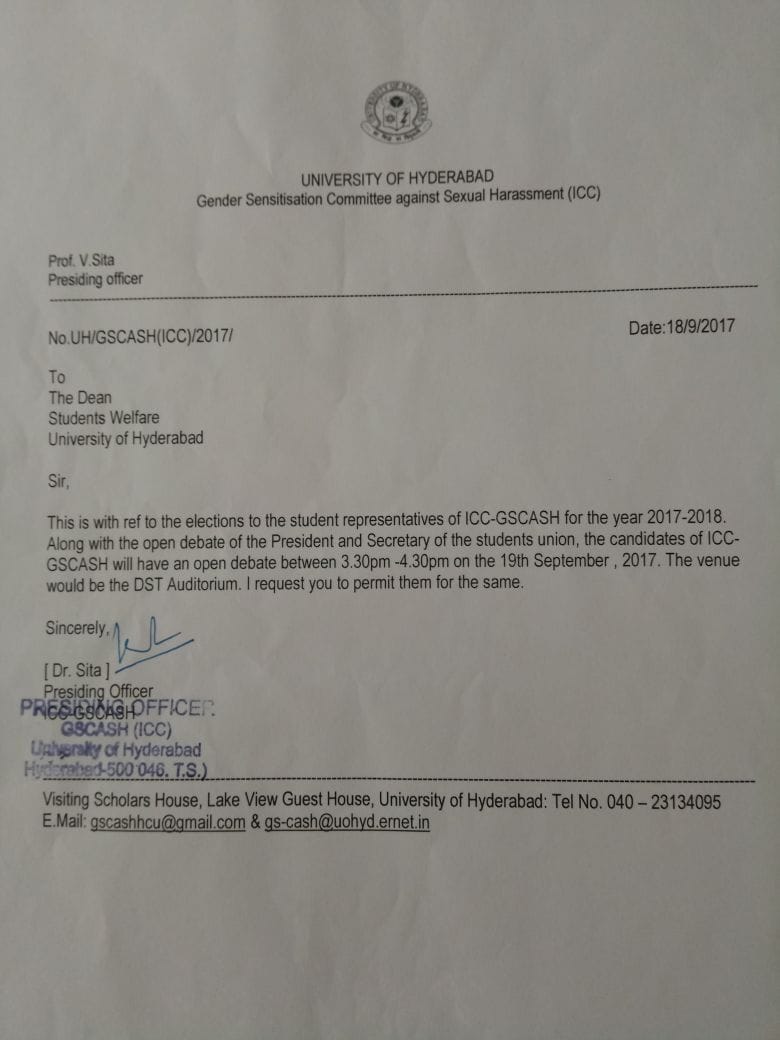
Subsequently, the election commission ordered for a public debate to be held on September 19 as part of GSCASH elections.
“It is of utmost importance that our university engages with the institution of GSCASH seriously and sincerely. GSCASH is not an extension of the students’ union. Many logistical reasons are given as explanation for why GSCASH elections are held along with the students’ union elections. Consequently, the discourse of gender takes a back seat as the campus is overwhelmed with ‘more important’ engagements of the union elections. It has been a struggle for GSCASH to become as public and as accessible as possible. It is a part of anti-caste and feminist politics to make the personal political and therefore also public,” Soni argued against the suppression of GSCASH autonomy.
This comes following the recent development in central universities across the country. Despite the student and faculty resisting Ministry of Human Resource Development’s circular to rename and revamp the GSCASH as Internal Complaints Committee (ICC), the JNU administration, in a surprising turn of events, officially replaced GSCASH with ICC on September 18
While GSCASH remains a contentious issue in educational institutions, the debate around absence of female candidates in ASJ and ABVP panel has struck a chord with female voters across the university campus. “It is a reflection of the masculine nature of student politics, and a grave mistake from ASJ alliance. But having said that, the burden of gender and fighting patriarchy lies upon men as it is of women and other genders. So I will definitely support ASJ and work with them to de-masculinise the university space. This alliance should now make efforts to ensure that women’s voices are very much a part of the collective decision making processes of the union,” Soni added.
Responding to the criticism, Tinanjali Dam, ASJ’s GSCASH nominee, said, “Alliance for Social Justice will surely fight against the patriarchal notions, moral policing and threats, unnecessary hostel raids which happen on campus. We want a better inclusive campus irrespective of any gender, a safe space for LGBTQ community as well.”
Incidentally, the ABVP panel does not have much to boast about when it comes to gender representation either. With two female candidates in their central panel (for the post of Cultural Secretary and Joint Secretary), ABVP has also shied away from handing over the important positions to female candidates. However, they have maintained the age-old gender stereotype of fielding female candidate on the post of Cultural Secretary. “Every organisation has their own perspective and code of conducts. If we talk about our student body, I don’t think there is under-representation. We have two female candidates in our central panel including GSCASH,” said Neha Rani Patel, ABVP’s GSCASH candidate.