Delhi media mum on Sohrabuddin case judge BH Loya’s ‘suspicious’ death
The Caravan story on the allegations raised by Loya’s family has not got its due in print and online media. The regional media pounced on it.

Days before the verdict in the Sohrabuddin Sheikh fake encounter case in which BJP chief Amit Shah was the prime accused, CBI judge BH Loya, who was hearing the case, died on December 1, 2014. The next judge, who took over the case, wrapped up the case later that month and Shah was acquitted.
This Monday, The Caravan magazine in its story – Family breaks its silence: Shocking details emerge in death of judge presiding over Sohrabuddin trial – made shocking claims on Loya’s death. Three years later, his family has raised doubts about the circumstances surrounding his death. Makes for one of the biggest news breaks of the week, and probably the month as well? But the mainstream media (read Delhi media) and the big media houses didn’t find it interesting enough. Contrary to this, the regional media found it interesting enough to give it significant space in their print publications as well as online. The reverse of the tyranny of distance, perhaps.
Kannada, Tamil and Malayalam news organisations carried the news of The Caravan story. Kerala-based news organisations such as Madhyamam, Mathrubhumi and Manorama Online, Kannada news organisation such as Vartha Bharati and Kannada Prabha have given space to the newsbreak. Asianet Tamil and Theekkathir were Tamil news organisations to have covered the suspicions raised by Loya’s family.
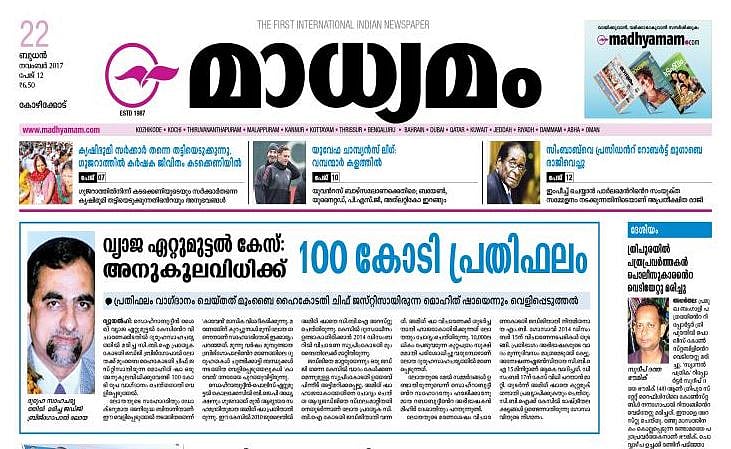
Page 1 treatment in Malayalam daily Madhyamam.
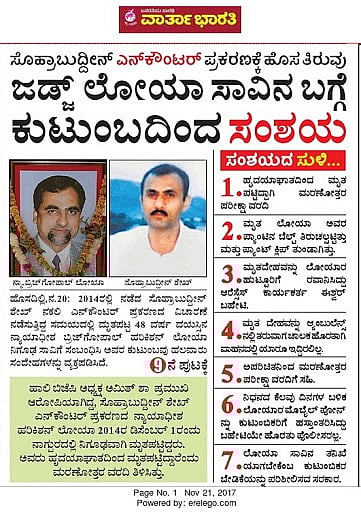
A Page 1 clipping of Kannada newspaper-portal Vartha Bharati.
The reason for ignoring such an important newsbreak on one of the biggest political-legal case remains best known to the mainstream media. The Sohrabuddin case was transferred to Mumbai by the Supreme Court in 2012 to ensure a fair trial. Every development related to the case has made national headlines but Loya’s death. The Caravan Executive Editor Vinod K Jose told Newslaundry, “The coverage has been only from regional media and certain parts of the country.” He added that the silence of the English and the Hindi press is appalling. “What is more shameful is when a story of this importance about a politician of tall older breaks, what you see in the largest selling newspaper on the front page is the same politician learning Bangla, Tamil and Manipuri. That speaks for the journalist judgment that people are making,” said Jose.
With running stories based on allegations becoming a norm for the mainstream media, the serious doubts raised by the Loya family have been completely side-stepped and ignored. Remember the dramatic press conference of Delhi legislator Kapil Mishra where he fainted while showing cheques in the name of the Aam Aadmi Party? Mishra had made wild allegations of corruption against Delhi Chief Minister Arvind Kejriwal and questioned the funding of the party. But the mainstream media was all over the story. Similarly, the claims of bursting the “Love jihad” modules by TV news crews are based on statements of individuals. These make great selling stories. However, the questions surrounding the death of a CBI judge dealing with such a sensitive case wasn’t sexy enough for them.
In his story for The Caravan, reporter Niranjan Takle spent a year on speaking to the family and building it from ground up. Loya’s sisters – Anuradha Biyani and Sarita Mandhane – and father Harkishan Loya raised five primary questions on the circumstances related to Loya’s death. Biyani also made a sensational allegation against the then Bombay High Court Chief Justice Mohit Shah. She claimed Loya had told her that Mohit Shah had offered Rs 100 crore for a favourable judgment in the Sohrabuddin case. Shah is yet to respond to the queries sent by the publication.
Loya was in Nagpur to attend the marriage of the daughter of a fellow judge, Sapna Joshi. At the time of his death, he was in a VIP guest house. According to the reports, CBI judge had died of a cardiac arrest. As per The Caravan, Loya’s post-mortem report said that he “died on 1/12/14 at 0615 hours” after experiencing “chest pains at 0400 am.” The post-mortem was conducted at the Government Medical College Hospital at 10.55 am in the morning and was over after an hour on December 1.
Loya’s sister Biyani, however, has claimed that the family got a call about the CBI judge’s death around 5 am. The caller identified himself as a judge named Barde. How did the caller get to know of Loya’s death even before he died? Mandhane too received a call informing her of the death at 5 am.
The second suspicion was raised on the entire episode of the post-mortem itself. The post-mortem can be conducted only after informing the family. How did the police go ahead with the post-mortem of a CBI judge handling such a sensitive case without even telling the family? The post-mortem report was signed by someone, who identified himself as the paternal cousin brother. Surprisingly, the family claimed that they don’t have any relatives in Nagpur.
According to the family, Harkishan was told that the body will be sent to Gategaon – the ancestral village of the family – by an RSS worker named Ishwar Baheti. “Nobody knows why, how and when he came to know about the death of Brij Loya,” Biyani said. Why was an RSS person communicating with the family instead of a representative from the police or the administration?
The family claimed the body was sent in an ambulance and even the judges who had gone to attend the marriage in Nagpur didn’t come along. Biyani, a practising doctor, claimed that there were blood stains on the neck and at the back of the shirt. But this important fact is missing in the post-mortem report. In The Caravan report, Biyani has referred to her diary entry, “There was blood on his collar. His belt was twisted in the opposite direction, and the pant clip is broken. Even my uncle feels that this is suspicious.” Similar claims were made by Harkishan and Mandhane.
The more startling revelation is about the phone of the CBI judge. Loya’s phone was returned to the family three-four days after his death, not by the police, but by RSS worker Baheti. According to Biyani, days before his death, Loya received an SMS – ‘Sir, stay safe from these people.’ She claimed that when the phone was handed over, everything was deleted.
While these claims are startling enough to revisit the circumstances in which Loya died, there are also a few loopholes in the scoop. It’s all wink-wink-nudge-nudge. There is no material evidence to prove these claims – including pictures of the body showing blood stains.
Hartosh Singh Bal, The Caravan’s political editor, when asked whether the reporter asked for the pictures of the dead body, said, “The reporter has checked everything. The story is as thorough as it could be. These questions have been asked and we have gone through this.” Bal was speaking on behalf of the Caravan Magazine. “It is not usual for a family to photograph a body they are about to cremate. I think it is clear in the report that they were asking for a second post-mortem but the people attending that cremation were senior Bombay HC judges. They were the ones telling them to go ahead, do not create a problem.”
There is no direct quote from the Nagpur Police or even denial on why an RSS worker was in touch with the family instead of someone from the administration
Why did the family break its silence after two years of his death? What stopped them from raising these issues in 2014?
“Two months after the death, there is a letter from the son [Anuj Loya] to the Chief Justice [Mohit Shah], who is the appropriate authority, asking for a probe in this matter. The family doesn’t hear back,” Bal told Newslaundry. “The suspicions are related to the authorities themselves. The Chief Justice has been asked, there has been no response. They finally get in touch with a reporter who is willing to look into the story. The question is the very fact when a judge dies in suspicious circumstances, why there were stories not done? ” He added that the reporter took time to the necessary leg-work and couldn’t find a place to publish it.
The Caravan’s story doesn’t have the version of Loya’s wife Sharmila and son Anuj Loya. They declined to speak as they “feared for their lives”.
On Wednesday, Bal addressed a press conference in Delhi to discuss the details of the report. When a journalist questioned why The Caravan broke the story right before the Gujarat Assembly elections, Bal said, “There are elections every three months in this country. The story does relate to the BJP, the BJP takes part in every election in the country. At any point, if we release the story, the timing will be seen political. We released the story when we were ready for it.”
But for the mainstream media, barring NDTV India’s primetime show on Wednesday and The New Indian Express, it was a non-story even if The Caravan’s reporter took a year on it.