Nitish Kumar’s Prohibition era and its political fallout
A corrupt administration has joined hands with the liquor mafia but does that mean Prohibition has failed?

While traversing the narrow, stinking lanes of Jagdevpath Mussahari area, you need to be careful to avoid being swallowed up by open manholes. Children clutter the streets, playing games, while old men scratching themselves shout at them. Young girls wash grains alongside older women washing utensils.
Welcome to Danapur, a small town just outside Patna.
This area is a settlement of a Mahadalit community. And we’re trying to find answers to questions associated with the Janata Dal (United) and Bihar Chief Minister Nitish Kumar’s most controversial and audacious decision—Prohibition.
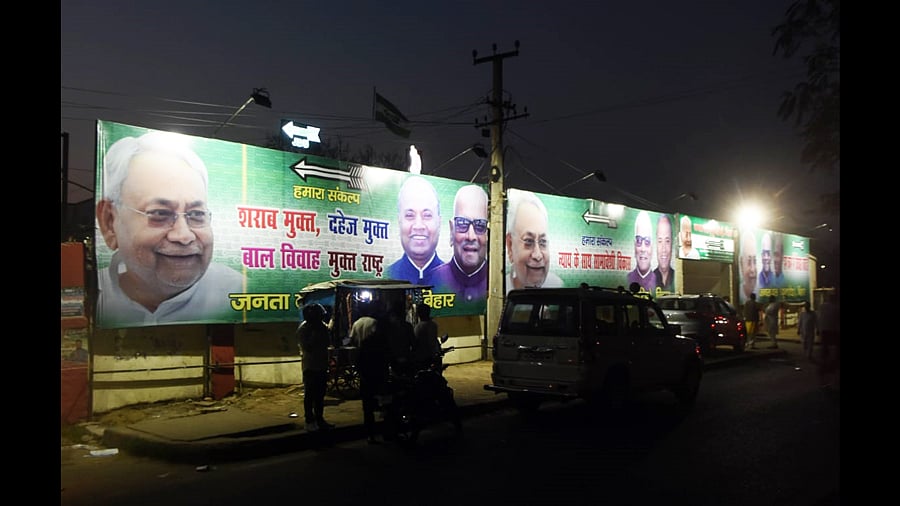
The Nitish Kumar government had projected Prohibition as a major achievement. The State DG Police claims that 160 public meetings were held last year to create awareness. (Photo: Nagendra Kumar)
The Prohibition law was enforced in the state in April 2016. Any attempt to drink, manufacture, sell or store alcohol is punishable by law. The result is an organised racket across the state to sell and supply liquor.
When the ban came into place, the Mahadalits of Jagdevpath Mussahari were forced to leave their age-old occupation of making liquor, losing their only means of livelihood in the process. Three years later, they openly manufacture and sell illicit liquor—under the patronage of the local police. Residents explain that liquor is manufactured in many houses, but are cautious about revealing exact locations for fear of backlash from the police.
Sitting in the mohalla, 25-year-old Pintoo says, “Liquor was banned here earlier … But after forming a nexus with the police, its manufacturing has started again.” This is corroborated by 45-year-old Manjhi Ram, who lives in the same colony and works in a slaughterhouse. Manjhi himself quit the business of brewing liquor, but says many from his community carry on with it under police patronage. “There are bribes which the police accept and then tell people to make and sell liquor. This is rampant,” he says.
Like the Musahar community, the traditional occupation of many castes and communities in Bihar is the manufacture of liquor. In Lalkothi, about 10 km from Danapur, 65-year-old Sudha Verghese runs an NGO called Naari Gunjan which works for the education and empowerment of Musahar women. Verghese recalls how rural women were “quite happy” about the 2016 Prohibition law, even as the Musahars opposed it.
“The Musahar community thought we joined hands with the government to bring in Prohibition, thereby affecting their livelihood,” Verghese explains, adding that the police started extorting money under the guise of cracking down on liquor. “In 2016, the police extorted ₹80,000 in broad daylight from two persons on the same pretext. We protested and complained to the officers but it hasn’t helped.”
Social Worker Sudha Verghese on how the police is extorting money and torturing people
It doesn’t stop at extortion—Verghese says there have been incidents of torture in police custody. On May 22, 2018, the police picked up a young man named Jayiki Manjhi from Naharpura, 20 km from Patna, after a raid in the area. Four days later, his corpse was sent to his family.
Village women on how the liquor is available and police is colluding
“His tongue was protruding out, his eyes were bulging. The post-mortem report said the death was normal but these physical signs tell a different story,” says Verghese, emphasising that she’ll continue her fight to get Jayiki Manjhi justice. These are the various dimensions of Nitish Kumar’s Prohibition law—dimensions that raise more questions than answers.
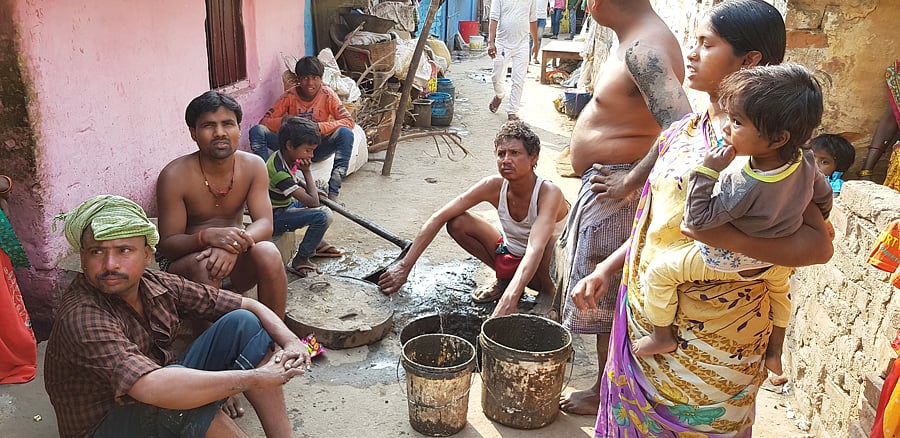
To make and sell liquor at home is a traditional occupation of Musahars and they also allege police extortion. (Photo: Hridayesh Joshi)
Gupteshwar Pandey, the Director General of the Bihar Police, admits that what the cops are doing is illegal. “Lawbreakers are outside the system as well as inside the system, today those inside are openly challenging the system. I have said on record, on public platforms, that some of our personnel are also involved in this and we have taken action against 400 cops. Several of them have been dismissed under Article 311(B) of the Constitution.”
***
Nitish Kumar has always been popular amongst women of the state—he’s known as “Mr Good Governance”—and Prohibition has been made one of his key campaign issues for the general elections. How much will this issue impact the polls? While prohibition did provide Bihar’s women with temporary relief, that’s being offset by a combination of the liquor mafia and the activities of the police.
In her village of Khabra in Muzaffarpur, Meena Devi (33) remembers the events of September 6, 2012. About 500 women had gathered in a middle school in Muzaffarpur at around 5 am. They proceeded to collect liquor bottles and pouches from homes and shops, going door to door. Their efforts were met with resistance, even attacks with swords, but their resolve was unflinching. The women finally laid down their gatherings in the middle of the road, and proceeded to jam the highway.
Meena tells Newslaundry: “It was chaos all around due to liquor. Women couldn’t stay outside after the evenings, men would get drunk, create a ruckus and beat their wives.” Liquor become the fulcrum of physical and economic exploitation. The women’s fury against liquor finally spilled into the revolutionary step of forcefully taking over the liquor stop in homes and stores. It became a trailblazer, igniting similar movements across the state.
That’s when Nitish Kumar smelled an opportunity. It was just after the 2014 Lok Sabha polls, and his counter to the juggernaut of Narendra Modi was to join hands with Lalu Prasad Yadav—and win the votes of rural women by tackling the issue of alcohol. This is how Prohibition finally became his poll promise in the 2015 Assembly polls.
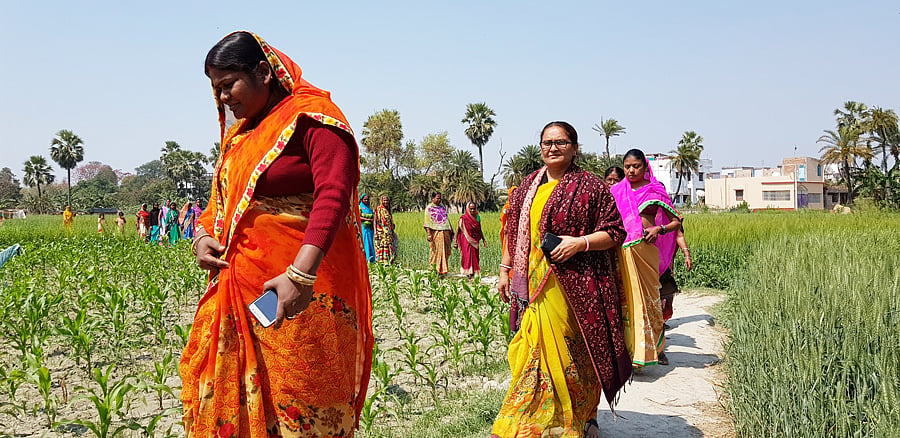
Hundreds of women launched a campaign against liquor consumption and sale including Meena Devi from Muzaffarpur. (Photo- Hridayesh Joshi)
Since the imposition of Prohibition in Bihar in April 2016, a large number of arrests have been made, cases filed, and liquor confiscated. Earlier the law stated that all adult members in a house would be arrested if a member was found consuming alcohol. After resounding criticism for being too harsh, the law was later relaxed.
According to data provided by the state government to the Election Commission, under the Prohibition law, over one lakh cases were registered till December 2018, about 1.5 lakh persons were arrested, and 43 lakh litres of liquor was confiscated. Incidentally, only 193 persons were prosecuted by the courts.
However, state officials and detractors of Nitish Kumar are quick to remember that during the tenure of Kumar’s NDA government in 2005, he played an instrumental role in spreading the menace of liquor.
At the time, the state was in financial chaos following 15 years of Lalu Prasad Yadav’s regime. One way to fill the state exchequer’s empty coffers was through the sale of liquor. So it began: liquor licences were freely distributed, and liquor counters mushroomed across cities, smaller towns and rural areas too. The state government’s economic survey reveals that the income from excise was ₹319 crore in 2005-06 which increased to ₹3,142 crore in 2015-16—an almost ten-fold increase of 900 per cent.
Shivanand Tiwari, a former colleague of Nitish Kumar now with the Rashtriya Janata Dal, says, “Nitish ensured that liquor reaches every home. I was an excise minister in Rabri government of 2005 and the income from the sale of liquor increased ten-fold during Nitish Kumar’s regime. People are still drinking liquor if they have the money. The only difference is that it’s a bit expensive for them. But it is readily available. ”
After the implementation of Prohibition, the excise revenue came down to ₹32 crore in 2017-18 from ₹3,142 crore in 2016-17. In 2017-18, the government also bore a loss of ₹3 crore. The overall loss to the exchequer is speculated to be about ₹5,000 crore, since Prohibition also led to the shutdown of smaller units producing snacks.
Business has also been hit across the state. Vinod Kumar, a taxi driver from Patna, says, “People are not organising any functions or marriages here. Businessmen hold their bid meetings in Jaipur, Ranchi or Lucknow instead.” Another hotel owner from Patna tells me, “For people in cities, drinking is a matter of fun and status. But for the time being, our business is ruined.”
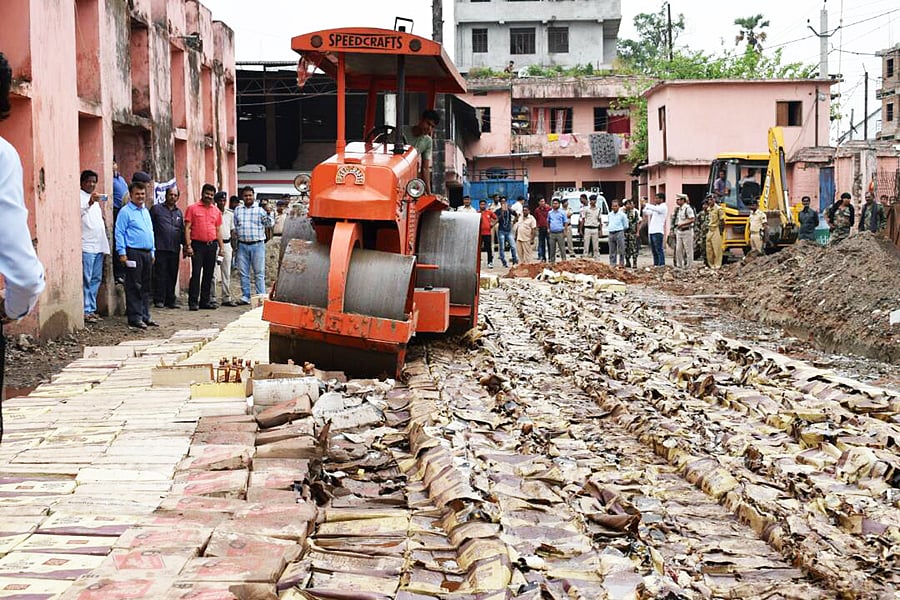
According to government statistics, 43 lakh litres of liquor has been confiscated since Prohibition but the liquor mafia-police nexus is an open secret. (Photo: Nagendra Kumar)
At Patna airport, entrepreneur and engineer Sudhir Kumar is flying to Ranchi for a school alumni meet. “The party was to be held in Patna, but what’s the point of meeting friends here?” he says. “It’s a dry zone. The programme can’t be held at any hotel here.”
***
A poster hangs on the wall of the JD(U) office in Patna. It carries a picture of Nitish Kumar emblazoned with the slogan: “Our resolve: liquor free, dowry free, child marriage free”. A second poster announces: “Our Bihar is now liquor free”.
The placing of Prohibition as an election plank is clear—despite its many shortcomings. Its resonance with rural women, especially those from impoverished backgrounds, is too vast to ignore.
Many women working with the Jeevika employment generation programme tell Newslaundry that Prohibition has reduced disorder in society. These women come from Muzaffarpur, Samastipur, Nalanda, Madhubani and areas outside Patna, but a common thread runs through their stories. Sanju Devi, 34, says: “Initially, the change was dramatic. Liquor had vanished. Now some people drink but not openly, they fear that women can complain on police helpline numbers where the identity of the complainant is not revealed.”
Saibal Das Gupta, who heads the Asian Development Research Institute, says Prohibition is popular in the state and has been successful—in its initial implementation, at least. “As a social policy, it’s been quite successful and is popular with women. But legally, it hasn’t been executed so well. The police didn’t do its work. That is why liquor has become an illegitimate way of profiteering here.”
Government statistics show the crime rate came down within a year of Prohibition being enforced. The state economic survey for 2017-18 says during April-September 2016, murders came down by 28.3 per cent, incidents of rape by 10 per cent, dacoity by 22.8 per cent, and robbery by 12.5 per cent.
Additionally, post-Prohibition sales of milk, milk products, honey and sweets increased, an indication of a shift in spending. Thirty-two-year-old Kiran Devi says, “My husband started drinking after he had bad company. But now he’s understood its harmful effect. There is peace at home now. I’m getting more money to run the household.”
***
But all is not well.
Bihar has borders with Uttar Pradesh, Jharkhand, West Bengal and Nepal, all of which require strong and constant vigilance to check the smuggling of liquor. Nitish Kumar’s cabinet established an IG post to handle it, and high-profile IPS officer Ratna Ranjay was put in charge. Yet the porous borders of the state became a ready excuse for liquor smuggling, even as trucks carrying liquor enter the state from Haryana, Punjab and Jharkhand—under the protection of the police.
A doctor in Patna, whose relative is involved with this trade, says, “₹4 lakh is the fixed rate for releasing a truck. There is a fixed rate for catching a truck also. It is a big business now. Often, the police sell the confiscated liquor without showing it in its records.”
On January 13 this year, 300 crates of liquor were confiscated from Amitabh Kumar, the Station House Officer of Motipur Police Station in Muzaffarpur. Amitabh Kumar was found to be selling the liquor in one of the most high-profile cases post Prohibition involving the police.
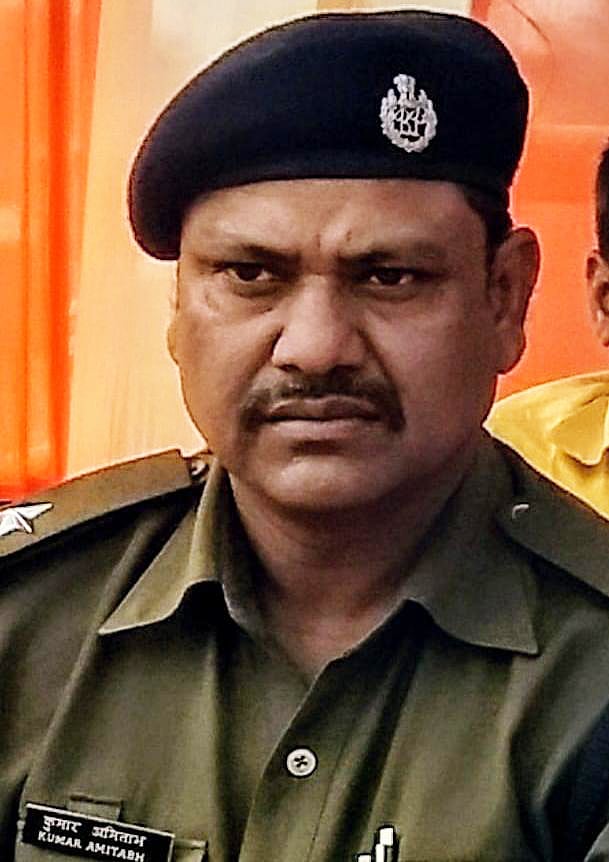
Motipur Police Station head Amitabh Kumar in Muzaffarpur from whose residence 300 crates of liquor were confiscated.
The impact of the police’s involvement in the liquor racket is visible in the state of law order in Bihar.
“Mr Good Governance” might have ensured better law and order when compared to his predecessors, but the criminals are clearly back in action. Take Muzaffarpur, for example. About 10 murders took place here every month over the past year. On September 23, 2018, its mayor was gunned down with an AK-47. Incidences of loot and robberies are on the rise. On November 22, 2018, ₹52 lakh was looted from an Axis Bank van. This February, gold worth ₹10 crore was looted from Muthoot Finance.
Why did this collapse in law and order take place?
A senior police official posted at Patna’s police headquarters explains how the police has been consumed in curbing Prohibition: “Initially, the idea was to implement only partial Prohibition by banning country liquor and selling liquor through select outlets only. But some officials, not ready to do the hard work, gave feedback to the chief minister, telling him partial Prohibition won’t do. They provoked him to bring in full Prohibition.” As a result of this measure, he says, “Our administration and police stations have collapsed. We could have checked the issue though [selling liquor in] a limited number of government shops. But it didn’t happen.”
***
In Ramnagar Diyara village, which falls under the Munger Lok Sabha seat, a group of 100 women have gathered. Belonging to the Mahadalit community, they’re upset with the administration’s attitude towards Prohibition.
Enraged, a woman named Seswati says, “Who says liquor is not available? It is being manufactured and made available (in the village). Initially, men were drinking for ₹20. Now they’re spending ₹300 for the same.” The other women agree. Thirty-year-old Anita Devi holds her child in her lap as she says, “Nothing has changed. The police have ruined everything. Liquor is freely available all around.”
The sentiment is repeated in other villages that dot the state.
In Ghoswari village, 55 km from Patna, Minat Parveen and Jahanara Khatoon have been at the forefront of the Prohibition movement in their area. They believe that if the cops continue to support the liquor mafia, Prohibition is of no use.
Of the 1.5 lakh people arrested under the Prohibition law, a majority belong to weaker sections of society—sections that comprise Nitish Kumar’s vote bank. Is Kumar worried about possible cracks in his citadel? The political ramifications are starting to emerge. The Musahars are some of the worst affected, and the leader of their community, Jeetan Ram Manjhi, is now part of the Mahagathbandhan opposing Kumar.
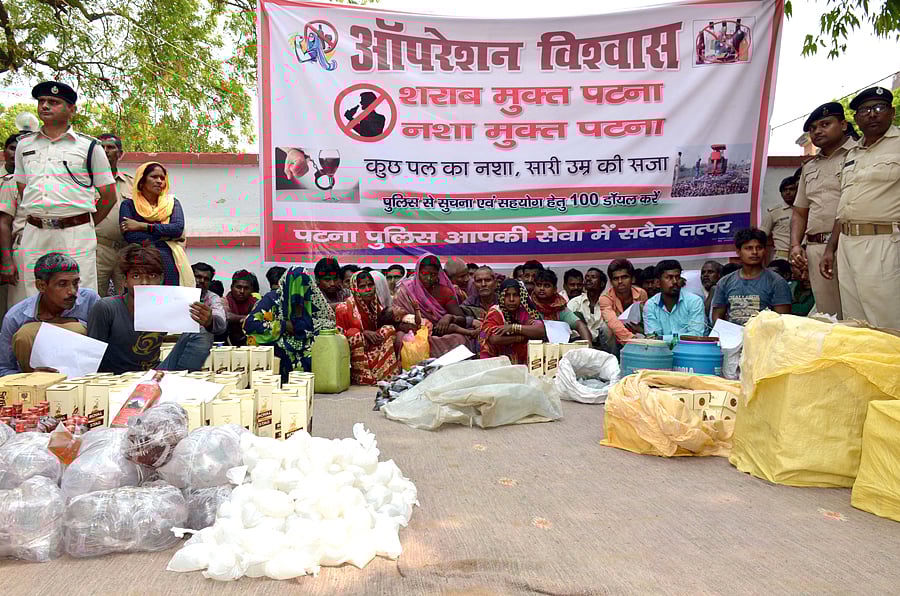
It is a fact that under the Prohibition law, a large number of persons from Dalit, Mahadalit and Most Backward Community have been arrested and this would play an important role in the election. (Photo: Nagendra Kumar)
Yet the chief minister touts it as a success. He talks about a “qualitative change” in the lives of the people, rejecting issues on the reduction of revenue. On more than one occasion, Kumar has said, “Money is saved and people are spending it for their welfare.” The government’s version is that those who lost their livelihoods to Prohibition are now running general stores and clothes shops, or selling vegetables, eggs, fruit and supplies.
It’s unclear how much Prohibition will benefit—or hit—the JD(U) and the NDA across Bihar. What’s unarguable is that he’s gained the respect of a section of women, cutting across caste, creed and religion, in rural areas.
Salma, a resident of Majholi Khetal village in Muzaffarpur, says, “Everyone has benefitted from Prohibition, be it a Muslim or Hindu. After all, men from all households used to get drunk. So there is some relief for everyone.”
I ask: “So will you vote for Nitish because of Prohibition, despite being Muslim?”
“Yes, why not?”
“Even though you know he is with Narendra Modi?”
“It doesn’t matter … we can give him our vote.”
Ajay Kumar, editor of Patna-based Prabhat Khabar, says, “Nitish understands the importance of the relief he has provided and he underlines it strongly in his speeches. He appeals to neighbouring states to take such steps, but he’s also conscious of the failures and corruption issues related to this. That’s why he recently pulled up the state DGP, telling him that instead of trying to hog media headlines, he should focus on work.”
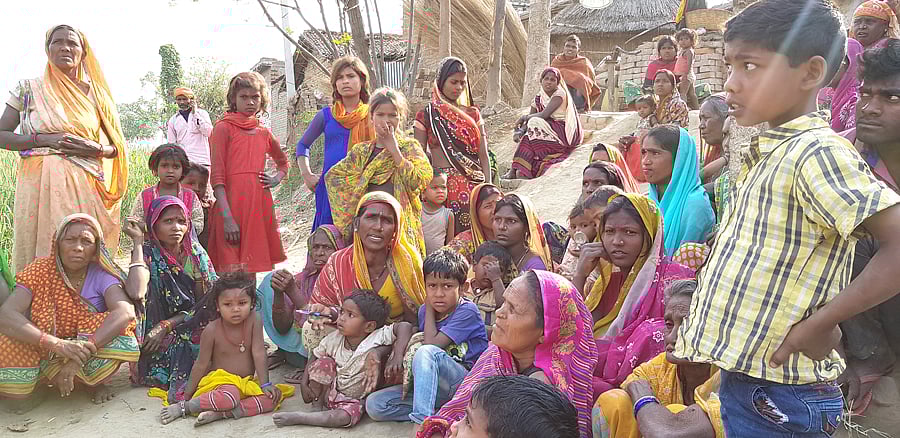
These women, who stay at a little distance from Nitish Kumar’s village, say that because of police’s failure, liquor sale and consumption has resumed. (Photo: Hridayesh Joshi)
After the Pulwama attack and the Balakot airstrikes, issues of national security and nationalism are back on the poll agenda. The impact is visible in Bihar also. Given the situation, the relevance of Prohibition when people cast their votes is brought into question. Kumar says, “Issues of elections are different at times. Sensing the mood of these polls, it appears that Prohibition will only get the votes of a small section of voters.”
In fact, in his 15-year regime, Nitish Kumar has moved from one extreme to another. Initially, it was the massive promotion of liquor. Now, it’s a complete ban, even as the liquor mafia and corrupt administration have joined hands to form an alliance.
***
“Who will you vote for?”
I ask this question to 28-year-old Kesar at Gopalganj crossing in Siwan. Kesar responds, “I will vote for the one who will remove Prohibition.”
Even as he and his friends break into laughter, it isn’t an answer to be taken lightly. When asked why, the reasoning is simple: “When it’s available everywhere, why should we pay more and drink secretly?”