If 70% of India is against Modi now, 69% of India was against Rajiv in 1984
This logic fails to account for the ‘first past the post’ system and the fact that voters who didn’t vote weren’t necessarily against Modi.

A senior journalist, who cannot get his head around the idea that Narendra Modi and the Bharatiya Janata Party have well and truly won the 2019 Lok Sabha elections, recently tweeted something along these lines: The BJP-led National Democratic Alliance has won 45 per cent of the votes polled. Hence, 55 per cent of the voters are still against Modi.
There is an extended version of this logic which is being offered over coffee table conversations which go beyond Khan Market and Lutyens’ Delhi. This is how it goes.
In the 2019 Lok Sabha elections, 67.11 per cent of the electorate voted. This means that around two-thirds of the people who could have voted actually voted. Hence, the logic being offered is that only 30 per cent (two-thirds of the 45 per cent who voted for the NDA) of the electorate supports Modi. Given this, 70 per cent of the electorate is against Modi.
Depending on how you do the math, 55-70 per cent of the electorate is against Modi. Or so we are being told.
The problem is that mathematics is ultimately a tool that throws up results, depending on how it is used. But those results need some interpretation as well, depending on the overall context. Let’s take a look at the issue pointwise and see why the logic of 55-70 per cent of the electorate being against Modi is not correct.
1) A little under 33 per cent or one-third of the voters did not vote. Now just because someone did not vote, it doesn’t mean he or she does not support Modi. It does not mean he or she is not in favour of one party or a leader or in favour of another party or leader. Hence, saying 70 per cent of the voters are against Modi is out and out wrong. Also, the fact that one-third of those who could vote decided not to is no fault of the politicians standing for elections.
2) When it comes to elections, India follows the first past the post system, which basically means that the candidate who gets the maximum votes in an election wins, even if he or she does not win 50 per cent or more votes and hence, a majority of the voters are not in his or her favour. In a situation where multiple candidates from multiple parties are fighting, it is but natural the winning candidate will not win 50 per cent of the votes, unless the fight is largely between two candidates, even though more than two candidates are contesting.
In fact, this phenomenon played out in many states across the country in the 17th Lok Sabha elections. The BJP won 50 per cent or more votes in 16 states and union territories in total. In states like Maharashtra and Bihar, where the party was a part of an alliance, the NDA won more than 50 per cent of votes.
3) It is important to understand that the first past the post system tends to benefit the major party. This used to be referred to as the “Congress multiplier”. In the last two elections, this has clearly become the BJP multiplier. In the 2019 Lok Sabha elections, the BJP won 37.4 per cent of the votes and around 56 per cent of the seats. In the 2014 Lok Sabha elections, the BJP had won 31 per cent of the votes and around 52 per cent of the seats.
The Congress won around 19.5 per cent of the votes in both the 2014 and 2019 Lok Sabha elections, but it managed to win only 8.1 per cent and 9.6 per cent of the Lok Sabha seats, respectively.
The first past the vote system tends to benefit the major party. This used to benefit the Congress earlier, and now benefits the BJP. Take the case of the 1984 Lok Sabha elections, which happened after the assassination of the then prime minister Indira Gandhi and led to a huge sympathy vote for the Congress and Rajiv Gandhi. The Congress won 49 per cent of the votes and 79 per cent of the Lok Sabha seats. Or take the case of the first Lok Sabha election, where the Congress won 45 per cent of the votes and 74 per cent of the Lok Sabha seats. The major party does benefit disproportionately.
So, the point is that Narendra Modi is not the first person and BJP not the first party, to benefit from the first past the post system. There were others before him and there will be others after him as well. Also, the BJP on its own getting 37.4 per cent of the votes is the best performance of a leading party since 1989.
4) Take a look at the accompanying chart. It charts the vote share of the leading party and voter turnout in all the Lok Sabha elections starting from 1952 onward.
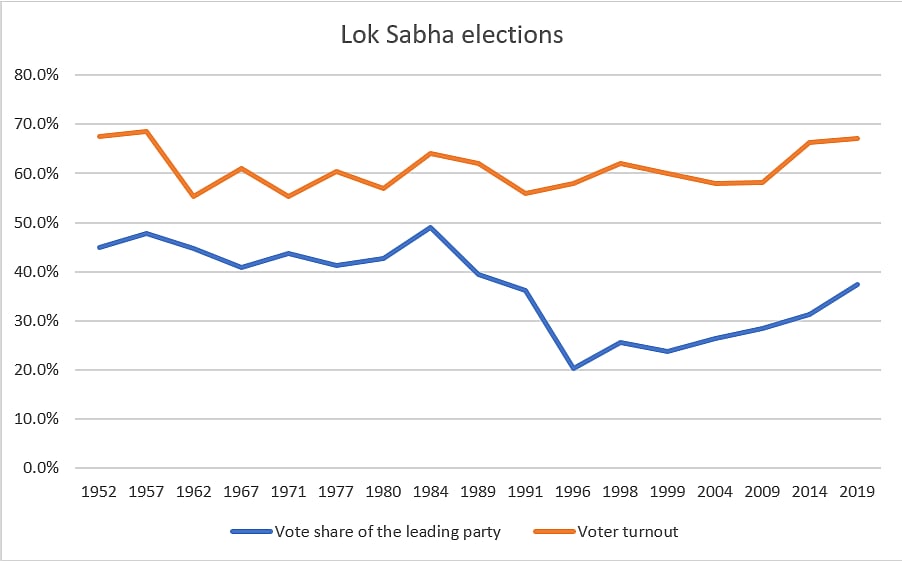

The chart clearly tells us that no leading party has ever won more than 50 per cent votes, on the whole, across the country, in a Lok Sabha election. The closest any party has ever come to winning 50 per cent or more of the votes polled, was in 1984, when the Congress won 49 per cent of the votes.
The voter turnout in the 1984 election was 64 per cent. Using the same logic used at the beginning of this piece, only 31.4 per cent of the voters (64 per cent of 49 per cent) were in support of Rajiv Gandhi. So, 68.6 per cent of were against Rajiv Gandhi.
Simplistically put, if 70 per cent of India is against Narendra Modi right now, around 69 per cent of India was against Rajiv in 1984.
Of course, as we have seen earlier, this does not make sense, simply because we don’t know how those who did not vote would have voted if they had voted. Or to put it more simply, just because 36 per cent of the electorate did not vote in 1984, it does not mean that they were against Rajiv.
5) Another point that needs to be made here is that the first past the post system also tends to benefit smaller parties with concentrated vote shares. Take the case of the 2014 Lok Sabha elections. The AIADMK with 37 seats was the third largest party in the Lok Sabha. It had won 3.3 per cent of the total votes polled across India but had a representation on 6.8 per cent of the seats. The CPM has been a huge beneficiary of this in six out of 11 Lok Sabha elections between 1977 and now, when it was the third largest party in the Lok Sabha, with its concentrated vote share in a few states like West Bengal and Kerala.
Hence, the first past of the vote system tends to help parties with small-concentrated vote shares and the largest party. Parties with middling vote shares, spread across the country, like the Congress has had in the 2019 and 2014 Lok Sabha elections, tend to lose out the most.
6) Suggestions have been made that India needs to move away from this system. One way of doing this is that if the candidate who gets the most votes, but does not get 50 per cent of the votes polled, is not deemed to be elected. In such a situation, there needs to be a run off between the candidate who gets the most votes and the candidate who gets the second most votes. The winner of this run off becomes a Member of Parliament.
The problem is India’s Lok Sabha elections already run into six to seven weeks. If one more layer is added, the elections will last even longer. More importantly, imagine moving an electorate of 90 crore to a new system of voting. The challenges associated with that will be mind-boggling.
To conclude, any math, numbers and percentages, are all tools at the end of the day. And like any other tool, they need to be used properly to get the right results. They are all a part of an overall context and that needs to be understood, even if one doesn’t like the idea of Modi and the BJP being elected all over again with a greater majority.