In Bihar’s Muzaffarpur, no water and squalor drives citizens to the streets
‘No water, no drains, garbage everywhere’—but the administration remains apathetic.

On June 29, residents of Muzaffarpur’s Aam Gola blocked traffic at the flyover that passes near their settlement. Around 1 pm, the crossroad that leads to the flyover was closed off with thick rubber wires, and about 50 men and women, young and old, stood in resolute protest. Rubber tyres burned in the middle of the road, giving off smoke that was dark and acrid. When passersby with vehicles tried to force their way through, wizened women with brooms stepped forward and shrieked at them until the vehicles meekly U-turned and departed.
Under the blazing afternoon sun, the residents were protesting against the broken water supply and the squalid state of sanitation in their ward—numbered 35—in Aam Gola. In towns, municipalities are divided into wards that are represented by popularly-elected ward councillors. These councillors are supposed to voice the concerns of the people of their ward in the municipal council.
“Our ward councillor, Abha Ranjan, does absolutely nothing for us. There is no drain, there is no road, there is no water and there is garbage everywhere. We’re panting and dying. We’re here because we want water,” a furious old woman at the crossroad tells me. Beside her stands a doubly-furious Parmita Devi. “We’re blocking the road and if the SP, DM or the collector shows up, we’ll beat them up,” 55-year-old Devi shouts in an enraged outburst.
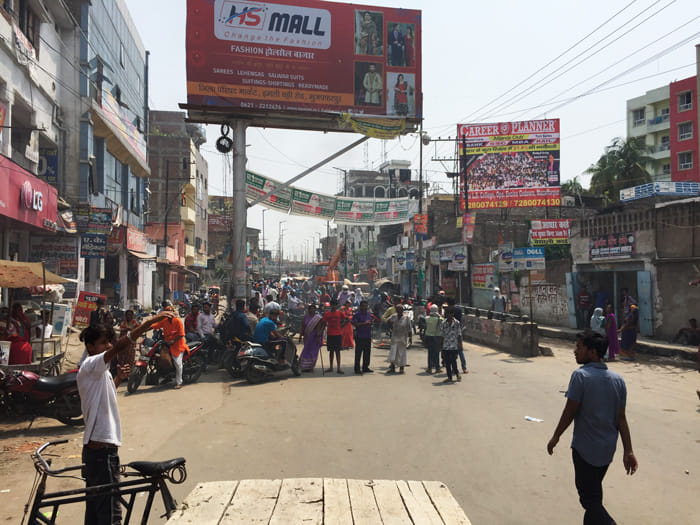
Two young men lead me to their nearby locality, called HSI gali. The road on the way contains a heap of foul-smelling garbage. “This is the main road and this has been here for weeks,” says a young Rahul Kumar, a local resident.
Upon entering the gali, one is again greeted by a mass of putrid garbage. Hardly three feet away lies the house of Manak Kumar, who says the garbage is at least two months old. “We’ve complained to the councillor multiple times. She says it’ll be done but it never happens. She doesn’t pick up our calls anymore. How many times are we expected to meet her? Don’t we have a life?” Kumar asks. Kumar then call the councillor thrice in the presence of this correspondent. She doesn’t answer.
An 85-year-old resident named Bansi Kumar adds that elders in the area sit in a nearby open verandah every evening. “It’s become hell for us. It’s unbearable to just sit and talk to others over there.” He adds that the locality has given up on the area’s MLA, the Bharatiya Janata Party’s Suresh Sharma. “He comes here during elections, that’s it. We haven’t received our pensions in years nor do we get our rations. Once when we did get to meet him at his office, he said ‘Abse pension milega, jao (You’ll get your pension now. Go away)!’ Nothing came of it.”
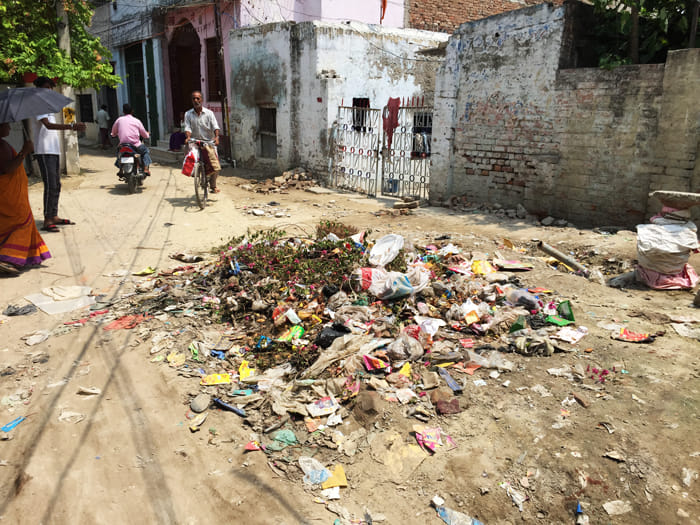
Garbage near the entrance of the locality in Aam Gola.
Young men lead this correspondent to the filth and dark sewage water that accumulates in stinking corners of the area. The drains are hopelessly clogged with garbage, soil and bricks.
The locals explain how corruption unfolds in the area. “Labourers came here two weeks ago. They ask us for money to clean the area. They say give us ₹500 or else we won’t clean things up. So we thought if ₹500 can solve our problems, why not? Dozens of families gave ₹500 each. And since then, we don’t know where the labourers went. The contractor says they fled, but we know they simply distributed our money among themselves. Can you imagine the conscience of these people? The feed on the poorest of the poor,” says Parmita Devi.
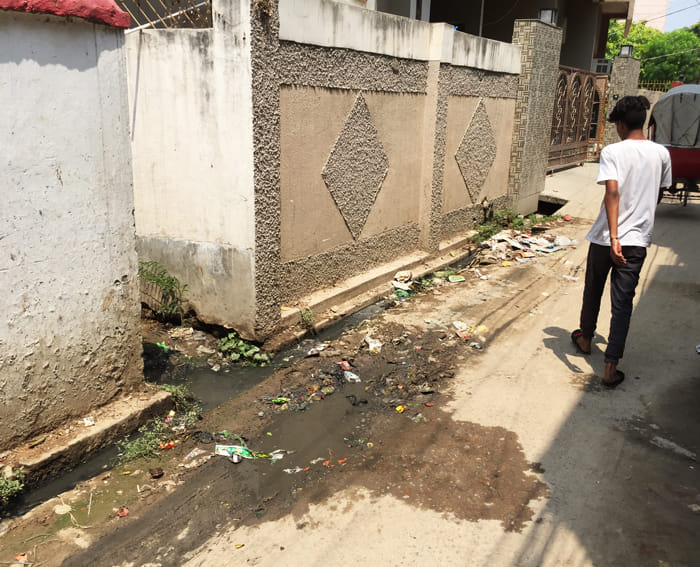
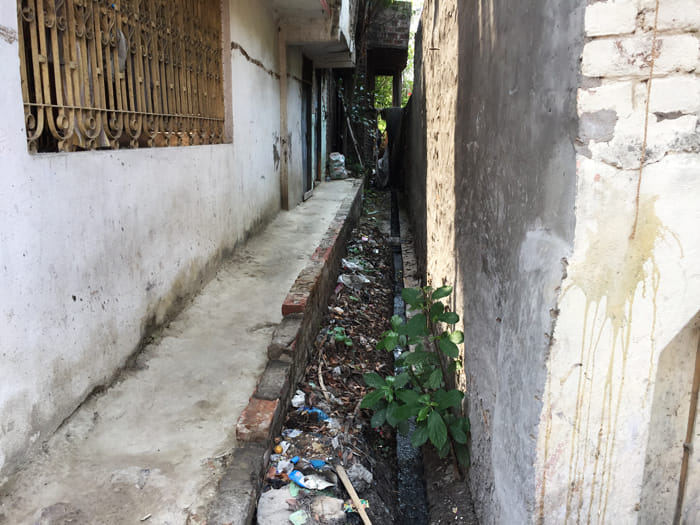
Clogged drains overflow at Ward No. 35 in Aam Gola.
A local named Reena Devi and her husband Johny say there’s no water in the area and the electricity hardly has voltage. “The fan moves so slowly that we are soaked in sweat all day. We have five daughters. The youngest is a year old. The handpump in our house hasn’t leaked even a drop of water in the last three months,” Reena says. Her husband adds that he earns some ₹8,000 every month and can’t afford to get new water connection pipes to cope with the problem.
Reena adds: “My family lives in another part of town. There is a working handpump at every step there. But look at this place. Everything is being done by the ward parshad. Woh chor hai (She’s a thief).”
Just opposite the family’s house is an imposing, freshly-painted duplex. Locals add that this house gets water thanks to their affluence. “They get the water because they got deep underground pipe connections. They even help us out in dire times,” Johny says.
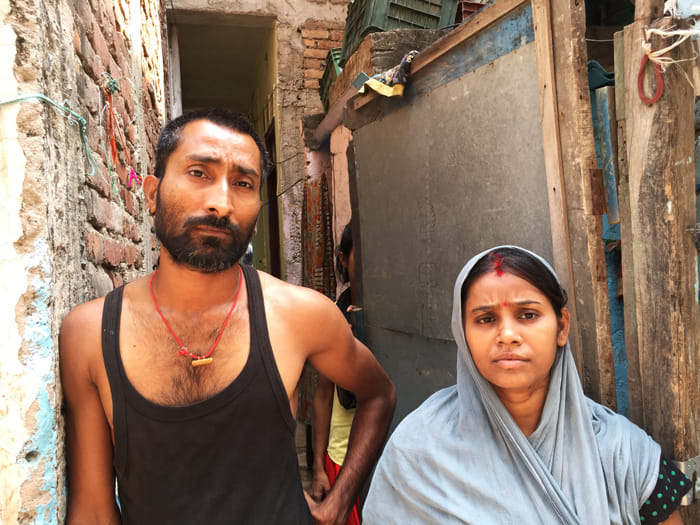
Johny and Reena Devi complain about no water and low voltage in Aam Gola.
The neighbourhood has to usually buy drinking water at ₹25 a litre from a local vendor. For bathing, they go to a shop near Jawahar Cinema where a community leader switches on the motor for them and doesn’t ask for any money.
According to residents, there are about 500 families living in the area. “Hum sab bahut gareeb aadmi hai sahab. Kuch bhi kaam hota hai toh paisa lene sab aata hai lekin rahat kabhi nahi mila (We are all poor people, sir. Whenever something goes wrong, people come here and ask for money to fix things but they never do it),” says Parmita Devi.
I’m led to a bylane where half a dozen buckets and containers surround a water pipe. Water dribbles thinly from the pipe and a woman patiently waits for her container to fill. A couple of metres away, a flea-infested drain with dark and murky water brims ominously. On the opposite edge, what was supposed to be a drain is now a dry pit four feet deep. A local named Vinod Kumar says that he and other men have to come together every now and then and clean the drains themselves. He asks: “What else can we do?”
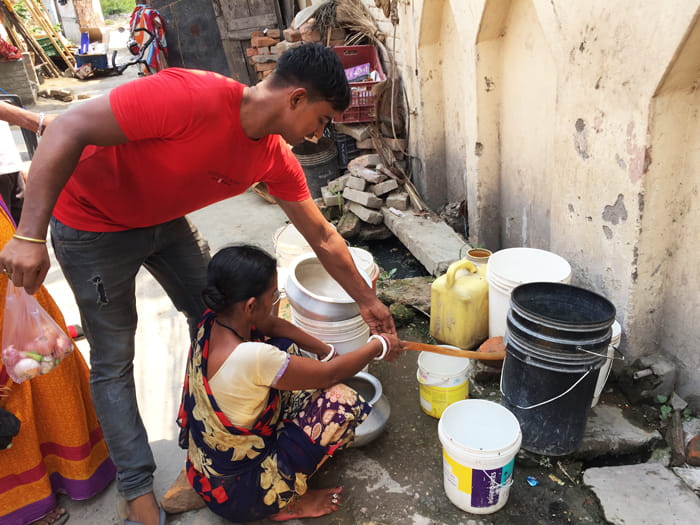
The only area in the neighbourhood with a working water connection. But the water supply is thin.
As neighbours pour out of their houses with complaints, a woman tells me that the lack of water has forced families to cut down on their cooking. Less food and accumulating filth, she adds, is also impacting the health of children. “We can eat less but how can we go on living without drinking water?” she asks agitatedly.
Parmita Devi brings me to her house. Located beside a railway track, it is surrounded on two sides with mounds of trash. She points to a shiny blue pipe and tells me that it was supposed to fix the household’s water problems. “We spent ₹500 on this. When we finally put together our money, we got this pipe. We still don’t get water. It has been like this for months. The ward councillor never listens to us.”
Newslaundry reached out to the local MLA Suresh Sharma. “The water levels have been down lately, so there is not much water anywhere,” he said. “As for the garbage, the municipality has been on a strike since 3-4 days. I’ve personally taken a round today and made sure that the area is cleaned up.”
When I told Sharma that residents claim that the area hasn’t been cleaned in weeks, he denies it. Instead, he blames the people: “Sometimes people throw the garbage outside themselves after it is cleaned in the morning. We have given them dustbins for it. It’s also an awareness problem.” There were no dustbins when this correspondent visited the area.
When I tell Sharma that residents claim that he hasn’t visited the locality after election season, he denies again. “They’ve given you the wrong information. I visit the entire town on Saturdays and Sundays, whenever needed. If you demand, I can bring a thousand people who will attest to this.”
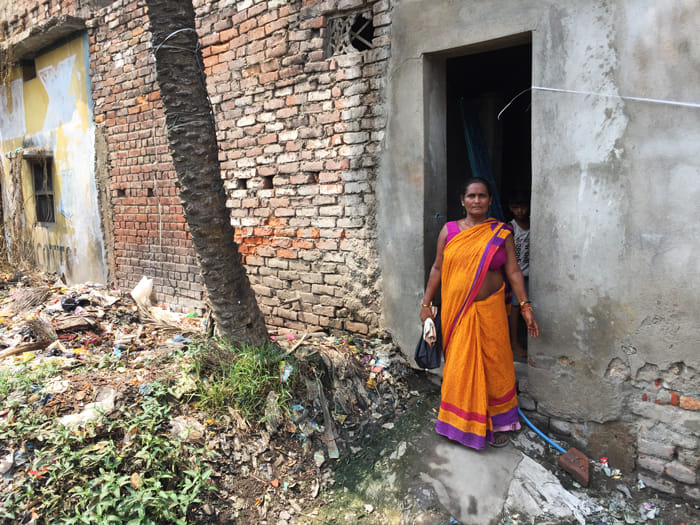
Parmita Devi at the entrance of her house. Near her feet lies the blue pipe which was supposed to fix the household’s water problem. It did not.
In a ground report from rural Muzaffarpur last week, this correspondent had reported on the extreme socio-economic penury that goes unaddressed by the government. But things don’t look too good in urban Muzaffarpur either.
Outside a neighbourhood temple, residents gather and tell me that there is hardly any water to clean the temple’s floor. The sacred premises are washed just once or twice every week after men and women collect water from Jawahar Cinema. Bansi Kumar rues: “Not even God has the luxury of water in this area; we are anyway secondary.”