From oil to S-400s: The calculus behind Putin’s India visit
The Russian president arrives in Delhi on Thursday for the 23rd India–Russia annual summit, at a moment when continuity and change sit side by side in the relationship.

As Russian President Vladimir Putin arrives in New Delhi on Thursday for the 23rd India–Russia annual summit, the visit comes at a moment when continuity and change sit side by side in the relationship.
Despite the vagaries of global politics, especially Western pressure, India’s ties with Russia have endured not just because of historical pull but because they have adapted to changing geopolitical conditions while keeping strategic trust intact. A dependable partnership cultivated in the second half of the last century has now evolved into a contemporary, interest-driven understanding. And this fits neatly into India’s multi-aligned assessment of the current world order.
India’s sustained and trusted channel with Moscow also means New Delhi does not see this relationship as coming in the way of ties with the United States, Europe, Japan or Australia, or even its “competitive co-existence” with China. The visit just reflects how inherited strategic capital and present-day interests intersect in shaping India–Russia relations.
Two episodes in recent years illustrate India’s autonomy in managing this relationship. The most recent is India standing its ground against Western pressure after 2022, refusing to curtail economic engagement with Russia. As Western sanctions on Moscow expanded, the US and Europe urged Delhi to scale back. India largely continued importing discounted Russian crude. There was a subsequent dip in imports but attributed in part to market dynamics. That marked a continuation of India’s long-standing insistence on an independent foreign policy and its refusal to act as a vassal state of the West – a point India made clearly during the Cold War and continues to make now.
The second example came in 2018 when India declined to follow Washington’s line under the Countering America’s Adversaries Through Sanctions Act (CAATSA). Despite US concerns, New Delhi went ahead with the $5.4–5.5 billion S-400 air-defence deal with Russia. India makes its security and economic choices on its own terms. Notably, the Russian-made S-400 system proved valuable during Operation Sindoor earlier this year.
The challenges
The depth of bilateral economic ties, however, has produced challenges since 2022. One of the most significant is the need to work around Western sanctions by stabilising alternative financial channels for Indo–Russia transactions. The financial mechanisms supporting trade came under strain as sanctions expanded, leading exporters to report delays in receiving payments. Indian banks, wary of secondary sanctions, have acted cautiously. Large rupee balances accumulated in Special Rupee Vostro Accounts (SRVAs) have been a concern because of their limited usability, creating frustration among traders. Both governments will want to ease the situation by fixing rupee–rouble settlement rules and establishing clearer guarantees to make transactions predictable.
Recent media reports suggest that officials in both countries have explored ways to stabilise payments. One possibility under discussion, as reported by the Times of India, is RuPay–Mir interoperability. If implemented, this would link India’s RuPay system with Russia’s Mir network – benefiting not just large trade flows but also small businesses, students and tourists. Even before these deliberations, the Reserve Bank of India adjusted SRVA rules in 2023, allowing surplus rupees to be invested in government securities and simplifying compliance. In their bilateral talks, the two sides will be looking to build such bulwarks against external uncertainties.
Defence cooperation remains the core of India–Russia ties. Over the past two decades, India has diversified its sources of armaments, increasing imports from France, the United States, Israel and South Korea, while building its domestic defence industry. Yet Russia remains central to several key procurements. The S-400 system has been among India’s prized acquisitions – a long-range surface-to-air missile platform designed to detect and intercept aircraft, drones and certain missile classes. Its performance during Operation Sindoor strengthened New Delhi’s confidence in its role within India’s layered air-defence network. It is unclear whether India will announce new orders during the summit, but there are indications that additional units and support systems are under consideration.
Beyond this, Moscow has shown willingness to offer advanced systems such as the Su-57. New Delhi, however, is now focused not only on hardware but on clear delivery timelines, maintenance assurances and robust technology-transfer commitments. These priorities have risen in importance amid disruptions triggered by Western sanctions. Defence analysts note that India’s stance is to “enhance capability without signalling alignment.” In some ways, this balancing act reflects New Delhi’s goal of ensuring that its defence procurement from Russia is not viewed as abrasive in Western capitals.
No blocs
The larger geopolitical environment requires delicate navigation in both New Delhi and Moscow. There are no neatly divided blocs in the current phase of global politics; countries work through overlapping alignments that serve specific interests. India’s foreign policy reflects this reality as it works closely with the Quad on security, with Europe on technology, and with Russia on defence and energy. If the Quad capitals are central to India’s maritime security framework, Moscow remains crucial for its continental security guarantees.
Beyond defence, India–Russia economic ties have entered a phase of careful rebalancing. While India’s imports from Russia have risen sharply, its exports have not kept pace. New Delhi will seek better access for pharmaceuticals, IT services, machinery and agricultural products – and this may be feasible given Moscow’s own interest in diversifying trade beyond China. Strengthening SRVAs will be important to unclog financial channels needed for smoother bilateral trade.
Amid shifting geopolitical sands, the Russian President’s visit is a significant marker of where the intersection of great-power competition and middle-power balancing now lies. Both New Delhi and Moscow recognise that the visit is a symbolic reaffirmation of time-tested ties rooted in bilateral trust as well as a pragmatic appraisal of strategic interests.
While reinforcing a partnership that has adjusted to new externalities without losing its core, both sides will also seek tangible outcomes in addressing immediate issues – from expanding defence cooperation to facilitating energy trade and easing financial mechanisms. Putin, who has a sharp sense of history, will see the interplay of continuity nourishing Moscow’s ties with New Delhi even as he seeks deeper relevance through adaptive dialogue aimed at advancing the strategic interests of both countries.
In times of misinformation, you need news you can trust. We’ve got you covered. Subscribe to Newslaundry and power our work.
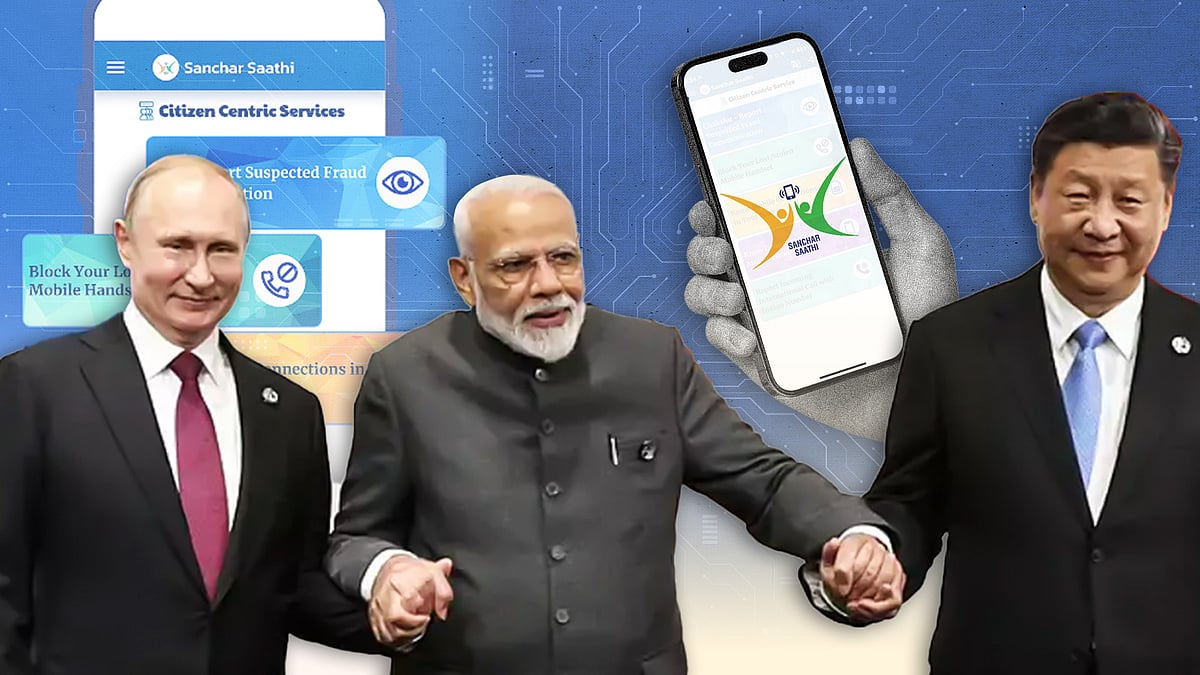 When our democracy shares tech policy with Russia and China, that should terrify us