Responsibility without power: When human buffers become punching bags for the public
The IndiGo fiasco is a telling example of how the Indian public misdirects its anger at frontline staff, while those in power hide behind them.

The passing of Britain’s well-known playwright Tom Stoppard late last month prompted many to recall his enduring body of work. Most tributes rightly recalled his theatre plays and screenplays. There was, however, less mention of his little-known novel Lord Malquist and Mr Moon, published in 1966, quite early in his career. It was the only novel he wrote, marking a brief foray into a different genre. Almost six decades after its publication, a sentence from the novel lingers with particular force, striking a chord even today.
At a point in the novel, somewhere in chapter six, the narrator quips, “Responsibility without power: the prerogative of the eunuch throughout the ages.” It reverses a famous formulation attributed to Rudyard Kipling and made politically resonant by Stanley Baldwin. In 1931, during a speech attacking the British press barons, Baldwin quoted Kipling as saying: “Power without responsibility: the prerogative of the harlot throughout the ages.”
The metaphors may sit uneasily with contemporary sensibilities, but the substance of the contrast endures. Kipling’s formulation captured a long-standing anxiety about those who wield power while evading accountability. Stoppard turned the lens the other way. He pointed to settings where accountability is heavy, but authority is thin, where people are burdened with responsibility without the means to act. That inversion has proved remarkably portable. It resonates across institutions, workplaces, and everyday interactions.
Closer home, the mismatch of responsibility and power plays out in plain sight in everyday India. It appears not in legal texts or policy debates, but in ordinary encounters where citizens meet authority as they experience it – face to face, at counters, gates, and street corners. These are moments when responsibility is visible, power is absent, and frustration flows downward to the nearest available human presence.
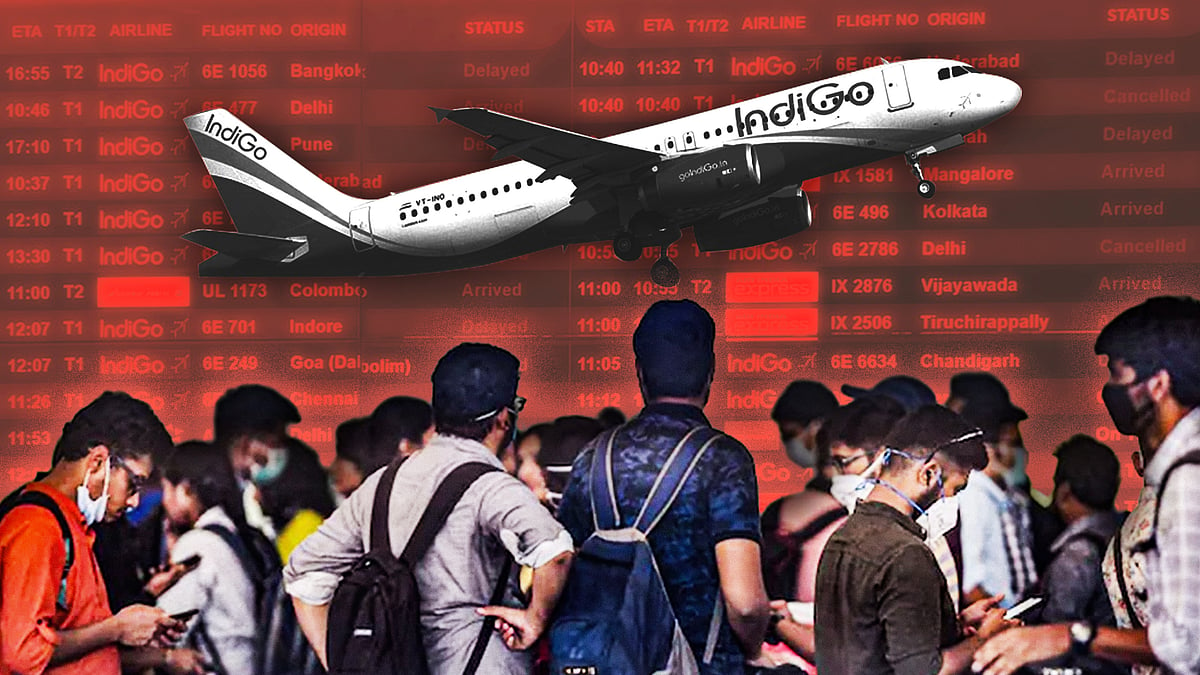
The recent disruption involving IndiGo flight cancellations is a telling example. As anger flared over delayed and cancelled flights, some videos of people shouting began circulating. People were seen yelling at airline staff stationed at check-in desks and at the airline's facilitation counters. Even if anger was understandable, was it well-directed?
The targets of that anger were often junior ground staff – employees tasked with answering questions, issuing apologies, and representing the airline. They become the readily available public face of the company, the easy punching bags – taking blows and bearing much of the brunt of public ire at the spot. They are stationed at the counters, often exuding the air of cogs in a giant machinery, tasked with humanising the contact point of a largely impersonal operation.
Their training for rehearsed politeness under pressure is often mistaken for their access to some concealed information flow. That might not be the case; they mostly don’t figure significantly in that flow. It need not be reiterated that they have no say in aircraft availability or control over crew deployment and operational responses. These are obviously decisions taken much higher up the order, and understandably out of public view. Power sits elsewhere, responsibility stands in front, shielding those who matter from the immediacy of public inquiry and simmering wrath. That has meant that those lower in the rung, often powerless to be of any meaningful help, are soft targets when public frustration is looking for a release.
This by no means is an isolated setting. The pattern is well entrenched in how everyday India grapples with interactions in public spaces, the workplace, as well as the personal sphere. In urban housing societies, residents routinely vent their anger at security guards. A visitor allowed in, a delivery delayed, a gate left open, the guard becomes the focus of complaint. He appears to represent authority. In reality, his power is minimal. He follows instructions set by management committees or residents themselves. He cannot redesign security systems or enforce rules against those who override him. Yet, he absorbs the reprimand because he is present and visible.
Traffic policing offers another example. Citizens frustrated by congestion, encroachments, or chaotic roads often direct their anger at the constable standing at a junction. The constable becomes the symbol of state failure. He is accused of inefficiency, venality, or indifference, often with good reason. Even if some of the criticism is justified, that’s only a part of the larger problem and even systemic crisis over which they have little or no power to solve. The list of her limitations is long, but not enough to hold the citizenry, running out of patience. She works with constrained discretion and lies at the bottom of a system with overlapping duties among multiple administrative organs. But the fact remains that she is the face of the authority in the heat and dust of the road, and she has to absorb all that comes her way, standing there.
The same dynamic plays out in the circuitous government offices. Clerks at counters and junior officials handling files are often caricatured as symbols of red-tapism. They are supposed to wield the nuisance value, and those who can actually hold up or speed up paperwork. That’s, however, a partial view of how power is configured. They may be the face for explaining delays. They repeat procedures. They may be only partly responsible for outcomes they cannot change. They often know the problem as well as the complainant does. But they lack the authority to alter timelines or override rules. The power to act lies several layers above. Responsibility remains at the desk.
Hospitals reflect this imbalance starkly. Nurses and junior doctors confront anxious families first. They deliver bad news. They enforce protocols. They face anger generated by shortages and delays they did not create. Decisions about staffing, equipment, and capacity lie elsewhere. Yet proximity turns them into targets.
Even private organisations mirror this structure. Customer service executives, delivery staff, and retail workers are held accountable for satisfaction scores and complaints. They are evaluated relentlessly. Yet pricing policies, logistics decisions, and system failures are controlled at levels they never see. They carry responsibility without control.
Across these settings, a pattern emerges. Power protects itself through distance. Responsibility is assigned through presence. Large systems place human buffers between decision-makers and the public. These buffers are expected to absorb frustration while remaining powerless to resolve its causes.
This helps explain why everyday interactions in India often feel charged. It is not only impatience or temperament. It is the structure of accountability itself. When responsibility is detached from authority, confrontation becomes routine. People demand answers from those who cannot give them. Those who could act remain insulated.
Stoppard’s line directs itself to this condition. Responsibility without power is not just an institutional problem. It is a social arrangement. It shapes how authority is experienced and how anger is distributed. It explains why those at the bottom of hierarchies often face the harshest treatment. They are accessible and visible. But, they are powerless.
This does not absolve individuals of misconduct or inefficiency. Nor does it deny the existence of corruption or failure at lower levels. But it complicates the picture. It asks us to distinguish between responsibility as exposure and power as capacity. It invites a more accurate reading of everyday encounters.
Stoppard did not write with Indian airports or housing societies in mind. Yet his pithy insight on settings of responsibility-power rupture travels easily into these spaces. It explains why anger so often misses its real target. It reminds us that the places where responsibility is most visible are often not the places where power truly resides. That should somehow creep into mind when another video of someone fuming at a powerless support staff emerges again – the adjuncts aren’t the levers of power. The irony is that adjuncts are mauled for not being levers.
The first quarter of the century is coming to an end, and with it 25 years of rising misinformation, shrinking newsrooms and growing corporate control. Make it count by subscribing to NL and TNM so independent journalism can survive the next 25.
 The 2019 rule change that accelerated Indian aviation’s growth journey, helped fuel IndiGo’s supremacy
 Indigo: Why India is held hostage by one airline