Is India’s environment minister lying about the new definition of the Aravallis?
Environment minister Bhupender Yadav has done a slew of interviews in the media criticising 'YouTube channels' for creating 'confusion' about the much-maligned definition of the Aravallis. Upon closer scrutiny, his explanations don’t add up.

The #SaveAravalli campaign stands out in an unexpected way. At a time when most protests against the government are quickly branded “anti-national” or dismissed as the work of “Urban Naxals,” that script hasn’t been rolled out here.
In fact, the country's loudest TV anchor is doing something rarely seen: questioning the government instead of defending it. And the government, in turn, is responding.
Over the past few weeks, Environment Minister Bhupender Yadav has given a series of interviews to defend a new definition of the Aravalli range. The definition was drafted by a committee led by his own ministry and accepted by the Supreme Court on November 20.
According to Yadav, these interviews were meant to “clarify” the “confusion” being spread by YouTube channels and other critics.
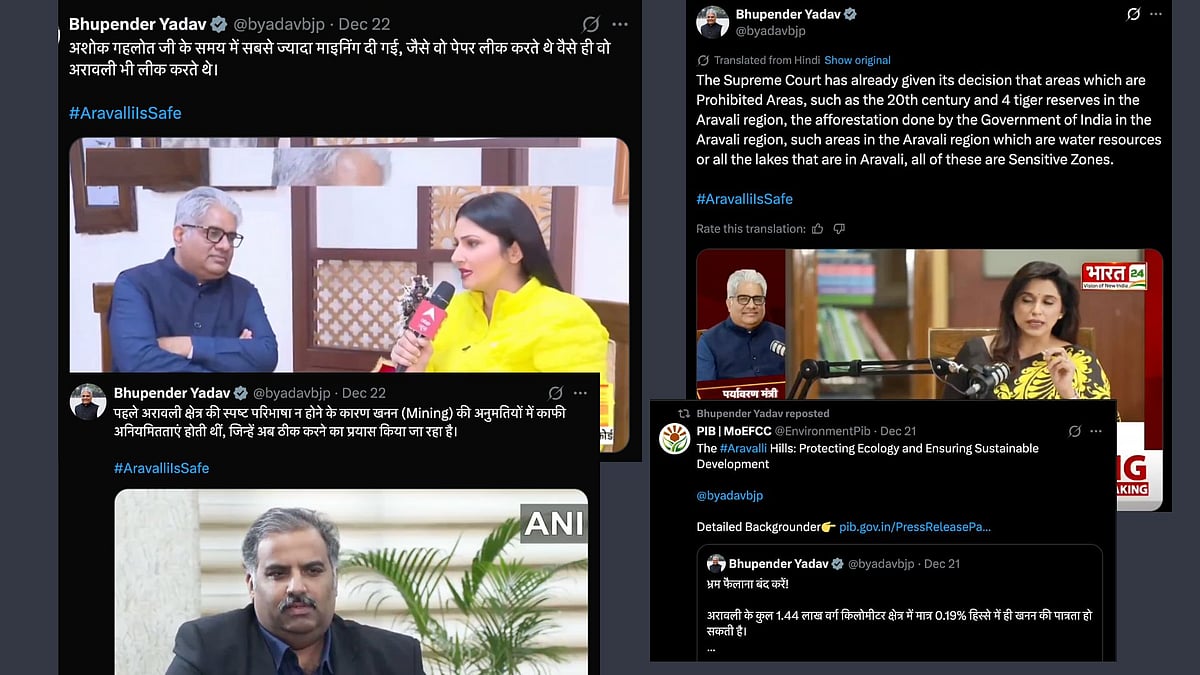
His reassurances, however, do not align with the technical details of the new definition, which has raised alarm bells among environmentalists and citizens alike.
At the heart of the issue is the new 100-metre definition, which determines what counts as an Aravalli hill – and hence what is worthy of protection.
Dismissing concerns, or rather sidestepping them, Yadav said in an interview on December 21, “Some YouTube channels and others have created confusion by saying that 100-metres will mean 100 till the top, but that is not the case.”
Yadav argued that protection would begin from a hill’s “base structure”, even suggesting that this base could start 20 metres underground.
He then proceeded to a theory that no environmental activist has raised.
“The confusion that people have created that the top 100-metre is safe, and the hills below will be open for mining, is not true. Let me clarify again, 100-metre definition means, from the top 100 metres till under the bottom.”
In another interview with ANI, he used a familiar analogy: like a tree, he said, protection applies not just to the trunk but also to the roots.
At first glance, this sounds reassuring. But it is also misleading.
Yadav is referring to the term “local relief” to confuse the public into believing that the 100-metre definition is more inclusive. That is not the case.
Local relief is defined as the height of the highest point of a landform measured from the lowest contour line that encircles that same landform. Put simply: Local relief does not mean measuring a hill from underground. It has a specific, technical meaning: the height of a hill measured from its lowest visible edge – the point where the land begins to rise.
This is where the 100 metres will be measured from.
Over two-thirds of the Aravallis are in Rajasthan. A report by The Indian Express, based on an internal FSI survey, said that only 8.7 percent of the hills in the state meet the 100-metre height criterion. Yadav, however, has claimed in a press conference that the new definition of “hills” and “ranges” brings 90 percent of all Aravallis under protection.
Another misleading claim by the ministry was its assertion before the court that the average slope in 12 of 34 Aravalli districts across four states is below three degrees, suggesting these districts would not qualify as Aravalli hills under the FSI’s slope-based criteria. This argument ignores that plains dominate these districts, and that averaging their terrain inevitably flattens out the steeper slopes of the actual hill regions.
The environment minister also claimed in a press conference on December 21 that this definition, credited to Richard Murphy’s Landforms Classification, has been in effect in Rajasthan since 2006. While that is true, what is glossed over is that Rajasthan has had hills reaching up to 600 metres. In contrast, the Aravallis in Delhi lack a single 100-metre hill, rendering the application of the new definition absurd.
It is important to note that during the same hearing, the Supreme Court cited the amicus curiae K Parmeshwar’s submission.
“If the definition as recommended by the Committee (headed by the MoEFCC) is accepted, all the hills below the height of 100-metres would be opened up for mining and as a result the Aravalli Hills and Ranges would lose their continuity and integrity. He [amicus curiae], therefore, submitted that if the definition as suggested by the Committee is accepted, it would totally endanger the environment and ecology of the mountains.”
Yadav also said that mining is already banned in Delhi and that it will never be allowed. Delhi has no hills above 100 metres, so none meet the new definition. While mining is banned, Yadav said nothing about real estate construction in the Aravallis, several cases of which have been documented before.
The mining exemptions
While much of the public focus has been on the new 100-metre definition, the Supreme Court’s judgment also includes other directions that deserve attention.
The court accepted a ban on mining in core or inviolate areas of the Aravallis. But this comes with significant exceptions.
Mining would still be allowed for “critical, strategic and atomic” minerals listed under the Mines and Minerals (Development and Regulation) Act (MMDR).
These include minerals notified as essential to national and strategic interests.
This matters because, in 2023, the Centre amended the MMDR Act to add a new Seventh Schedule, listing 29 minerals that can be mined even in protected or restricted areas. The list includes copper, gold, silver, diamonds, lithium, cobalt, nickel, graphite and zinc, among others.
In effect, this means that even core areas of the Aravallis could be opened up to mining if the minerals fall under these exempted categories.
The court had asked the environment ministry to prepare a Management Plan for Sustainable Mining (MPSM) for the entire Aravalli range, through the Indian Council of Forestry Research and Education.
Until that plan is finalised, no new mining leases are to be granted.
In response to public concern, the environment ministry issued a press release on December 24, stating that it has directed states to impose a “complete ban” on new mining leases in the Aravallis, and asked ICFRE to identify additional zones where mining should be prohibited.
Note that the judgement already called for a ban on new leases.
The press release, however, does not address the court's exclusionary legal definition of the Aravallis – a core concern raised by environmentalists. If only hills with a height of 100 metres are “Aravallis”, what remains protected?
While it is also true that the government has articulated an intent to stop degradation of the Aravallis through initiatives such as the Aravalli Green Wall, what remains to be seen is how the apex court’s order is read and adhered to by the Centre, forest departments in Aravalli states, the Geological Survey of India, and the FSI.
With Delhi-NCR facing hazardous air every year, further erosion of the Aravalli’s protection will only make things worse, and no clarifications can refute that.
Twenty-five years have transformed how we consume news, but not the core truth that democracy needs a press free from advertisers and power. Mark the moment with a joint NL–TNM subscription and help protect that independence.
 A toxic landfill is growing in the Aravallis. Rs 100 crore fine changed nothing
 What happened to Arnab? Questioning govt on Aravallis, taking shots at ‘Rs 15 cr anchor’