IndiGo’s dominance is not about ‘success’. Here’s what Sanjeev Sanyal overlooked in his ANI interview
The Indian aviation market looks nothing like the competitive, contestable environment Sanyal’s argument presumes.

When Sanjeev Sanyal, Principal Economic Adviser in the Ministry of Finance, argued in a recent ANI interview with Smita Prakash that IndiGo’s dominance is not the real issue because “you can’t tax success” and that policy should instead “ensure churn”, he was appealing to a familiar liberalisation-era instinct in Indian economic thinking.
As one of the government’s most prominent economic voices and a vocal advocate of market-oriented reforms, Sanyal’s framing carries significant weight in shaping regulatory discourse. But the problem is empirical. The Indian aviation market, as it actually exists, looks nothing like the competitive, contestable environment his argument presumes.
Structural asymmetry and the slot-lock problem
Start with scale. IndiGo reportedly accounts for roughly 60 to 65 percent of domestic passenger traffic, depending on the month. No other Indian airline crosses even half of that. The next largest carrier operates at less than a quarter of IndiGo’s capacity. This is structural asymmetry. In most large aviation markets, a carrier crossing 40 percent domestically would already trigger heightened regulatory scrutiny. However, in India, it is treated as a neutral fact of life.
This dominance is reinforced by physical constraints. Delhi and Mumbai together account for a disproportionately large share of domestic air traffic, and both are slot-constrained for most of the day. Slots at these airports are also the primary barrier to entry.
IndiGo controls a significant share of peak-hour slots at both airports, accumulated over years of expansion and reinforced by the exit of competitors. India’s slot allocation regime operates on a ‘grandfather rights’ basis – once assigned, slots remain with the carrier indefinitely, with no sunset provisions or use-it-or-lose-it enforcement that might allow reallocation.
Unlike markets such as the EU or US, there is no meaningful mechanism to redistribute slots to new entrants or expanding competitors — no mandatory slot pools for new entrants, no secondary trading mechanisms, and no periodic reviews to prevent hoarding; effectively creating a regulatory vacuum that locks in incumbent advantage. It has allowed dominant carriers to consolidate their hold on the most valuable airport access.
Once these slots are locked in, competition becomes largely theoretical. A new airline may exist, may even have aircraft, but without access to commercially viable timings at these hubs, it cannot meaningfully challenge the incumbent.
This is where the idea of “churn” runs aground on reality.
Destructive churn, not creative competition
Since liberalisation, India has seen repeated airline failures: Kingfisher, Jet Airways, Air Deccan (absorbed), Go First, and others. Yet despite this churn in corporate names, the market has not become more competitive.
Capacity does not smoothly transfer to new entrants; it collapses, gets redeployed slowly, or ends up reinforcing the position of the largest surviving player. Aircraft leases are cancelled, trained crews scatter, airport staff are laid off, and routes are abandoned for months or years. This is churn in the destructive sense, not the creative one imagined in economic theory.
Crucially, this concentration has not produced obvious price gouging, which is why it is politically easy to ignore. India remains one of the lowest-fare aviation markets in the world on a per-kilometre basis. Though price is the wrong metric here. The harm shows up in operational resilience.
IndiGo operates with extremely high aircraft utilisation rates, minimal slack in crew rosters, and tight turnaround schedules. These practices are efficient in stable conditions but brittle under stress. When disruptions occur – engine issues, weather, air traffic congestion, or crew shortages – the effects cascade across the network. Because of IndiGo’s sheer scale, a disruption that would be manageable for a smaller airline becomes a nationwide problem.
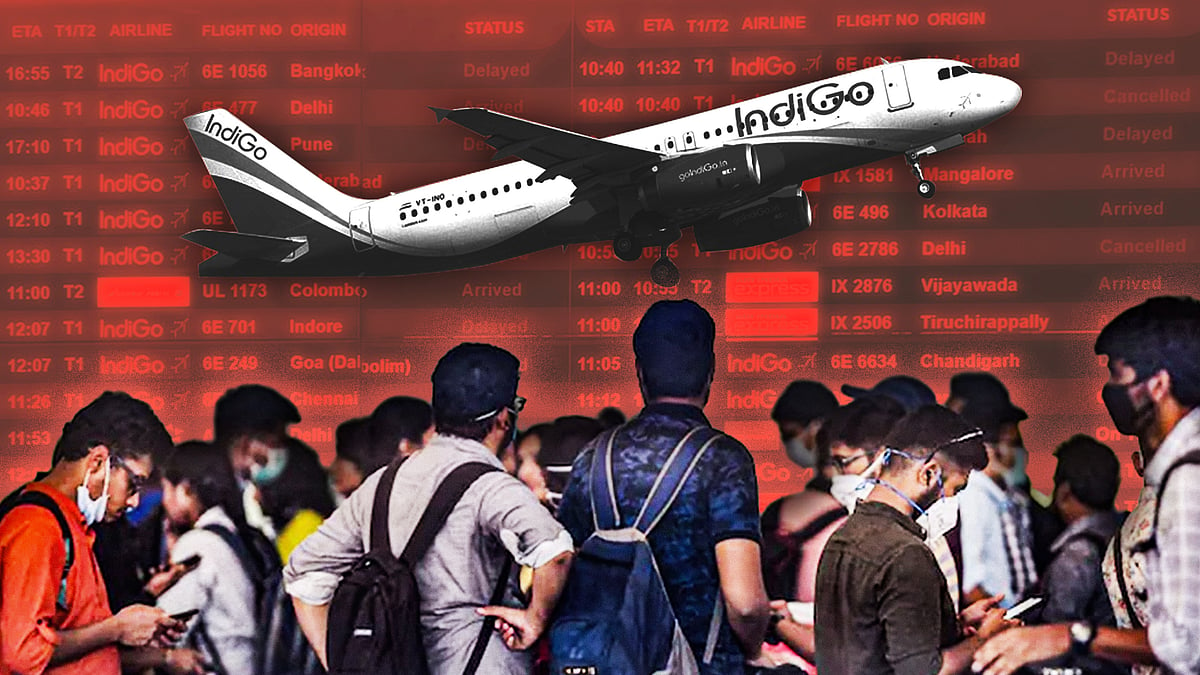
In recent years, operational failures at IndiGo have resulted in hundreds of delayed or cancelled flights over short periods, affecting a large fraction of all domestic passengers on those days. The same event in a more balanced market would have been absorbed by competitors with spare capacity. In India, there is no such buffer. This is precisely the kind of systemic risk that regulators worry about in banking or power generation, and for the same reason: concentration turns firm-level problems into system-level failures.
International lessons
International comparisons make this clearer. In the United States, no single airline controls much more than 20 to 25 percent of domestic traffic. Even then, dominance at specific airports is tightly regulated through slot controls and antitrust oversight. In the European Union, large carriers like Lufthansa or Air France–KLM operate under slot-use rules, state aid conditions, and competition law constraints that actively prevent indefinite accumulation of power at congested hubs. These systems are market-preserving.
Mexico offers the closest parallel to India precisely because it ignored these lessons for too long. Aeroméxico’s dominance at Mexico City airport resembled IndiGo’s position at Delhi and Mumbai. Fares remained competitive, masking deeper fragilities. Safety oversight weakened as regulators became accustomed to scale and growth. The crisis only became undeniable when the US FAA downgraded Mexico’s aviation safety rating, restricting new services and exposing institutional failure. Only then did slot caps, redistributions, and tighter operational scrutiny become politically unavoidable.
China and Brazil avoided this trap by design. China never allowed a single carrier to dominate all major hubs, explicitly treating aviation as strategic infrastructure rather than a pure market. Brazil accepted early on that aviation would be an oligopoly and focused regulatory energy on maintaining balance within that structure, nurturing entrants and managing failure so that capacity was preserved rather than destroyed.
Yes, they’re interventionist, but that’s precisely the point. Unregulated markets in infrastructure-heavy industries like aviation tend toward monopoly or oligopoly. So the question isn’t intervention versus none, but whether intervention preserves competition or entrenches dominance. The US still has significant hub dominance and consolidation, Europe struggles with flag carrier bailouts, and China’s model sacrifices market efficiency for state control. But none of these have a single-carrier dominance like India’s.
From slogans to governance
Sanyal champions “continuous churn” as essential for dynamism, citing Jet Airways’ closure as beneficial market discipline that allowed others to expand. This embodies pre-2008 neoliberal assumptions that failure automatically produces efficiency, ignoring how IndiGo simply absorbed Jet’s slots without new entry – capacity consolidated rather than renewed.
This framework assumes markets self-correct and infinite contestability, precisely the triumphalism the global financial crisis discredited. The persistence of such arguments in India is best understood as institutional avoidance.
Free-market slogans are attractive because they absolve the state of responsibility in a sector that is technically complex and politically sensitive. As long as fares are low, the deeper questions of resilience, redundancy, and systemic risk can be postponed. But postponement does not eliminate those risks; it concentrates them.
When a senior economic adviser to the government frames dominance as merely “success” that shouldn’t be “taxed,” it signals regulatory reluctance at the highest levels – a preference for ideological comfort over empirical engagement with market structure.
Empirically, the Indian aviation market exhibits high concentration, severe physical entry barriers, repeated destructive exits, and growing system-wide fragility. These facts are incompatible with a hands-off, “don’t tax success” posture. Though regulation here is about recognising that when one firm carries the majority of passengers in a capacity-constrained network, its failures cease to be private events.
The priority should be breaking the slot-lock at Delhi and Mumbai – a problem that exists precisely because regulators have treated “don’t tax success” as policy wisdom rather than 1990s-era dogma incompatible with infrastructure-constrained markets. India could implement a graduated slot cap – limiting any single carrier to 40 percent of peak-hour slots at congested airports, with existing holdings above that threshold subject to a five-year phase-down. Freed slots would go into a new-entrant pool, reserved for carriers with less than 15 percent national market share, allocated through transparent auctions with use-it-or-lose-it conditions enforced quarterly. Slot trading could be permitted but regulated – any transfer above 20 slots would require DGCA approval and competition impact assessment, preventing incumbents from buying back released capacity.
On the operational side, DGCA could move from compliance monitoring to stress-testing – a shift that becomes possible only when regulators stop deferring to scale as inherently legitimate.
Carriers above 50 per cent market share should face mandatory resilience audits – assessing crew reserve ratios, spare aircraft availability, and network recovery capacity under simulated disruptions. If a carrier cannot demonstrate absorption of a 10 percent fleet grounding without systemic delays, it should face expansion restrictions until reserves are built.
Finally, slot allocation should move out of airport operators’ discretionary control into an independent statutory body with transparent criteria and published decisions – removing the opacity that allows informal arrangements to override formal rules.
Mexico was forced into reform by an external downgrade. India is receiving the same signals internally. Whatever the prevailing ideology, the data already tell us that dominance in aviation is more a question of governance than success.
Sahasranshu Dash is a research associate at the International Centre for Applied Ethics and Public Affairs in Sheffield, the United Kingdom.
In times of misinformation, you need news you can trust. We’ve got you covered. Subscribe to Newslaundry and power our work.
 The 2019 rule change that accelerated Indian aviation’s growth journey, helped fuel IndiGo’s supremacy
 Indigo: Why India is held hostage by one airline