From health trackers to Puranas: Andhra CM Naidu’s pivot to alternative medicine
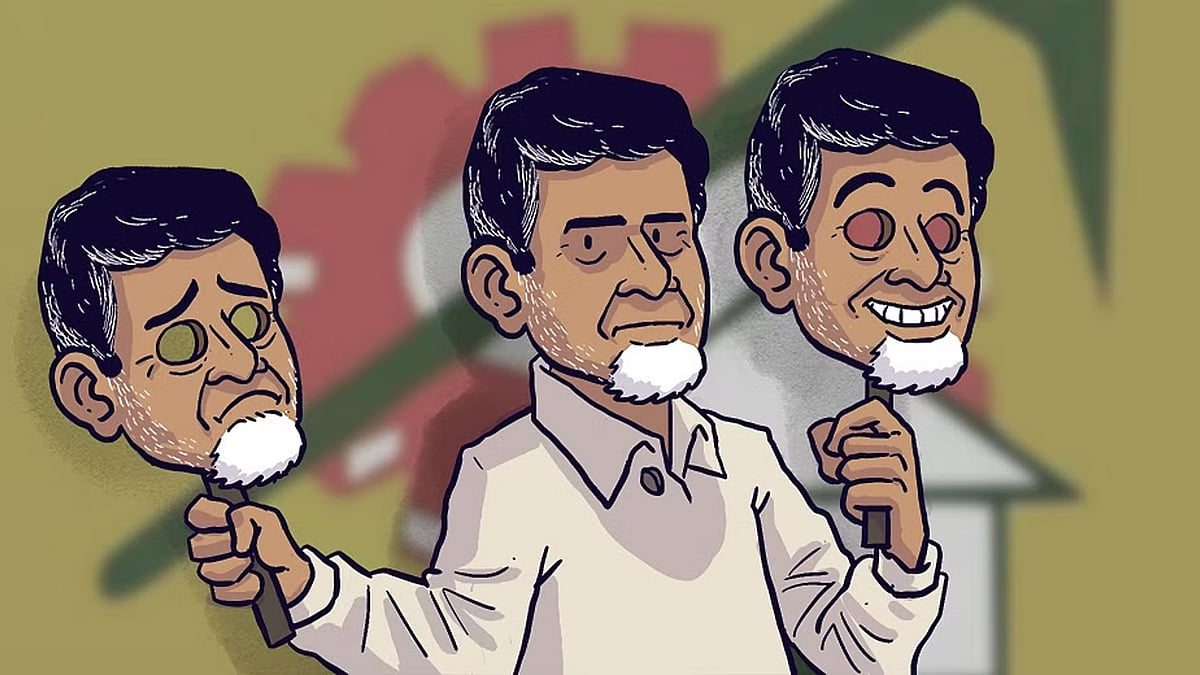
TNM spoke to activists, looked at recent legislation and data, and changes in Andhra’s health policy to see how the TDP and its top leader have tilted from a pro-tech persona to support for alternative medicinal systems.

Three-and-a-half years ago, Telugu news channels dedicated sufficient time discussing the health tracker ring worn by Telugu Desam Party (TDP) supremo, then opposition leader and incumbent Andhra Pradesh Chief Minister Chandrababu Naidu. A simple, no-nonsense platinum band, it went well with his signature beige attire. At that point in July 2022, the TDP chief was touring Chittoor, his home district.
“Many such devices have come to the market to help people maintain a healthy lifestyle. It is my appeal to all TDP functionaries to take care of your health by using such gadgets,” he had said.
The anecdote isn’t out of character for the TDP chief. Since coming to power in 1995 and four subsequent chief ministerships, Naidu has always been the disciplined, hard-as-nails pro-tech voice synonymous with business, and broadly a science-first approach. So it came as a surprise to many when his government passed an order in December 2025 allowing Ayurveda doctors to perform surgeries.
TNM spoke to activists, looked at recent legislation and data, and changes in Andhra’s health policy to see how the TDP and its top leader have merged a pro-tech persona with alternative medicinal systems such as Ayurveda. Naidu has in fact been supportive of Ayurveda and herbal medicine for years now, since the bifurcation of the Telugu states. The key difference now is an increased spending on Ayurveda and a drastic shift in Andhra’s healthcare policy.
Ayurveda as an important health component
The December 23 announcement came from Health, Family Welfare and Medical Education minister Satya Kumar Yadav. An ardent member of the Rashtriya Swayamsevak Sangh (RSS) and a protege of former Vice President Venkaiah Naidu, Satya Kumar is the only Bharatiya Janata Party (BJP) leader to hold a post in Naidu’s current cabinet.
Ayurvedic students are allowed to perform 58 types of surgeries, which include 39 Shalya Tantra (general surgery) procedures and 19 Shalakya Tantra (disease of eye, ear, nose, throat, head or dentistry) procedures.
While the Health Department’s press release relied on the Indian Medicine Central Council (PG Ayurveda Education) Amendment Regulations, 2020, the rules have been under sustained criticism since they were notified five years ago. Health activists, bureaucrats, and doctors, including those from the Indian Medical Association (IMA), have opposed the move. Andhra Pradesh remains the only state to have permitted Ayurveda doctors to perform surgery, something even BJP-led states have so far refrained from.
“We need to remember that it is not a TDP government in Andhra Pradesh right now. It’s a TDP-led National Democratic Alliance (NDA) government,” Andhra Pradesh’s former health secretary PV Ramesh told TNM in an earlier interview. Ramesh, who had worked with the TDP in 2014 as Andhra’s principal finance secretary, spoke about how “the nationalist idea of health with Ayurveda as an important component and pivot to privatised hospital care has gained prominence in India.”
Three days after the Health Department allowed Ayurveda doctors to perform surgery, CM Naidu too made a push for Ayurveda. Speaking at an event organised under the Bharatiya Vigyana Sammelana banner, at which he shared the stage with RSS chief Mohan Bhagwat, the CM said that children should be taught the Puranas (ancient Hindu sacred texts) instead of stories about Batman, Superman, and Spiderman. He also praised ancient India’s achievements, which he said prompted “the global spread of yoga and Ayurveda”.
“Every Indian should sync with Mohan Bhagwatji’s ideology,” Naidu, well known for being an agnostic for a major portion of his life, remarked.
This tilt to Ayurveda, however, isn’t new.
In June 2025, self-styled guru Baba Ramdev, a vocal ally of the BJP-led Union government, referred to Naidu as a “pure soul”. The statement was made in a speech at the Global Federation for Sustainable Transformation tourism conclave held in Vijayawada, where Ramdev also promoted yoga, naturopathy, and ayurveda.
At the same conclave, CM Naidu urged the guru to expand operations of his Ayurveda company Patanjali in Andhra Pradesh and sought recommendations on how to promote the state’s tourism.
During his previous chief ministership in 2014, Naidu – whose party was a part of the BJP-led NDA even then – urged Ramdev to set up a major yoga centre in Tirupati along with a world-class herbal park at Tirumala.
“It is only fitting that the centre is opened in Tirumala, the abode of Kaliyuga Venkateshwara, which attracts Hindus from all over the world,” Naidu had said. Ramdev responded that he would consider the proposal via Patanjali’s trust and asked Naidu to include “yoga and spiritual knowledge in the education curriculum in Andhra Pradesh.”
The TDP chief agreed.
The National Ayush Mission and the TDP
A review of the publicly accessible government orders (GOs) shows that the AP government sanctioned funds nine times in 2025 for promoting Ayurveda. In January 2025, Rs 31.61 crore and Rs 10 crore were sanctioned to the AYUSH Department to meet expenditures under the National Ayush Mission (NAM).
NAM is a flagship scheme of the Union government with the stated aim to improve the quality of Ayush education through upgrading existing Ayush educational institutions and establishment of new Ayush colleges in different states.
In June 2025, the Andhra government sanctioned Rs 3 crore for “the purpose of organising state level competitions in the NTR district and meet the Guinness Record Fee, consultancy fee and other administrative expenses of Ayush Department” as part of YOGANDHRA-2025, the state government’s month-long yoga campaign leading up to International Day of Yoga on June 21, yet another pro-BJP pivot.
In October 2025 alone, a total of Rs 83.22 crore was sanctioned at six different times for the AYUSH Department – Rs 36.46 crore, Rs 2.85 crore, Rs 7.85 crore, Rs 28.13 crore, Rs 5.77 crore, and Rs 2.16 crore – as additional funds towards NAM expenses.
In fact, in May 2025, Health Minister Satya Kumar criticised the previous YSR Congress Party (YSRCP) government for neglecting the AYUSH sector. He proposed “integrating AYUSH with allopathic medicine through hybrid hospitals” to enhance healthcare delivery – an idea repeatedly slammed by the IMA.
In comparison, Naidu’s previous tenure between 2014-2019 shows that lesser funds were sanctioned for NAM. According to government data, only Rs 16.34 crore was sanctioned in 2017. In 2018, funds were released in four tracts for NAM – Rs 13.7 crore, Rs 2.11 crore, and Rs 13.8 crore were sanctioned in May 2018 while Rs 6.24 crore was sanctioned in November 2018, bringing the total to Rs 35.85 crore in 2018.
Policy changes since TDP came to power in June 2024
In policy and legislative terms, the TDP has also brought in significant changes since forming the state government in June 2024. In March 2025, the Andhra Assembly amended the Andhra Pradesh (Andhra Area) Ayurvedic and Homeopathic Medical Practitioners Registration Act, 1956.
Aside from replacing the term ‘Ayurveda’ with ‘the Indian system of medicine,’ the legislation also “regulated the qualifications and provided for the registration of practitioners of Ayurvedic (Ayurvedic system including Sidda, Unani, Tibbi and Prakriti systems) and Homeopathic systems of medicines” in the state. To ensure that regulation and registration happened smoothly, the amendment also established the AP Council for Indian System of Medicine and the AP Council for Homeopathy.
In September 2025, CM Naidu introduced a healthcare digitisation project named Sanjeevani on the floor of the Assembly. The initiative, he said, was being developed in partnership with the Bill & Melinda Gates Foundation and Tata Consultancy Services. Sanjeevani integrates the Union’s Ayushman Bharat initiative and the NTR health services to deliver doorstep healthcare to citizens.
“The name Sanjeevani is inspired from the mythical herb in the Ramayana. When Lord Rama’s brother Lakshmana fell ill during the battle, Hanuman procured the herb to save his life. Our initiative too intends to save lives and strengthen healthcare delivery in the state,” Naidu added.
From privatisation to Indianisation
Roping in the Tata Group and Bill Gates Foundation is an old page from Naidu’s political playbook. However, while earlier conversations revolved primarily around privatisation of health, this tenure also includes support for alternative medicine.
While the Sanjeevani initiative and other moves of the TDP have been criticised as yet another ploy to bring private tech players into public health systems, PV Ramesh argues that privatisation of health per se isn’t new for the TDP.
“In 2014 when I worked as an advisor for the Andhra Pradesh government, the TDP made a full pivot towards privatisation and outsourcing. Chandrababu Naidu has always been a private sector man, one celebrated by the World Bank,” Ramesh said.
The opposition YSRCP had dubbed TDP’s recent plan to bring 10 medical colleges under the Public Private Partnership (PPP) model the “mother of all scams”. The TDP only doubled down on its decision and said that the PPP model was to ensure that the government does not face financial loss and clarified that it would retain complete control and oversight of the colleges.
Ramesh, however, argued that this move posed a foundational ideological problem and questioned its very need if the strategic and essential public services are privatised.
Speaking about the changes post bifurcation, Ramesh said that 104 services (toll-free health information and advice helpline number) and 108 services (ambulance helpline) were privatised.
“Some institutional changes that I had worked on between 2009 and 2012 as the principal health secretary – for instance, establishing community health and nutrition clusters by bringing together the Integrated Child Development Services (ICDS) and primary and secondary health services, a series of transformative institutional changes to strengthen primary health services, establish referral system, strengthen secondary and tertiary hospitals, robust maternal and child health services, rationalising the Arogya Sri scheme to ensure continuum of care – were diluted or partly or wholly dispensed with. They were broadly continued in Telangana post bifurcation,” Ramesh added.
In April 2025, Naidu also announced the launch of the Digital Nerve Centre (DiNC), an initiative aimed at achieving 100% Ayushman Bharat Health Account creation and integrating all electronic health records. The Health Department again roped in Tata MD and the Bill & Melinda Gates Foundation in designing DiNC.
As part of the same announcement, Naidu, true to his moniker of the ‘CEO of Andhra Pradesh’, said that the Union government plans to develop 25 medi-cities in collaboration with state governments under a PPP model. “Andhra Pradesh has offered 200 acres in Amaravati for the project,” he added.
When asked where the larger pivot to privatise healthcare came from, PV Ramesh said this wasn’t unique to the TDP.
“It’s not an exaggeration to say that none of the political parties – national or regional – have a commitment, let alone a strategy or a plan, to secure universal and quality healthcare, education, nutrition, which are key investments for human development, which are sine qua non for economic development,” Ramesh said.
This report was republished from The News Minute as part of The News Minute-Newslaundry alliance. Read about our partnership here and become a subscriber here.
 Chandrababu Naidu’s saga of political flip-flops