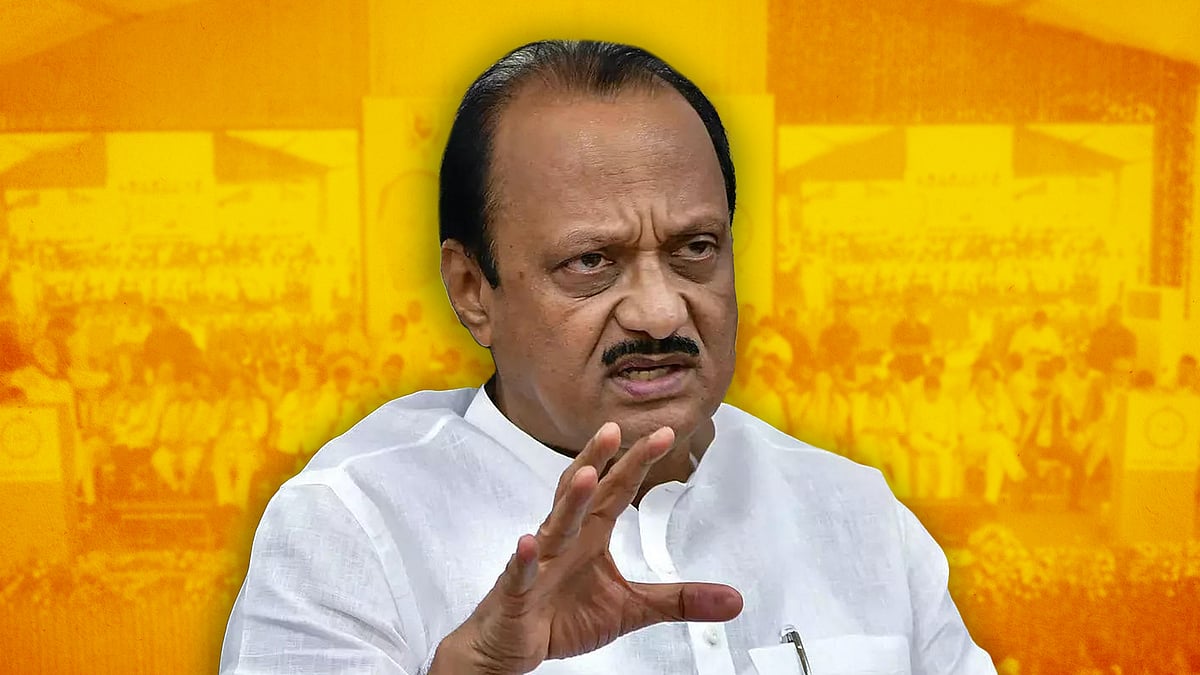
‘Can’t imagine Baramati without Dada’: The end of a powerhouse who shaped Maharashtra politics
The NCP chief was scheduled to address four campaign meetings in the town.

Vishal Jadhav’s voice breaks as he tries to find words. The NCP worker stands in Baramati on what should have been a day of political rallies and jostling crowds – four sabhas scheduled across the constituency for the Zilla Parishad elections. Instead, there is only silence. The party chief who was meant to address them, Deputy Chief Minister Ajit Pawar, died in a plane crash this morning.
“We have lost our father. He was everything to us. We cannot imagine Baramati without Dada. Throughout his life, he worked tirelessly for the people of Baramati and Maharashtra. He was supposed to hold four sabhas here today.”
Ajit Pawar was traveling from Mumbai to Baramati in a private chartered aircraft. The other victims of the crash have been identified as Pawar’s personal security officer Vidip Jadhav, pilots Sumit Kapoor and Shambhavi Pathak, and flight attendant Pinky Mali. Within hours of his death, Baramati – Pawar's political fortress and the town he transformed over decades – has become a landscape of shuttered shops and silent streets.
Gajanan Hagawane, a resident of Katewadi – Ajit Pawar’s native village – described the scene.
“Everything has been shut down. Shops, sugar factories, gram panchayats and schools have all closed. People are in shock and deep grief. Dada (Ajit Pawar) had a very close connection with the people of Baramati, children, youth and the elderly alike. Everyone loved him. He worked for us all his life. Such was his nature that people trusted him completely. If Dada said yes to any work, no matter what obstacles came, that work would surely be done. This is an extremely difficult time for Baramati. We simply cannot imagine Baramati without him.”
Born on July 22, 1959, in Deolali Pravara village of Rahuri Taluka in Ahmadnagar, Ajit Pawar was the son of Anantrao Pawar and Asha Pawar. His father was the elder brother of Sharad Pawar, making Ajit the nephew of one of India’s most prominent political figures. But unlike other members of the Pawar family, Anantrao worked in the film industry, notably for V Shantaram at Rajkamal Studios.
While Ajit Pawar’s grandfather Govindrao Pawar managed a farmers’ cooperative, it was his grandmother Sharda Pawar who began the family’s political journey. She became a member of the Pune local board (now known as Zilla Parishad) in 1936 as part of the Peasant Workers Party (PWP), a leftist organization.
Just as Sharad Pawar was strongly influenced by his mother – though his politics differed markedly – Ajit Pawar was shaped by his uncle. His entire political career was developed and nurtured under Sharad Pawar’s mentorship.
Pawar completed his schooling at Maharashtra Education Society High School in Baramati before enrolling at Gopal Krishna Gokhale College in Kolhapur to pursue a Bachelor of Commerce degree. However, he was unable to complete his final year following the untimely death of his father. He returned to Baramati and took up farming, running a dairy and poultry farm in Katewadi. He later joined the cooperative sector, the backbone of rural Maharashtra politics. In the early 1980s, when elections were held at the Chhatrapati Shivaji Sahakari Sugar Factory, Sharad Pawar decided to introduce fresh leadership alongside experienced hands. Consequently, Pandharnath Sahebrao Kate was appointed as the senior director and Ajit Pawar as the young representative for Katewadi. This marked Ajit Pawar’s first official position. He served as a director for 11 years.
Considered a strict teetotaler and known for his punctuality, Ajit Pawar began his electoral political career with the Lok Sabha. In 1991, Sharad Pawar fielded him as the candidate from Baramati constituency. Although Sharad Pawar’s elder brother, Appa Saheb Pawar, was keen to contest the seat, local sentiment strongly favored Ajit, citing his youth and proven performance as a sugar factory director. After several local-level meetings where this preference was communicated to Sharad Pawar, Ajit Pawar went on to win the election by a record margin of 3,36,263 votes.
However, his tenure in Delhi was brief. Following the assassination of Rajiv Gandhi in 1991, Sharad Pawar – then serving as Maharashtra’s Chief Minister – returned to the Lok Sabha and assumed charge as Defence Minister under P V Narasimha Rao. Sharad Pawar wanted someone from his own circle to represent Baramati in his absence, setting the stage for Ajit Pawar’s transition to state politics.
Ajit Pawar’s political rise gathered momentum after Sharad Pawar parted ways with the Congress and formed the NCP in 1999. Until then, he was largely known within the Pune region, but he soon emerged as a prominent figure across Maharashtra. While Sharad Pawar focused on expanding the party at state and national levels, Ajit Pawar concentrated on addressing local issues in Baramati, building a reputation as a strong administrator with a decisive, hands-on style of functioning.
The people’s leader
Despite his straightforward – sometimes blunt – manner of speaking, Ajit Pawar was widely regarded in Baramati as an accessible leader and problem-solver. He regularly conducted a ‘Janta Darbar’ every Sunday at the Vidya Pratishthan premises in Baramati. These sessions typically began early in the morning, following a prior inspection of ongoing development works. Large queues of people gathered outside from as early as 7 am, often stretching over long distances. Visitors were required to submit written applications detailing their grievances.
During these sessions, Ajit Pawar personally read each application and resolved many issues on the spot. He continued until the last person was heard. Even when emergencies required him to leave, he collected the applications himself and reviewed them while traveling, issuing immediate instructions to his staff for follow-up. A dedicated support vehicle equipped with office essentials accompanied him to ensure prompt action. He closely monitored the progress of each case and pushed for swift resolution.
Ajit Pawar never encouraged the use of intermediaries. He was known for being directly accessible and discouraged people from approaching him through mediators. Those seeking his intervention received a clear response – either an assurance if the work was feasible or a direct refusal if it was not – avoiding prolonged delays or false expectations.
Raviraj Taware, a Baramati resident, once told this reporter: “Ajit Pawar was widely regarded as unusually accessible. Anyone can approach him directly, without the help of intermediaries, irrespective of whether the person is a supporter, a voter, or financially well-off. The only requirement is that the person should submit a written application clearly stating the problem along with their name and contact details. Issues ranging from medical emergencies and police matters to court cases, education-related concerns, and other public grievances are taken up. If Ajit Pawar believes a problem can be resolved, he initiates action immediately; if not, he communicates this clearly without keeping people waiting or raising false expectations.”
Taware recounted a personal incident that exemplified Pawar’s commitment to his workers: “In May 2021, while I was a minor worker of the Nationalist Congress Party, I was shot at by members of my own party after being given a ticket for the Zilla Parishad elections. I was returning home with my wife after evening shopping when I was shot in the chest. At the time, Ajit Pawar was serving as the Deputy Chief Minister. My wife rushed me to a hospital and informed Ajit Pawar while he was attending a meeting in Mumbai. He immediately cancelled his engagements. By the time I reached the hospital, multiple doctors had been mobilised, and within an hour, the Superintendent of Police of Pune Rural was present. Ajit Pawar also arranged for an air ambulance, though doctors advised immediate surgery, which was successfully performed at Baramati itself. He remained in constant touch with my family, doctors, and police authorities through the night, staying awake until he was informed that I was out of danger. The following day, he ensured that I was shifted to a hospital in Pune for further treatment.”
Locals and NCP workers observed that Ajit Pawar was an early riser who started work at 6 am. He was particular about promoting people ready to work around the clock for the public and discouraged supporters who indulged in drinking and alcoholism. As one local put it: “Dada may shout at us, he may get blunt sometimes, but he never lets people down and makes sure to get their work done. He is like a coconut – hard from outside but soft from inside.”
A leadership vacuum in Maharashtra
Pune-based senior political analyst Prakash Pawar assessed that the entire political landscape of Maharashtra will be affected by Ajit Pawar’s untimely demise.
“Both factions of the NCP are now likely to reunite, but the party will face a leadership crisis as there is no leader who can match Ajit Pawar's stature or mass appeal. Ajit Dada was part of the ruling alliance, and it remains to be seen who will now fill the space he occupied.”
He pointed out that in the recently held Municipal Corporation elections, Ajit Pawar took on the BJP directly and proved his political strength by winning decisively in his strongholds. “Ajit Pawar was secular at his core, and his decision to align with the BJP-Shiv Sena alliance was driven purely by political considerations. He was the only leader capable of taking on the BJP had he chosen to sit in the opposition in the future.”
“With his demise, a leadership vacuum has been created in Maharashtra politics, one that cannot easily be filled, because Ajit Pawar was the only leader with such a strong grassroots connect across both urban and rural Maharashtra.”
Parimal Maya Sudhakar, head of the department at MIT School of Government and a political analyst, said that politics in the state is definitely going to be affected. “As emotions are running high, both factions of the NCP are likely to come together now. MLAs who were with Ajit Pawar will certainly explore their options, but at the organisational level, the NCP is expected to reunite. For the time being, the NCP will continue to remain with the BJP and will explore its future options over the next three years.”
“Ajit Pawar had created his own political brand and had a dedicated base of followers. Whatever may be said about him and his politics, one thing was certain, Ajit Pawar was a man of his word. His absence will create a significant void in Maharashtra’s politics”.
In times of misinformation, you need news you can trust. We’ve got you covered. Subscribe to Newslaundry and power our work.
 How Ajit Pawar became the comeback king of Maharashtra