What the ‘murder’ of Washington Post means for India
As foreign bureaus close and global coverage shrinks, countries like India lose one more watcher – and we’re reminded how fragile journalism becomes when it rests in the hands of billionaires.

Pranshu Verma, the Washington Post’s Delhi bureau chief, learned on Wednesday that his contract was being terminated. He was among nearly 300 editorial staffers laid off as Jeff Bezos gutted the newspaper’s newsroom – a purge that has almost ended the Post’s presence in South Asia.
“Heartbroken to share I’ve been laid off from The Washington Post. Gutted for so many of my talented friends who are also gone,” Verma posted on X. “It was a privilege to work here the past four years.”
The Post’s South Asia team in Delhi comprised three journalists and two administrative staff until Wednesday’s bloodletting. While only Verma has received formal notice so far, the remaining four staff members have not been told whether the bureau will continue to exist. “There is no clarity if the paper will continue with its bureau in Delhi,” a source familiar with the matter told Newslaundry. “So far, only Pranshu’s layoff has been communicated.”
This is part of a broader collapse. Nearly 300 of the Post’s roughly 800 editorial staffers were let go Wednesday, with international news, sports, books, and local coverage bearing the brunt. Foreign bureaus that once held power to account across continents are being shuttered. The message is clear: the world beyond America’s borders no longer matters to one of the country’s most storied newspapers.
For India, the loss is more than symbolic. The Washington Post in New Delhi, with all its flaws, did something many Indian outlets could not: it asked questions.
The Bezos betrayal
In 2019, Jeff Bezos said his stewardship of the Washington Post “is something I will be most proud of when I’m 90 and reviewing my life”.
But seven years later, he has laid off a significant chunk of its workforce, practically wiped off most foreign bureaus, and overseen a revamp that has been described by some as wilful decimation of the brand and its revenue.
This week’s decision has been attributed to financial pressures, including $100 million losses in 2024, subscriber drops after skipping a 2024 presidential endorsement, and declining traffic from AI tools. Prior cuts included severance packages for 240 employees in 2023 and about 100 in business roles in early 2025. Recent total staff estimates, according to some, hover around 3,000 employees.
Matt Murray, the Post’s executive editor, said on a call Wednesday morning with newsroom employees that the company had lost too much money for too long and had not been meeting readers’ needs. He said that the result would be a publication focused even more on national news and politics, as well as business and health, and far less on other areas, according to a report in the New York Times.
The cuts have compelled many to point out the obvious – that Jeff Bezos, who is currently the world’s fourth-richest man, worth an estimated $261 billion, could easily eat the paper’s losses. Considering that Bezos-owned Amazon is investing at least $75 million dollars to acquire and market a documentary on Melania Trump, or reportedly spent $500 million on a superyacht. He spent $237 million on properties just in Miami. He spent at least $20 million – a pittance, compared to the rest of his spending – on his wedding last year.
Some have even gone on to term it “murder”.
‘Decimation, working out well for Bezos’
Ashley Parker, a former Washington Post star White House reporter, wrote in The Atlantic that the “least cynical explanation is that Bezos simply isn’t paying attention”. “Or maybe, as many of us who deeply love the Post fear, the decimation is the plan.”
“The Post has survived for nearly 150 years, evolving from a hometown family newspaper into an indispensable national institution, and a pillar of the democratic system. But if Bezos and Lewis continue down their present path, it may not survive much longer…Over recent years, they’ve repeatedly cut the newsroom – killing its Sunday magazine, reducing the staff by several hundred, nearly halving the Metro desk – without acknowledging the poor business decisions that led to this moment or providing a clear vision for the future.”
“Journalism is – has always been – a tough industry. But I watched firsthand as Bezos, Lewis, and company spoke in turgid corporate-ese (“Fix it, build it, scale it”) and failed to launch – or even attempt to launch – initiatives that might achieve their grandiose visions. They began 2025 by unveiling the “Big Hairy Audacious Goal” of jumping from about 2.5 million subscribers to 200 million paying users, despite having ended the previous year hemorrhaging tens of thousands of their existing subscribers, all while blaming the journalists for the paper’s travails.”
Another former Post reporter, Liz Sly, wrote on X that what Bezos did “is a monstrosity” and “should be criminalized.” Several others recalled their experience on X.
American media watchdog Media Matters for America had earlier noted that many corporate media owners had made their choice in Trump’s second term. “They are damaging celebrated news outlets like CBS and The Washington Post out of some combination of personal preference and political expedience.”
Pointing to restructuring decisions at the Washington Post, including the laying off of prominent writers and hiring of conservative voices, the piece noted that the changes seemed to have blown a hole in the Post’s subscriber numbers, and the owner was unwilling to eat the losses, resulting in the then speculated lay-offs.
“But defanging the Post — and finding a way to put money in the Trump family’s pockets — seems to be working out well for Bezos. His rewards include plum seats for Trump’s swearing-in, federal contracts for Blue Origin and Amazon Web Services, and the president publicly applauding him for ‘trying to do a real job with The Washington Post, and that wasn’t happening before’.”
Another Post staffer told The Wrap that Bezos, Lewis and Murray “just spit on the grave of Katherine Graham and the legacy of the Washington Post,” a reference to the courageous late publisher who stood behind the newsroom in the face of government pressure during Watergate and the publication of the Pentagon Papers. The Post, this staffer told the outlet, is “finished.”
However, the Post said in a statement that the restructuring is “designed to strengthen our footing and sharpen our focus on delivering the distinctive journalism that sets the Post apart and, most importantly, engages our customers.”
Meanwhile, Semafor reported that the cuts have inspired many top executives in the American media community to step in and expand their coverage to fill the gap. “According to multiple senior media executives, plenty of media companies and wealthy individuals would be interested in acquiring the Post if it ever goes up for sale, but people who have spoken to Bezos say they remain unconvinced he wants to sell it.”
An India parallel?
Using the hashtag #SaveThePost, reporters across global bureaus, including India, had earlier warned that foreign coverage may face substantial reductions. Roughly 60 members of the international staff had written to Bezos, arguing that scaling back overseas reporting would weaken both the newspaper and the public-interest journalism it produces.
In the Bezos saga also lies the cautionary tale of media ownership. In India, much has been written about how such models can impact editorial independence. Like Bezos hoping to feel proud about his ownership legacy, an India billionaire had also maintained – shortly after taking over arguably the only TV network that was critical of the Narendra Modi government – that there will be a “lakshman rekha”. However, the channel’s revamped editorial positioning indicates the silver lining came with an eraser. Other takeovers by the same company highlight the group’s efforts to establish a multi-platform media presence.
The Washington Post layoffs aren’t just about money. At some level, the institution no longer seems convinced why this journalism matters. There’s been a perceptible shift in how Americans understand themselves.
For decades, American journalism on foreign shores was shaped by the idea of America as the world’s moral custodian. Reporting on wars, democratic backsliding, human rights abuses was an extension of that self-image. America watched the world because it believed it was responsible for it.
That belief seems to be collapsing.
As American political scientist Evan A Feigenbaum noted, “The world is becoming less America-centric by the minute while the United States is becoming more America-centric than ever. It is just a depressing yet somehow perfect summation of our current moment that one of the most important newspapers in the history of the country - one that has actually shaped the history of the United States - doesn't think reporting on the world is of any use anymore. What an utterly perfect encapsulation of where we have arrived.”
Surveys show many Americans consume little foreign news. A report conducted by the Pew Research Center in 2022 found that only 48 percent of Americans could name the capital of Afghanistan (Kabul) and that only 41 percent could identify the flag of India, the world’s most populous country. There are possibilities that these trends will only solidify with the Republican push for isolationism and as Trump tries to redefine American exceptionalism. There is another, less discussed reason the Washington Post’s foreign coverage has become politically expendable: public disgust.
For many readers, especially millennials and Gen Z, the paper’s coverage of Palestine, contrasted with its moral clarity on Ukraine, has been staggering. Russia’s invasion of Ukraine was framed correctly as an assault on sovereignty, civilians, and international law. Israel’s war on Gaza, producing mass civilian death, collective punishment, and humanitarian collapse, was often laundered through euphemism and an almost pathological caution around naming power.
So the obvious question now is: why should the average American care what the Washington Post says about India? Or Sudan. Or Gaza. Or democratic erosion elsewhere. If America is no longer the world’s minder, then this journalism starts to look indulgent, even irrelevant — especially to a voter struggling at home. Which is why this isn’t just a media crisis. It’s about the sustainability of the liberal world order itself.
Meanwhile, to readers abroad, there has been another question amid the collapse of the much-touted rules-based global order: why listen to a paper explain global morality when it so visibly flinches at the moment of truth?
That erosion of trust matters because foreign reporting has always relied on something fragile: credibility without proximity. Most American readers will never see Gaza, Kyiv, New Delhi, or Tehran. They relied on institutions like the Washington Post. When that contract breaks, indifference follows. And indifference is lethal to foreign bureaus.
And here’s the part that should worry us far more than what this means for American readers.
The foreign correspondent has always been a controversial figure in Indian journalism. Indian reporters, often while secretly aspiring to those very jobs, have long rolled their eyes at foreign correspondents’ salaries, their parachute reporting, their occasional cluelessness about how the country actually works. There is real resentment about stories that Indian newspapers broke first, only to be “discovered” weeks later by a Western outlet and rewarded with global amplification. Some of this criticism is fair.
Foreign correspondents have often misunderstood caste, flattened political complexity, relied too heavily on English-speaking elites, and sometimes reproduced tired tropes about India for Western audiences — the monkey menace story never dies. They have been late to stories Indian journalists lived with for years. And yes, they have often been paid too much to know too less.
And yet for all these flaws there is something crucial they were doing. Especially now.
India’s media ecosystem is already deeply compromised. Television news has collapsed into propaganda. Large sections of the print media have normalised access journalism, deference, and self-censorship. In that environment, foreign journalism played a crucial, if uncomfortable, role.
With all its flaws, and there were many, the Post still did something Indian media increasingly could not. By producing deep-dive investigative series that mainstream domestic publications often find difficult to pursue, the Post established a consistently adversarial relationship with the Indian government. Their story, uncovering how the BJP and Hindutva groups leveraged their “vast messaging machinery” – including “a sprawling apparatus of 150,000 social media workers” – to inflame communal tensions and influence elections, was a standout. In 2023, they reported on the pressure on OTT platforms against daring content.
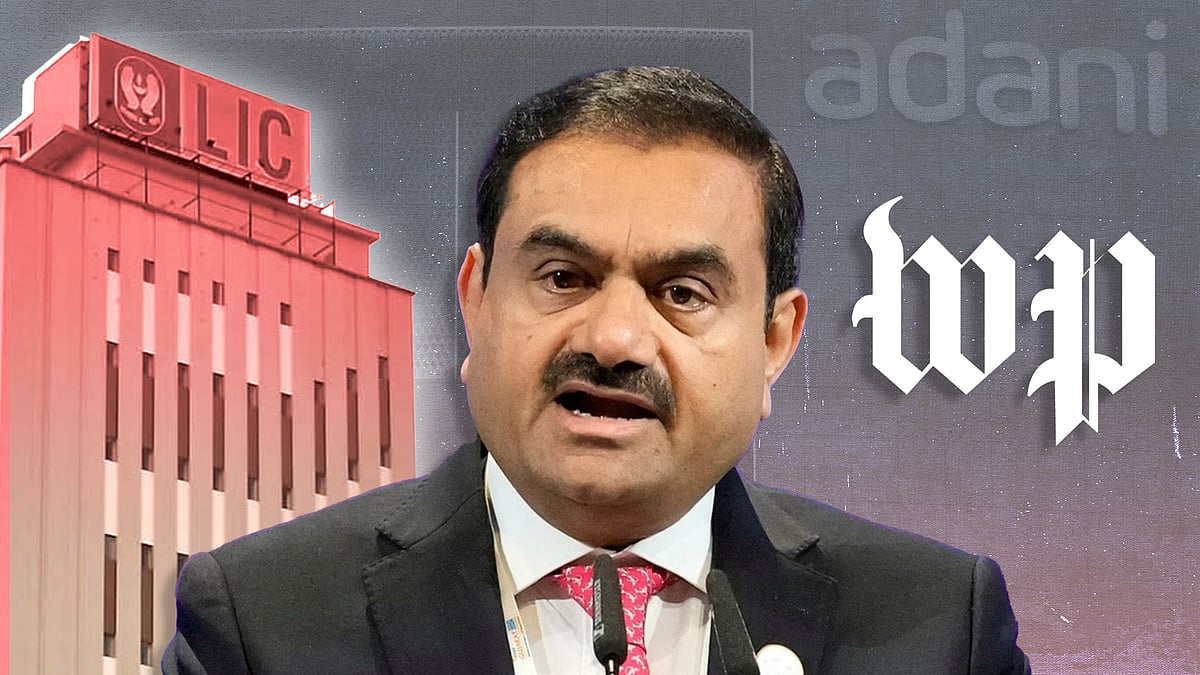
In late 2025, the Post published a story, headlined ‘India’s $3.9 billion plan to help Modi’s mogul ally’, alleging “how Indian officials drafted and pushed through a proposal in May to steer roughly $3.9 billion in investments to Adani’s businesses from the Life Insurance Corporation of India (LIC).” The story sent the government into a tizzy, eliciting strong denials from official channels. Their coverage of the COVID-19 ‘Delta Wave’ in India in 2021 offered a stark insight into the oxygen shortage and the “undercounting” of deaths during the 2021 surge.
Those stories mattered here. They gave Indian journalists cover. They gave civil society citations. They forced uncomfortable questions in international forums. They reminded the government that someone, somewhere, was still watching.
Now that watcher is retreating. And as always some government lackeys on X are happy.
As Western media turns inward, and as the liberal international order frays, countries like India will increasingly be judged less on democratic norms and more on strategic utility. Market size. Geopolitics. China containment. Arms deals.
The Washington Post laying off its world is, therefore, not just about America becoming more America-centric. It is about the world losing one more imperfect but necessary mirror.
Billionaires don’t have your back – whether it’s Bezos in Washington or someone else in Delhi, profits will always come before the public, and we’ve spent years reporting exactly what that does to newsrooms. The only real counterweight is you: subscribe, support independent journalism like Newslaundry, and help us prove that readers together are more powerful than any billionaire.
 Washington Post’s Adani-LIC story fizzled out in India. That says a lot
 Adani’s NDTV: New channels, Modi documentaries, a leadership void, and big plans for this year
  Who Owns Your Media: The saga of NDTV