‘Precautionary step’ or ‘fascist clampdown’? Confrontation with YouTuber leads to a protest ban at DU
While the administration cites law and order, students and faculty allege that it is a pretext to silence dissent.

On February 17, Delhi University issued an order banning any protests on campus for the next one month. This came after a confrontation between YouTuber Ruchi Tiwari and All India Students Association (AISA) members on February 13, resulting in cross FIRs being registered at Maurice Nagar police station.
According to the order signed by the DU proctor, “public meetings, processions, demonstrations, and protests of any kind are strictly prohibited within the University Campus for a period of one month.” The university administration justified the measure by citing concerns over potential unrest:
“This order is issued in view of information received indicating that unrestricted public gatherings, processions, or demonstrations on campus may lead to obstruction of traffic, threats to human life, and disturbance of public peace. In the past, organisers have often failed to control such protests, which have escalated and spread widely, resulting in deterioration of law and order within the University campuses.”
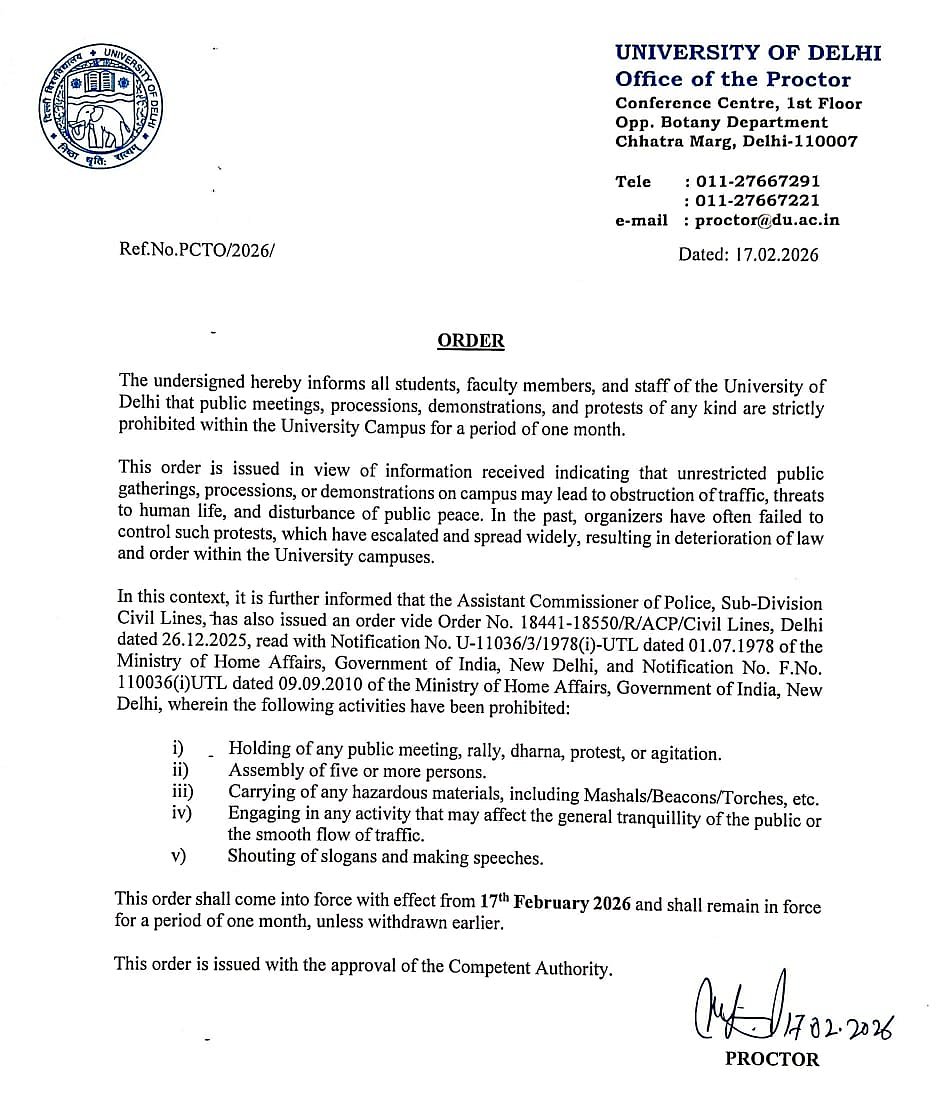
The university’s directive is reinforced by a previous order from the Assistant Commissioner of Police, Civil Lines, effectively authorising the Delhi Police to enforce the campus-wide protest ban for the next one month.
Speaking to Newslaundry, DU Proctor Manoj Kumar Singh said, “The events that transpired on February 13 regarding the UGC Regulations – we do not want a repeat of such events. This is a precautionary step we have taken to maintain law and order in the university.”
Adding that caste has become a flashpoint on campuses, Singh said, “We do not want to do anything regarding that since this is an educational institute.”
But what exactly led to this ban?
Chronology Samajhiye
In its 104-year history, Delhi University organised its first literature festival from February 12-14 with ‘Nation First: University in Diversity’ as its theme.
Claiming the festival to be “a mouthpiece for regressive propaganda and communal rhetoric,” the All India Students’ Association (AISA) organised a ‘People’s Literature Festival – Samta Utsav’ as an alternative outside the Arts Faculty in DU.
This was met by miscreants, allegedly members of the Akhil Bharatiya Vidyarthi Parishad (ABVP), who threw a bucket of water at historian Irfan S Habib and bricks at the students sitting outside the Arts Faculty at DU. The ABVP has denied these allegations.
On February 13, AISA organised an ‘Adhikar Rally’ in favour of the UGC’s Equity Regulations 2026 to address caste discrimination on campuses.
As per videos going viral on social media, Ruchi Tiwari, a YouTuber, had an altercation with a Dalit journalist, Naveen Kumar, during the protest.
When AISA DU secretary Anjali Sharma intervened, Tiwari allegedly “held her face and threw her to the ground. Then she tried to run away.”
Following this, AISA activists tried to physically detain Tiwari and take her to the police chowki on the other side of the road.
Later in the evening, when Anjali went to the Maurice Nagar police station, a mob that included some YouTubers was present. They could be heard abusing AISA activists and issuing violent threats against them inside the station.
Meanwhile, a video of another YouTuber, Megha Lawariya, known for making controversial statements, also went viral, where she can be heard shouting “Brahmanvaad Zindabaad” at the spot where the mob had gathered.
A day later on February 14, the Delhi Police turned the cross complaints – by AISA and Ruchi Tiwari, into cross FIRs, under BNS sections 74 (assault or use of criminal force against a woman with intent to outrage her modesty), 115(2) (voluntarily causing hurt), 126(2) (wrongful restraint) and 3(5) (common intent).
While Tiwari alleged that AISA members tried to “mob lynch” her and “whispered rape threats” in her ears because she is “a Brahmin”, the left student organisation said: “Tiwari, who has developed a notorious reputation of creating chaos and inciting violence in this social movement has taken a victim stage, while AISA activists are being targetted, getting rape and death threats constantly.”
Ruchi runs the YouTube channel Breaking Opinion. A scan of her recent uploads shows her at a Bhim Army rally, where she filmed a video claiming to be "surrounded" – an incident that triggered yet another confrontation and led to a chase. In another video titled “SC ST Protest mein mahila patrakar se badatamizi”, she can be seen engaging in another shouting match with journalists.
Meanwhile, as per a video on X, Megha Lawariya again raised controversial slogans on February 17 outside Shyamlal Nehru College.
‘Fascist Clampdown’
Abha Dev Habib, associate professor at Miranda House and secretary of Democratic Teachers' Front, told Newslaundry: “Basically, this is about peaceful campus protests calling for the implementation of the UGC equity regulations. The best places for these protests are public universities, where 70 percent of students come from marginalised backgrounds. There is a fear that campuses will become important sites for demanding laws that put an end to discrimination."
Habib added, “It’s the police’s responsibility that protests are carried out peacefully. Moreover, the university keeps investing money in CCTVs, but they are not able to find any footage to show that Ruchi Tiwari was assaulted. This is a fascist clampdown. They’re all connected – the police, the university, and the government.”
AISA Delhi State Secretary Abhi Gyan told Newslaundry, “It’s obvious that the Delhi Police and the university are not able to control the violence by miscreants such as Ruchi Tiwari. So, they are using that violence to curb any form of dissent. There is widespread anger among students over the Supreme Court's stay of the UGC Equity Regulations. So, this is just another excuse to repress students.”
Mithuraaj Dhusiya, associate professor from the English Department at Hansraj College, called for the order to be “immediately rolled back”.
Teaching literature since 2004, he told Newslaundry, “It is true that all protests and movements against wrong policies of the government, university and its constituent colleges have to be totally peaceful. It is the university's duty to ensure these protests remain peaceful. However, clampdown on protests and movements in the guise of ‘obstruction of traffic’ etc. is not acceptable at all.”
Demanding revocation of the prohibitory order, Students’ Federation of India (SFI) said in a statement, “The solution to such incidents is not the suppression of democratic voices. The right to dissent and to protest peacefully is intrinsic to the functioning of a university space and is constitutionally guaranteed. By imposing sweeping restrictions on assemblies and protests, the university administration, in tandem with the police, appears to be exploiting this incident as a pretext to curb students’ democratic rights. This amounts to penalising victims and silencing those who seek accountability.”
Newslaundry reached out to the National Students' Union of India (NSUI), the ABVP, and the Delhi University Teachers' Association (DUTA) President, Dr VS Negi, for comment. This report will be updated as they respond.
From Manikarnika Ghat to the Kashi Vishwanath Corridor, Banaras is being reshaped in the name of vikas. Our new NL Sena asks who pays the price. Power it here.
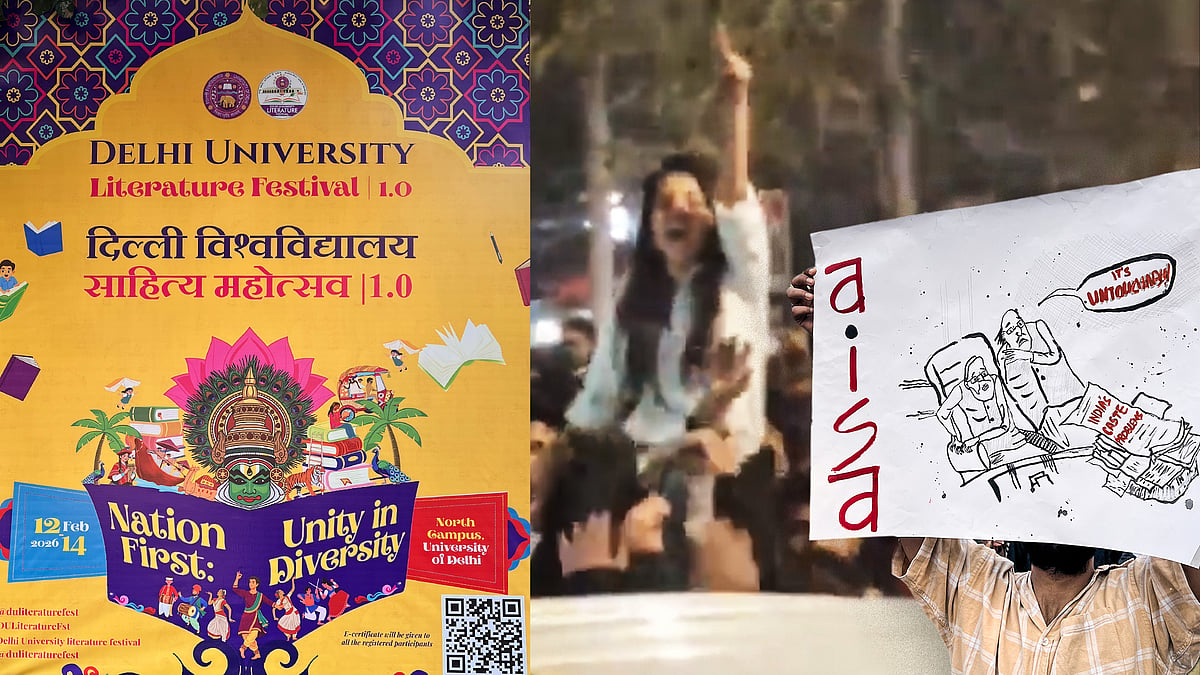 From ‘Nation First’ to ‘Brahmanvaad Zindabad’: Inside the chaos at DU
 Campus Pe Crackdown: The assault on student activism in India