Galgotias: Who’s really to blame? And what India’s AI summit got right
Can India’s AI dream survive its performance culture?

My six can be your nine.
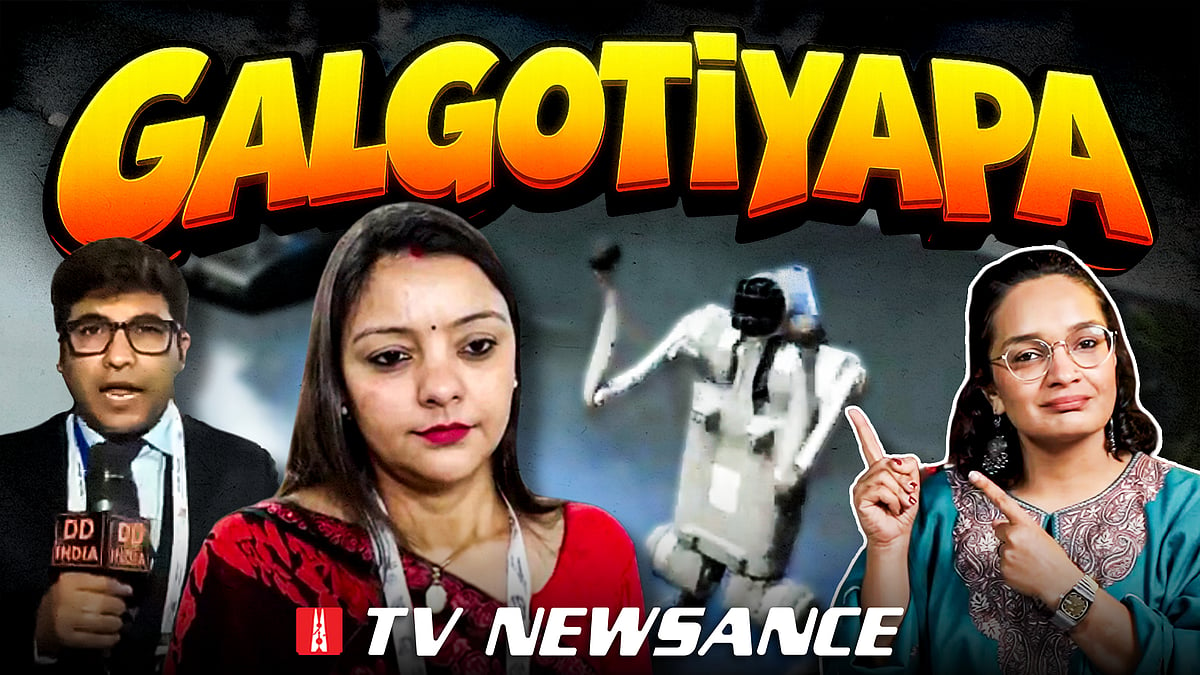
As Professor Neha of Galgotias University defended the indefensible, social media did what it does best: loop, remix, ridicule.
Within hours the clip was everywhere. By the end of it, I felt oddly sympathetic – for the professor, for her students, even for the DD News reporter whose breezy “news” package turned into global meme material. It cannot be pleasant to find yourself at the centre of an internet pile-on.
I have to admit I quite enjoyed the memes too, but here’s the problem. We are very good at enjoying the spectacle of humiliation. We are less good at locating responsibility.
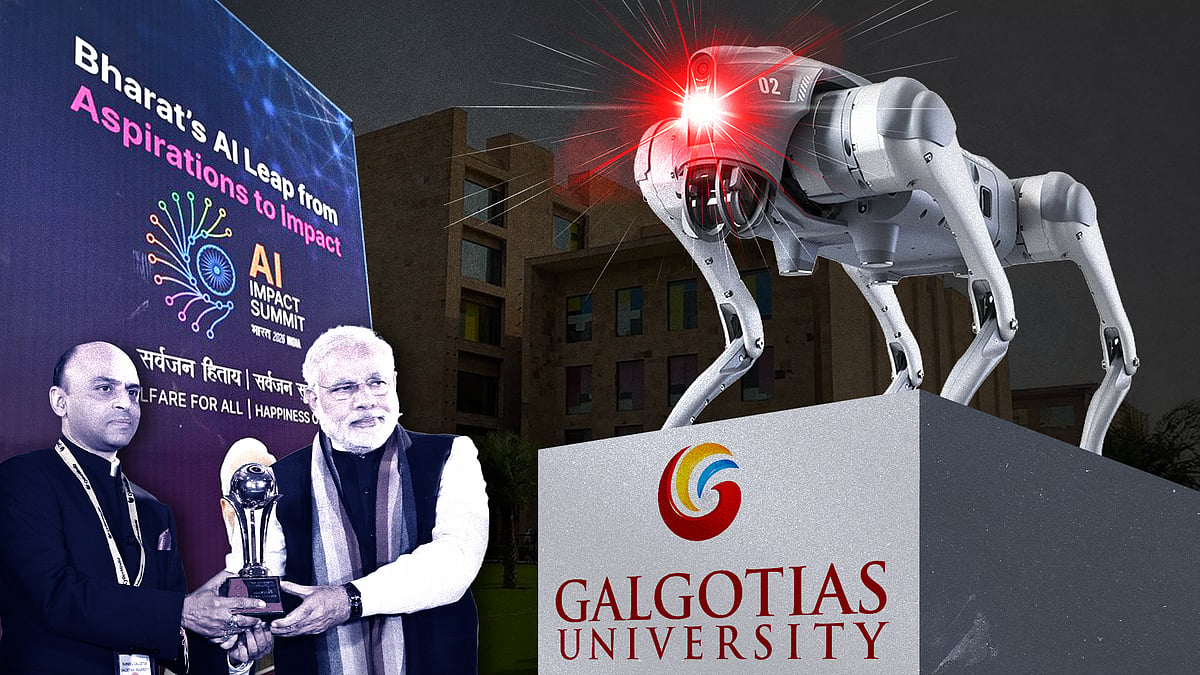
The problem is not one professor improvising innovation and then fumbling her way through her defence. The problem is a political culture that, over the past 12 years, has turned sycophancy into policy. Deference to power is not new in India. What is mind boggling now is the very formal reward structure. An Indian Express report said that the university bagged a booth bigger than what four IITs got combined. For what reason could that be other than aligning itself with the current government’s vision of higher education? The whole mess began with someone at DD News deciding Galgotias was worth amplifying. I refuse to believe that was the reporter’s call. Nonetheless, we see him move from one “innovation” to another, prompting gently: You built this?
“Yes. End-to-end engineering.”
You built this 3D printer?
This time not Neha, but a student who responded honestly: ‘actually the 3D printer had been provided by the university, among other things.’
That was the red flag. A teacher claiming total credit. A hesitant student qualifying it. Any editor with minimal scepticism would have paused. Are we reporting? Or airing a brochure?
But the segment aired. The memes followed.
If editors at DD News, if they exist, had applied even basic scrutiny, this would have remained a campus demo. Instead, journalism, now indistinguishable from PR, made a silly exaggeration combustible. When your primetime model includes figures like Sudhir Chaudhary, this outcome is not surprising.
The culture that produces six is nine
For over a decade now, the message from the top has been unmistakable: loyalty is currency. Those who chant the right slogans, who perform allegiance loudly enough, who say “Modi ji zindabad” at the correct decibel – they rise. Those who question are suspect.
We’ve seen what this did to television news. Between 7 and 9 pm, most channels are unwatchable. Credibility has collapsed so completely that even the political class they serve must privately wonder about the return on investment.
When sycophancy becomes a pathway to success, institutions adapt. Universities are beginning to mirror the same logic. The thrust is no longer to produce students who think, question, experiment. The thrust is to produce compliance. March in formation. Sing on cue.
Ask a question, and you risk being labelled anti-national. Raise doubt, and you’re slotted into some convenient “gang.” There is always someone on primetime anyway ready to malign you.
Since 2022, I have been to several colleges and I have lost count of the number of times I have heard students complain: The university doesn’t want us to be thinking citizens, protest karna mana hai, campus main azadi nahin hai khul ke bolne ki, VC bilkul ek ideology ko promote kar rahe hain.
I won’t get into the Left vs Right debates on campuses but the simple fact is that innovation cannot grow in an ecosystem that punishes questioning. Before we start announcing ourselves as the next great AI powerhouse, we need to confront this basic truth.
The real win for India’s AI summit
And yet, this was not the whole story of India’s first AI Summit.
I attended it on the third day. Without the VIP theatre, entry was easy. And away from the Galgotias stall, there was serious work happening.
No, we are not outpacing China. We are not dethroning the United States. But Indian companies are building systems designed for Indian constraints. That was heartening to see.
Globally, much of the AI conversation is capability-driven: What can AI generate? How realistic? How fast? Text, video, avatars, copilots, autonomous agents. But capability is not the same as problem definition.
The viral Brad Pitt-Tom Cruise AI fight video demonstrated technical sophistication. But what human constraint did it remove? What systemic bottleneck did it address?
At the AI summit, I found that much of the more interesting AI work is seriously thinking about this.
There was Plenome, Wadhwani AI, AI4bharat, IIT Madras, gnani.ai, and a bunch of other companies and organisations thinking of everyday fixes. Can we make the life of a farmer, an Asha worker or someone sitting somewhere in rural Telangana easier with AI? Can it work for someone sitting in small-town Bihar with patchy internet? Can it include people who don’t speak English? How can we help find solutions to our longstanding problems of educational assessments, malnutrition, digital inclusivity? I met two brothers – one had travelled from Latur, another from Bhopal. They were excited. There was a real twinkle in their eyes. An ambition to be part of this new technology, not left behind by it. That, to me, was the real win of the summit. A free event that allowed young people to imagine themselves inside the future.
Much of my Twitter timeline is geeking out over Sarvam – is it really that big a deal? Oh yes it is. But Google AI did the same thing? But we’re doing it better. I don’t care much for this mostly because it’s all jargon I don’t get. What interests me is this: can Indian companies build for Indians? In Indian languages? For Indian realities? Can we bring non-English speakers into the AI conversation? Can we serve our own market, in our own languages, with our own companies? That I think deserves more attention rather than a simplistic ask of our own ‘Deepseek moment’. The conversations I had were about taking small wins, knowing that AI won’t fix everything but it can improve lives. How can we help humans rather than replace them?
The central question was not whether AI can generate astonishing videos. It clearly can.
The question is: who defines the problem AI is meant to solve? If the problem is engagement and views, we will get more synthetic spectacle.
If the problem is institutional bottlenecks – overloaded doctors, under-resourced teachers, language barriers in governance – we will get quieter tools that rarely trend on social media.
The Galgotias episode reveals what happens when performance culture overtakes substance. The summit’s smaller deployments tell us about another possibility: that “small” systems, designed for real constraints, can produce large impacts.
The danger is not that India may stay behind in AI capability. It is that we might prioritise applause over accuracy. If we reward spectacle, we will manufacture more “six is nine” moments.
If we reward problem-solving, a culture of admitting to ourselves that a problem exists in the first place, we might actually outpace the world. In our very own way.
From Manikarnika Ghat to the Kashi Vishwanath Corridor, Banaras is being reshaped in the name of vikas. Our new NL Sena asks who pays the price. Power it here.
Complaining about the media is easy. Why not do something to make it better? Support independent media and subscribe to Newslaundry today.
 TV Newsance 333 | The Galgotiyapa of TV news
 The making of Galgotias: An expansion powered by land deals and media blitz