Plot twist! The ‘Real Kerala Story’: Keralites converting to Hinduism more than Islam
TNM’s analysis of Kerala gazette records shows Hinduism is attracting the highest number of converts in the state, followed by Islam and Christianity, offering a data-grounded view of religious conversion patterns.

The plot of the upcoming film The Kerala Story 2 revolves around the two-decade-old conspiracy theory about a Jihadist scheme to marry Hindu women and convert them to Islam. The first film in 2023, which claimed that 32,000 women had been converted by Jihadists in Kerala, was hauled up by the Supreme Court for putting out fake data.
Even though the premise of the sequel remains the same, the producers claim that this time they have spent seven months on “research”.
For months, we have been researching religious conversions in Kerala and have uncovered remarkable facts.
It turns out that Hinduism has been attracting the largest number of converts in Kerala – not Christianity or Islam. Our earlier story in the series pointed to the existence of a statewide network of Hindutva groups, including the Vishva Hindu Parishad, focused on converting Dalits to Hinduism.
We sifted through more than 10,000 pages of the Kerala Gazette to find that 365 Keralites converted to Hinduism between January and December 2024. Of these, 262 were Dalit Christians and Muslims, many of them induced by the promise of securing the Scheduled Caste status upon conversion to Hinduism.
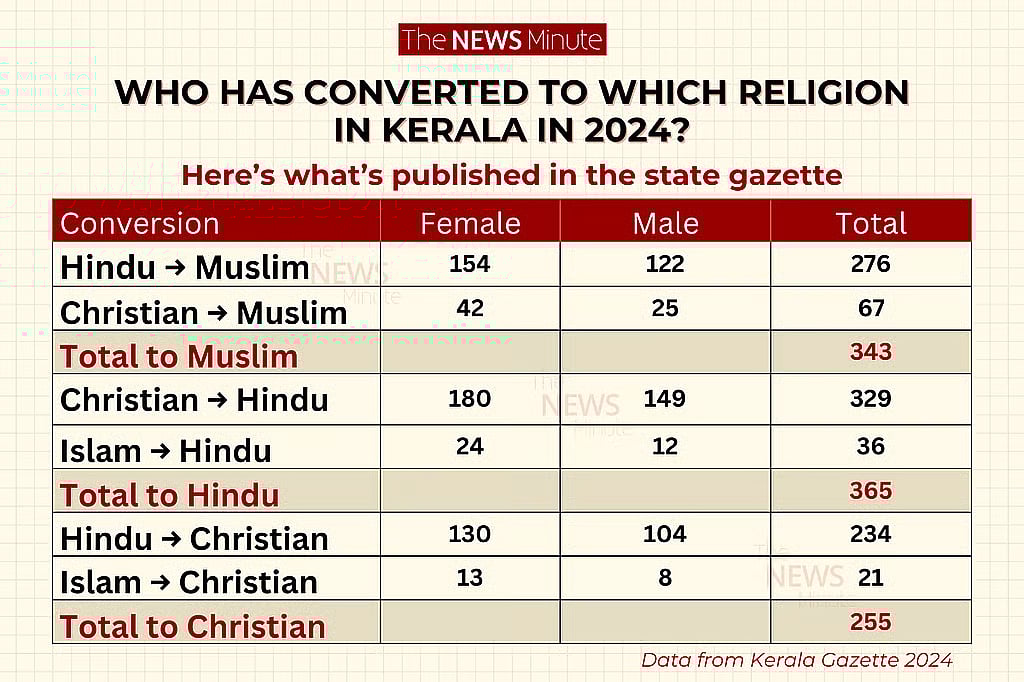
Every act of religious conversion has to be notified in the state gazette, as per law. Our data has been compiled by counting each individual case of religious conversion notified in the gazette.
In 2024, the second-highest number of conversions was to Islam. A total of 343 people converted from Hinduism and Christianity to Islam. Meanwhile, 255 people joined Christianity.
A section of the Christian establishment in Kerala has played a key role in amplifying the narrative of Love Jihad in these last 20 years. However, when government gazette data is examined, the claims made by right-wing Christian groups appear inconsistent.
In 2024, only 67 Christians converted to Islam, of whom 42 were women. At the same time, 234 Hindus converted to Christianity, including 130 women. Additionally, 21 Christians converted to other denominations of Christianity, among them 13 women.
Conversion patterns have remained broadly similar over the past several years, with Hinduism emerging as the biggest gainer.
According to the official 2020 data from Kerala, Hinduism recorded the highest number of new converts, accounting for 47% of registered religious conversions. Of the 506 individuals who formally declared a change of religion through the government gazette process, 241 converted to Hinduism.
TNM also found through interviews with multiple women across the state that the narrative of mass, forced conversions continues to upend lives.
Angel*, who is from northern Kerala, had just completed her graduation when her family discovered she was in love with a Muslim man who was her senior at college. What followed, she said, was not concern but punishment.
“They took me to retreats, counselling centres… there was emotional blackmail, physical abuse, everything. I was locked up for months,” she recalled.
The couple gave notice to marry under the Special Marriage Act, 1954, in a different district where the man had an address. That legal choice, meant to protect interfaith couples, instead became the trigger for a campaign of intimidation.
“After seeing the notice, some people approached my family and said I would be recruited into ISIS. After that, everything escalated and another round of torture started. One day I eloped with him,” Angel said. Soon, relatives and people from the church tracked down the couple’s hiding place.
“They beat us badly and dragged me home. I wasn’t even planning to elope. The torture forced me to do it,” she said.
A parish priest told her she was a victim of ‘Love Jihad’, a claim repeated to justify months of confinement, counselling sessions, and pressure to abandon her relationship.
“Neither my partner nor I had any plans to change our religion. He knew I was spiritually attached to Jesus, he respected that. Our plan was always to get married under the Special Marriage Act. If conversion was the intention, why would we give notice for marriage registration at all?” Angel asked.
Speaking to TNM, her voice trembled – not with confusion but with fear that still lingers two years after her life was torn apart in the name of ‘Love Jihad’.
Exhausted by marathon counselling and relentless coercion, Angel eventually gave up. “I quit the fight and decided to live as they wanted. It has been two years now. I don’t know where he is anymore," she said.
Angel’s story is not an aberration in Kerala. Over the past decade, ‘Love Jihad’, an allegation with no legal or empirical basis, has evolved from a fringe conspiracy into a powerful political tool, deployed by Sangh Parivar linked groups, Christian far right organisations, and sections of the Church to police women’s relationships, marriages, and religious choices.
Creation of ‘Love Jihad’
The origins of the ‘Love Jihad’ narrative are neither organic nor recent. In the book Love Jihad and Other Fictions: Simple Facts to Counter Viral Falsehoods, the authors Sreenivasan Jain, Mariyam Alavi, and Supriya Sharma trace how competing claims around the term’s birth have helped obscure its political use.
While a popular belief in Kerala suggests that the phrase was first coined by sections of the Christian community in the state, multiple reports cited in the book point to Karnataka’s Mangaluru, where the Hindutva organisation Hindu Janajagruti Samiti used the term as early as 2007. Other accounts locate its formal entry into Kerala’s public discourse in 2009, during a Catholic Bishops Council meeting, where a bishop allegedly warned, without evidence, that Muslim men were systematically luring Catholic women.
The same year also saw the first case in Kerala that would come to be labelled as ‘Love Jihad’. Two women, Midhula Madhavan and Bino Jacob, who had married Muslim men, were ordered by the Kerala High Court to temporarily return to their parental homes, despite expressing reluctance. The court directed that the women be allowed to remain in contact with their husbands during this period. That condition, however, was not honoured. When the women were produced before the court again days later, their positions had changed and they chose to go back with their families, raising concerns about coercion and confinement.
In August 2009, the then High Court judge Justice Sankaran asked the Kerala Director General of Police to respond to a set of questions within three weeks, beginning with whether any organised ‘Love Jihad’ movement actually existed in the state. No such finding was established.
Yet the allegation continued to gain political traction. In 2010, then Chief Minister VS Achuthanandan publicly accused the Popular Front of India of attempting to increase the Muslim population through “money and marriages”, lending institutional weight to an unproven claim that has since become a staple of Kerala’s conspiracy discourse.
In the years that followed, several senior church leaders, including Thalassery Bishop Joseph Pamplany, Pala Bishop Joseph Kallarangat, and Idukki Bishop Mar Mathew Anikuzhikkattil, openly invoked the term ‘Love Jihad’ while targeting the Muslim community. The allegation also became a bridge to closer engagement with right-wing groups, marking a shift where a conspiracy theory began functioning as a shared political language.
Surveillance and coercion
Kevin Peter, a leader of CASA, a Christian far right organisation, told TNM that the group works closely with the Rashtriya Swayamsevak Sangh (RSS) and other Hindu organisations to track interfaith marriages involving Muslim men and women from Christian or Hindu families.
“People associated with CASA regularly visit marriage registration offices across Kerala and check the notice boards for applications. If we see women from other religions marrying Muslim men, we collect their address and try to reach their parents. We inform the parents and take up the case,” Kevin said.
Describing the process, he said the first step is to locate the woman. “If it is a Hindu woman, we pass the information to Hindu organisations like the RSS. They also share information with us when they come across cases with Christians. The next step is to involve the parents and search for the woman if she is not at home. If we find her before it becomes a police case, we may even use force to bring her back,” he said matter-of-factly.
“Once the matter reaches the police or court, there is nothing we can do. In court, the woman will say she wants to go with the man,” he added.
Kevin also said that officials in some marriage registration offices assist their efforts by alerting them when applications involving interfaith marriages are filed.
In 2024, when TNM visited the Pala diocese, Fr Joseph Thadathil, the public relations officer of the diocese, said that the church maintained records of women allegedly targeted by Muslim men. “We have a file of young women lured by Muslim men. They are victims of Love Jihad,” he claimed.
This statement came months after Pala Bishop Joseph Kallarangatt publicly accused the Muslim community of engaging in what he termed ‘Love Jihad’ and ‘Narcotic Jihad’.
Kevin further argued that conversion to Hinduism does not invite the same concern. “If a Christian woman converts to Hinduism, there is not much of a problem. It is not a closed community, and she is allowed to continue following her faith,” he said.
Echoing similar views, the Kerala president of the Vishva Hindu Parishad (VHP), Anil Vilayil, told TNM that the organisation actively intervenes in cases of religious conversion. “If we receive information about Hindus converting to other religions, we undertake intensive and extensive efforts to stop it. Across Kerala, we have around 100 ‘Dharma Rakshakas’ working at the ground level. They visit families and intervene,” he said.
A gendered scrutiny
Official data shows that while more women converted from Hinduism to Islam, the difference is marginal. However, several male converts whom TNM spoke to said they faced little to no interference from religious or community groups following their conversion.
A similar pattern is visible among those converting from Christianity to Islam. Of the 67 Christians who converted in 2024, 25 were men. Yet scrutiny and resistance was focussed at women.
The campaign and hate mongering sought to control women’s choices, while men’s conversions have largely passed without visible opposition. In a perverse inversion of the Love Jihad rhetoric, some rightwing commentators even celebrated couples where the woman is Muslim. It marks the emergence of a gendered Islamophobia.
Indeed, online hate campaigns against Muslim women such as ‘Bulli Bai’ and ‘Sulli Deals’ were rooted in the same ideological ecosystem that gave birth to the Love Jihad conspiracy theory.
According Malavika Binny, assistant professor at Kannur University and a writer and activist, what is truly appalling in the love jihad allegations is the complete negation of the agency of young women – most of whom come from educated backgrounds – but are often infantilised as beings incapable of making decisions for themselves and cast as utterly gullible.
“The bodies of young women thus become sites of contestation where the honour claims of multiple communities are played out. Ultimately, this can only lead to a further denial of space, increased cloistering of young women, greater curtailment of their freedoms, and stricter proscriptions on their sexuality,” she said.
History professor Charu Gupta, in a 2009 commentary, compared love jihad claims to the 1920s drive by revivalist Hindu bodies – such as the Arya Samaj – targeting “abductions” of Hindu women by Muslim men. “Whether it is 1920 or 2009, Hindu patriarchal notions appear to be deeply entrenched. In both campaigns, images of passive victimised Hindu women at the hands of inscrutable Muslims abound, and any possibility of women exercising their legitimate right to love and right to choice is ignored.”
Malavika also pointed that in the 1930s, Arya Samajists unleashed a flurry of inflammatory allegations of rape, abduction, luring, “love,” and forced marriages of Hindu women by Muslim “goondas.” This propaganda soon led to the trope of Hindu women being “forced” into marriages with Muslim men, which the Hindu right repeatedly invoked in its discourse on conversion.
“Hindu women became both symbols of purity and figures of victimhood. This served the interests of Hindutva’s hypermasculinity, as it enabled the vilification of Muslims while simultaneously exerting control over young women through the same allegations,” she added.
She also pointed out that a 2021 Pew Research Center study says that 98% of Muslims marry within their own community while 95% of Christians and 99% of Hindus do the same. “On a lighter note, there is no allegation of ‘Love crusade’ when Hindu women marry Christian men even when anecdotal evidence suggests that there is often pressure on brides to convert to the groom’s religion,” she said.
Lives under watch
Sneha* went into hiding for nearly three months after marrying Afsal*, fearing retaliation from Hindu right-wing groups in her locality. She was 23, had just completed her Master’s degree, and says her decision was deliberate and informed.
“Afsal’s family would accept our marriage only if I converted. I was also comfortable converting to Islam. He asked me repeatedly if I was fully willing. This was my choice,” she said.
After she eloped, members of Hindu groups visited her home and convinced her parents that she was a victim of ‘Love Jihad’.
“I was an adult and this was my decision, protected by the Constitution. Then how does it become a jihad?” Sneha asked. She said relatives and local right-wing activists searched for the couple across Afsal’s relatives’ and friends’ houses. “We were constantly on the run. It was terrifying. We stayed in hiding for three months until the case reached the court. Only then was I allowed to go with him,” she said.
Sneha later converted to Islam and the couple married under Muslim personal law. She formally changed her name through a notification in the government gazette. The couple is now preparing to move to the UAE, where Afsal works and where Sneha hopes to find employment.
Anakha*, 25, from Palakkad, converted to Islam in 2023 to marry her partner Thahir*. “I wanted to escape my family. We fell in love and I converted wholeheartedly,” she said.
After students affiliated with Hindu groups informed her relatives about the relationship, members of organisations she identifies as the VHP and RSS intervened, creating pressure at home and in the locality. Anakha left and went ahead with the conversion.
In contrast, men who converted reported far fewer obstacles. Praveen*, 34, from Kollam, converted to Islam to marry a Muslim woman. “There were some objections from relatives, but nothing beyond that,” he said. The couple moved to another city and now live without interference.
Suresh*, a native of Malappuram, who converted after working in the UAE, said his decision was spiritual. “I found the truth in Islam. I faced no opposition,” he said.
Conversions for marriage are not limited to Islam. Anju* converted from Hinduism to Christianity to marry a man from the Syro Malabar Church. “He wanted a church wedding and his parents would not agree to a Special Marriage Act wedding,” she said. Though her parents initially opposed the marriage, they later accepted it. She now practises Christianity.
Sreeja*, who also converted to Christianity, said she is not an ardent believer. “I go to church occasionally, but I continue following Hindu traditions privately. My husband supports me,” she said. While some Hindu groups objected to her marriage, parental support shielded her from sustained harassment.
* Name changed
This report was republished from The News Minute as part of The News Minute-Newslaundry alliance. Read about our partnership here and become a subscriber here.
 Beef force-feeding claim not heard in Kerala: RSS member and former DGP Jacob Thomas