It was SAGAR, then MAHASAGAR and eventually a torpedo that stole the PM’s voice
For years, India’s maritime rhetoric has rested not on jurisdiction but on influence.

O dear PM, where art thou?
Our beloved Prime Minister Modi has always possessed a rather keen instinct for the political stage. Few leaders of the present age understand the choreography of power quite so well. When you see him at an international summit, the sequence of events appears almost like a ritual, choreographed to the minute details. His love for the crowd, the purposeful walk, sometimes folded and sometimes waving hands, and who can forget his insistence on giving every leader a jhappi: all this has become his diplomatic trademark. (Although one must admit, the aforementioned jhappi looks a bit awkward and forced these days.)
And who can forget his penchant for acronyms? One of these was SAGAR, launched in 2015, which stands for Security and Growth for All in the Region. In 2025, SAGAR was upgraded to being MAHASAGAR, which stands for Mutual and Holistic Advancement for Security and Growth Across Regions – increasingly suggesting that India is no longer just a country in the Indian Ocean, but something closer to its custodian.
For much of the past decade, our PM has spoken with growing confidence about India’s role in the Indian Ocean. Military exercises have expanded, which include naval exercises, maritime partnerships have multiplied, and the notion of India as a “net security provider” in the region has travelled widely through his and other BJP leaders’ speeches and policy briefings.
One must admit, this ambition has a certain pazzazz to it. After all, nations that dream to shape their neighbourhoods rarely begin by speaking modestly. But all this image and narrative building was torpedoed by a torpedo two days ago.
In the early hours of March 4, an American nuclear submarine targeted and sank an Iranian frigate in the Indian Ocean. The vessel – IRIS Dena – sank roughly 40 nautical miles south of Sri Lanka’s coast, over 1,200 km away from India. So far, 87 sailors have been reported dead and over 30 have been rescued by Sri Lanka.
But it’s the ship’s itinerary which has put Mr Modi in a small bind, if one may call it that. A few days earlier, the ship had sailed out of Visakhapatnam after participating in India’s International Fleet Review and the MILAN naval exercise. The Iranian sailors had spent their shore leave wandering through the port city like visiting officers everywhere do. They took photographs, bought a few trinkets from the market, and perhaps had a brief taste of Vizag flavour before returning home.
The situation becomes way more confusing considering the fact that personnel from the US Navy also participated in the event. The US, after all, is a member of the Quad (Quadrilateral Security Dialogue) – alongside Japan, India, and Australia – a grouping meant to counter China's influence, promote maritime security, technology, and economic cooperation for ensuring a free, open, and inclusive Indo-Pacific.
Yet here we are: the US, our most important strategic partner, attacked and sank a formally invited naval vessel from a friendly and fellow civilisational state, Iran, in our neighbourhood.
The PM and his meditative silence
Narendra Modi is not usually a quiet man when global events present dramatic material.
Over the years, he has fashioned himself as a leader who speaks early and decisively on international affairs. When a crisis erupts anywhere in the world, Mr Modi typically appears with a carefully crafted response which is firm, confident, and talks about his government. The skill is part of his political method: occupy the moment before someone else does.
Which makes the present quiet much more puzzling.
As of the night of March 5, the Government of India itself had issued no political statement on the sinking of a warship that had only days earlier attended its own naval exercise. The Prime Minister’s Office has remained silent. The Ministry of External Affairs hasn’t offered a formal statement.
It doesn’t mean nothing has happened. Official word so far has come from the Indian Navy, which released a brief operational update, describing its search-and-rescue assistance after Sri Lanka’s maritime rescue centre reported the distress call. Aircraft were dispatched, ships were diverted, and coordination was established with the Sri Lankan authorities to search for survivors.
And it read exactly like what it is, a professional naval situation report, or an operational note. What it does not read like is a government statement addressing the event as a whole, which is curious indeed, especially when a warship that had recently been India’s guest is sunk in waters that India frequently describes as its strategic neighbourhood. Yes, the Navy assisted in rescuing survivors. And still, the political voice which usually narrates such moments remains absent.
Law, influence and 3 questions
Leaders from the Congress quickly criticised the government’s silence, arguing that the sinking of a warship so close to India’s maritime sphere raised uncomfortable questions about India’s regional influence. The language was predictably sharp, with many accusations against the government, and arguing that the sinking of a warship so close to India’s maritime sphere raised uncomfortable questions about our regional influence.
The BJP responded with equal force. It accused the Congress of spreading “blatant lies and misinformation” and insisted that the strike occurred in international waters. “The strike occurred in international waters… not in Indian waters and certainly not under India’s jurisdiction or control,” the statement declared.
Now, technically, that’s correct. Maritime law does not assign responsibility for every naval skirmish occurring in distant waters. The defence offered by the BJP is a legal one, and not a geopolitical one. But for years, India’s maritime rhetoric has rested not on jurisdiction but on influence. The idea of a “net security provider” is not a legal concept under international law. It is a strategic aspiration, the suggestion that certain waters carry a particular country’s presence and weight. When events unfold in those waters, observers naturally expect that country’s voice to be heard.
Beyond these strategic calculations, however, the conflict has already hit home for millions of Indians. Thousands earlier gathered in cities of Uttar Pradesh, Delhi, Jammu and Kashmir, Madhya Pradesh and Karnataka, to mourn the killing of Iran’s Supreme Leader Ayatollah Ali Khamenei and his family who were killed in the strike that preceded the events which transpired in the Indian Ocean. For many in India’s Shia community, Khamenei was not merely a foreign political figure but a religious authority whose death carries deep emotional resonance.
But when some of our fellow citizens mourned, some of the prime minister’s most enthusiastic supporters reacted to these expressions of grief with a familiar tone of derision. The habit of mocking Muslim sentiment has, after all, become something of a political sport in certain corners of the internet over the past decade.
Surely our great PM can clarify whether such enthusiasm for ridicule helps or complicates India’s diplomacy in a region where cultural sensitivities still matter.
But our star voice is missing, and my naive heart cannot reconcile with three questions.
If the Indian Navy was indeed assisting in the search for survivors from the very beginning, why did that information surface only after more than a day of speculation?
If the government believes the incident carries no strategic significance because it occurred in international waters, what exactly becomes of the confident language about India shaping security in the Indian Ocean?
And finally – perhaps the simplest question of all – why has our beloved Narendra bhai, who rarely allows a geopolitical moment to pass without comment, has chosen to remain quiet this time?
Small teams can do great things. All it takes is a subscription. Subscribe now and power Newslaundry’s work.
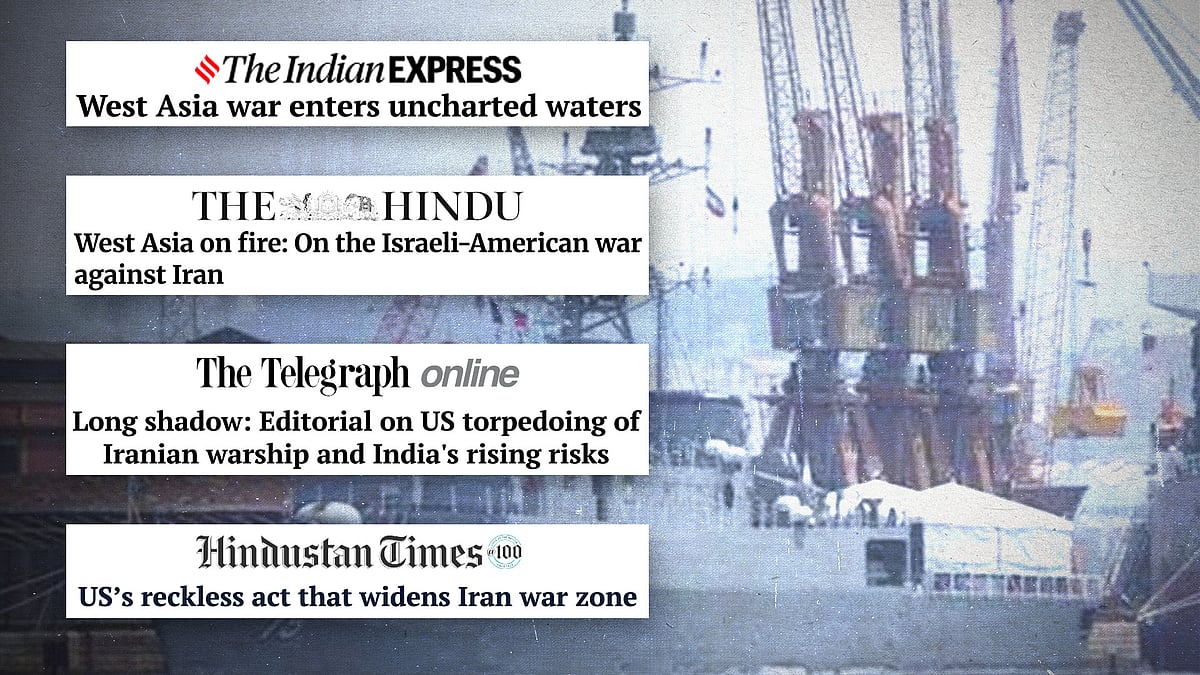 ‘Unlawful and an affront to India’: Editorials critical of US submarine attack on Iranian ship
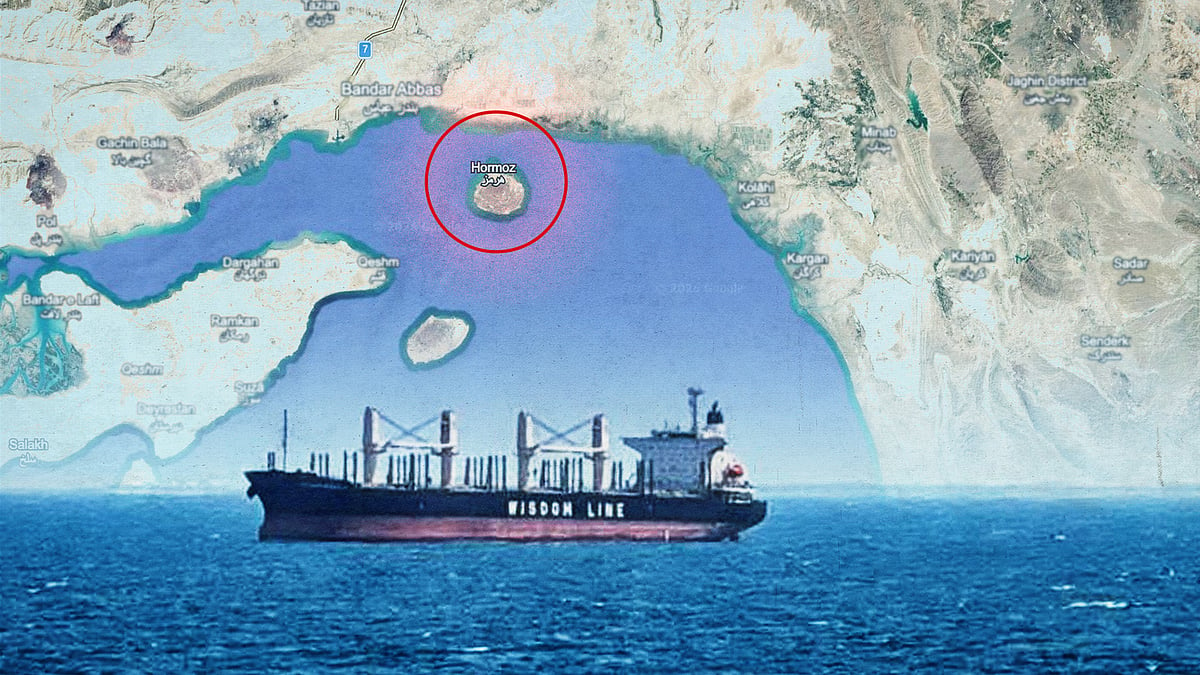 ‘How can we believe he’s dead?’: As Gulf war traps Indian sailors, a family waits