Limited menus, closures: Iran conflict hits Indian hotels as LPG shortage spreads
Hotels and restaurants are facing a severe cooking gas shortage, forcing many establishments to cut menus, reduce operations and warn of possible shutdowns.

Patrons in Bengaluru and Chennai walked into eateries on Tuesday, March 10, only to see some of their favourite dishes missing, smaller menus and talks of closure in a few days. The looming shortage of commercial Liquefied Petroleum Gas (LPG) supply in the face of the war against Iran by the US and Israel has hit hotels and restaurants hard, with many of them looking at closure.
On March 9, the Bengaluru Hotels Association and the Chennai Hotels Association announced that several establishments may be forced to shut down operations due to a shortage of commercial LPG cylinders. Restaurant bodies said supply disruptions have already begun affecting businesses, and similar problems were being seen in cities including Mumbai and Hyderabad.
Unprecedented crisis
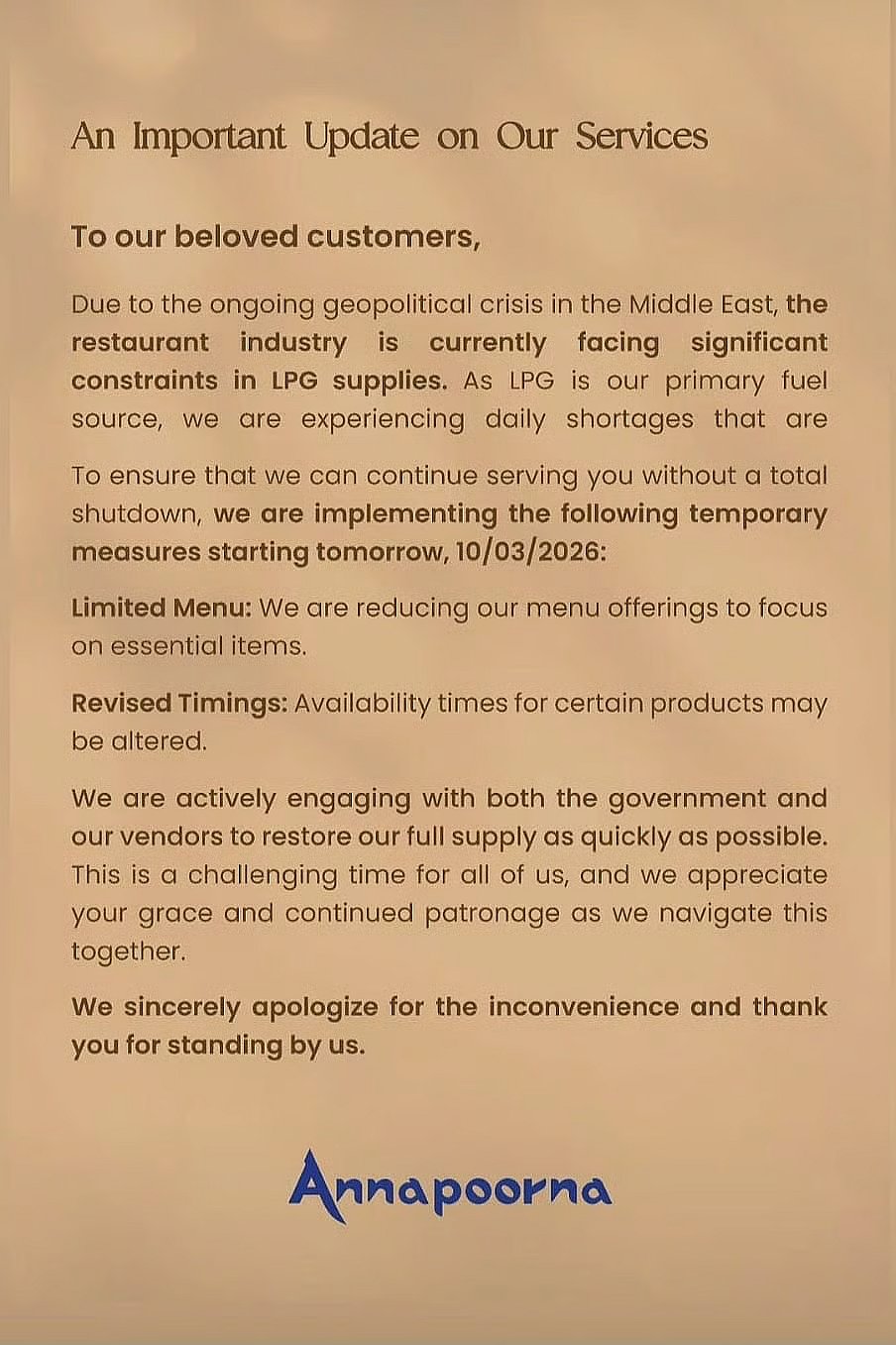
Popular restaurant Annapoorna in Tamil Nadu’s Coimbatore district, in a statement, said that they have restricted their menu and revised timings to avoid a total shutdown. “We are actively engaging with both the government and our vendors to restore our full supply as quickly as possible,” they said. Chennai’s Hotel Ananda had to limit its menu in view of the fuel crisis.
At Chennai’s Crescent Hotel, patrons found a considerably reduced menu list. No shawarma, no porikadi (fried snacks), no parotta, and so it went on.
“We’ve had to cut many items. Our customers support us, and that is why we can do business; otherwise, customers get disappointed and it feels bad when someone comes in thinking of a specific dish, and we have to tell them it's not available,” Raju, a supervisor of the Crescent hotel, said.
The hotel, which requires 10 cylinders a day, was told by vendors that there was no stock of LPG at all. While they did not get delivery on Monday either, they managed to scrounge up some cylinders on Tuesday but soon ran out.
Even if cylinders are available, the prices have shot up. Jomes, manager at Mishwar Hotel in Chennai, said a 47 kg commercial cylinder would cost Rs 4,600 and now the same costs around Rs 5,200.
“This higher rate started two days ago. They have cancelled the discounts and other reductions provided to hotels, and now we are getting them at the MRP. The MRP keeps increasing every day. But we cannot charge more for the food because we are paying more for cylinders,” he said.
The hotel is only serving food prepared in advance and has stopped ‘live’ cooking, which means food prepared when an order is given.
Chef Gurudath, Chef Partner at The Pizza Bakery, Smash Guys and Paris Panini in Bengaluru, said restaurants across Bengaluru are struggling to secure LPG supplies.
“It’s not just us; the entire city has been affected. There’s almost no LPG available in the market right now. No restaurant keeps two or three weeks of stock because we usually get regular deliveries. With supplies suddenly cut, every restaurateur is just trying to get through the day,” he said.
“We are all sourcing whatever we can from wherever it’s available, just to keep operations going. But there’s no clear picture from suppliers. Some say there won’t be a supply for the next 10 to 15 days; others say they don’t know at all,” he added.
According to him, restaurants are trying to reduce gas consumption wherever possible.
“Our pizzas are wood-fired, so we’re running them fully on wood to save whatever gas we have left. These are small measures, but that’s all we can do right now,” he said.
Gurudath said that the current crisis is unprecedented for the restaurant industry.
“There's a lot of uncertainty, and none of us can say how bad things will get or how long it will last. If we had a clear update, we could plan. At the moment, we’re just playing it by ear,” he said.
He added that while the government’s decision to prioritise essential sectors was understandable, the food industry also plays a critical role in urban life.
“The government has said cylinders will go first to hospitals and schools, which is understandable. But the food industry is also essential. A huge number of people in Bengaluru depend on restaurant food. If restaurants shut down, many people will struggle,” he said.
Veerendra Kamat of the Kamat food chain and secretary of the Bangalore Hotels Association said that hotels could not operate with zero gas supply.
“They should not have stopped commercial cylinders so suddenly. If we asked for five cylinders, they could have given two or three. We would have cut down the menu and removed items that consume more gas. Hotels could have managed with that,” he said.
Kamat also warned of the grocery supplies that would go to waste. “This is not just about closing hotels. What will farmers do? They supply nearly 14 lakh litres of milk to hotels in Bengaluru every day, along with vegetables, eggs, meat and greens. If hotels shut, all of that produce will go to waste.”
Hoteliers have been speaking to Karnataka MPs, asking them to take the matter up with the Union government. “They have assured us they will take it up. We were supposed to go to Delhi to meet Union Ministers, but right now we don’t even have time. As of now, no gas has been supplied to any restaurant. By afternoon, most hotels will shut down, and tomorrow 50–60% won’t open at all,” he said.
Small establishments are likely to be hit the hardest. Since they do not have the space to store cylinders, they buy daily. Ali Hussein, who owns a tea store in Thirumurthynagar in Chennai and requires about 12 cylinders a month, said they had been asking for cylinders for the last three days and hadn't received any.
“We get two cylinders every alternate day. But today we have one cylinder in the running, but as soon as that is over, we'll be done. Tea will be closed,” he said.
The manager of a small eatery in Nungambakkam, Dakshin Dosa, Muralikrishnan, said they had only four cylinders left. “Until now, we have not been informed of any stoppages, but cylinders, which usually come early in the morning, haven't come yet. They keep saying it will come. We have mostly transitioned to electric, but it will still be difficult.”
India, the world’s third-largest LPG consumer, sources over 90% of its LPG imports from the Middle East, much of which passes through the Strait of Hormuz. With the route effectively disrupted by the ongoing conflict, shipments of the widely used cooking fuel have come under pressure.
Amid the growing crisis, the Indian Hotel and Restaurant Association has also urged the government to ensure continued supply of piped natural gas (PNG) to the hospitality sector.
“In view of the unavoidable situation arising globally, we humbly submit that the industry may be able to manage with up to 25% curtailment in PNG supply. However, a 100% curtailment or complete stoppage would make it practically impossible for establishments to operate. We therefore request your kind intervention to ensure that the hospitality industry continues to receive at least a minimum PNG supply so that restaurants and hotels can continue functioning and protect the livelihoods of workers,” the association said.
Responding to the crisis, on Monday, March 9, the Union Ministry of Petroleum and Natural Gas directed oil refineries to increase LPG production, particularly domestic LPG meant for household consumption.
India is also attempting to secure alternative supplies from the United States, which currently accounts for about 10% of India’s LPG imports. However, shipments from the US take nearly 45 days to reach Indian ports, compared with less than a week for shipments from the Gulf, Bloomberg reported.
Meanwhile, in an effort to ensure that domestic households are not affected, the ministry has introduced a 25-day inter-booking period for LPG cylinders to prevent hoarding and black marketing.
“The ministry has prioritised domestic LPG supply to households and introduced a 25-day inter-booking period to avoid hoarding/black marketing. Non-domestic supplies from imported LPG are being prioritised for essential sectors such as hospitals and educational institutions,” the ministry said.
The statement added that a committee comprising three executive directors from oil marketing companies has been constituted to review requests for LPG supply from other non-domestic sectors such as hotels, restaurants and industries.
India is also securing LPG supplies from the international portfolios of global energy companies, including the UAE’s ADNOC (Abu Dhabi National Oil Company) and Algeria’s state-run oil and gas firm Sonatrach, among others, according to a senior government source quoted by Moneycontrol.
Fuel price hike
Amid the supply disruption, India has also raised the prices of domestic cooking gas for the first time in nearly a year. Indian Oil Corporation increased the price of a 14.2 kg LPG cylinder in New Delhi by about 7% to Rs 913. Other state-run oil retailers, Bharat Petroleum Corporation and Hindustan Petroleum Corporation, have implemented similar hikes.
Although low-income households will continue to receive a subsidy of Rs 300 per cylinder, they will still have to pay about Rs 60 more, pushing the price of an LPG cylinder for poorer households to around Rs 613.
The price increase is expected to affect nearly 333 million LPG-using households in India. While urban consumers may have access to piped natural gas, higher LPG prices could add to inflation by increasing the fuel component of the consumer price index.
Commercial LPG cylinders used by hotels and restaurants have also become costlier. Prices have been raised by about 6.5% to Rs 1,883 per cylinder, according to Indian Oil. Commercial LPG prices, which are revised monthly, had last been increased by 1.6% on March 1.
This report was republished from The News Minute as part of The News Minute-Newslaundry alliance. Read about our partnership here and become a subscriber here.
 All was well, according to sources (and media that quoted them). Then LPG reality arrived