‘My mother cries on the phone’: TV’s war spectacle leaves Indians in Israel calming frightened families
While many workers describe life under alert systems and shelters as manageable, they are fielding anxious calls from relatives who fear larger attacks.

Mohan Chandpa has lived around a mile from the Gaza border for two months. The 40-year-old spray-painter, who works in Sderot, an industrial town in southern Israel, says the most distressing calls he receives aren't about missile alerts – they are from his mother.
“My mother cries on the phone,” he said. “Recently she called after watching news about massive destruction in missile attacks. She thought the entire country was under attack.”
She had been watching Indian television.
On February 28, when the latest round of missile exchanges between Israel and Iran began, Mohan recalled watching Indian news channels on YouTube. One headline read: “Israel ke Tel Aviv mein tabaahi” – Devastation in Tel Aviv, Iran’s powerful strike. “I was shocked,” he said, “because that didn’t match what I was seeing around me.”
Mohan is one of roughly 18,000 Indians currently living and working in Israel – many employed as caregivers, construction workers and other labourers – caught in an unexpected bind: managing not just the realities of life in a country at war, but the panic generated thousands of miles away back home by dramatic war coverage. Many are fielding a relentless stream of tearful calls and anxious messages.
Preeti (name changed), a caregiver from Darjeeling who has been living in Israel for four years, says the constant calls from worried relatives have become exhausting.
“Living with security alerts is part of daily life here,” she added. “We receive alerts on our phones before sirens sound, and usually have around ten minutes to move into a shelter…In many ways we are safe here. But sometimes I tell them not to watch too much news because it makes them more worried.”
Another worker, Pooja, a caregiver from Gujarat who lived in Israel for more than a year, said the number of calls and messages from family members has increased since the latest escalation began.
“My family knows that I’m safe here.” she said. “But recently my mother called me after hearing from relatives about the worsening situation in Israel. My sister even sent me a reel from an Indian news channel…I have to keep reassuring them that I’m safe and ask them not to panic after watching the news,” she added.
This is not the first time Indian television news channels have faced criticism for their coverage of military conflicts nationally and internationally.
In May 2025, India and Pakistan exchanged airstrikes after a terrorist attack in Indian-administered Kashmir, several television channels turned their studios into mock “war rooms”, drawing criticism from media observers who said the coverage resembled spectacle rather than reporting.
Journalist Geeta Seshu, founding editor of The Free Speech Collective, said the dominant television news channels in India have always been dramatic and sensationalise everyday coverage in a performative way.
“We are seeing a clear attempt to use these ploys to distract from the ground reality of war - whether it is the suffering of people caught in the conflict, analysis of long-term impact of the war or attempts to question our government or hold them accountable for their stand.” She added.
Seshu also pointed to recent instances where Anjana Om Kashyap’s high-pitched assertion of US hostages in Iran as ‘breaking news’ describing the act as a blithely falsified and misrepresentation and have no compunction to air erroneous information.
Some Indian social media creators living in Israel have also raised similar concerns, saying the tone of television coverage has alarmed their families back home.
The debate over sensational coverage has also drawn the attention of policymakers.
The Ministry of Information and Broadcasting recently asked the Broadcast Audience Research Council (BARC) to temporarily suspend reporting Television Rating Points (TRPs) for news channels, citing concerns about the impact of sensational coverage.
However, critics question how practical the move will be, as TRPs remain the lifeline of the television news ecosystem.
Geeta argued that these newsrooms need to be very responsible and accurate with facts. “Jingoism puts people in danger and sensitive reportage is the need of the hour.”
Sensationalism and the spectacle of war
Media scholars argued that sensationalisation of news has a long history linked to the emergence of yellow journalism.
A S Pannerselvan, director general of Chennai Institute of Journalism and former reader’s editor at The Hindu, linked this to the globalisation that created worldwide competition, a 24-hour news cycle, and global audiences, pushing media to turn events, especially crises, into dramatic “spectacles” to attract attention.
“To portray war as a spectacle started in 1991 during the Gulf war known as CNN effect (1991). It has become a template and started a downward spiral,” Pannerselvan said.
He also pointed to structural changes inside newsrooms. “Earlier, many organisations had editorial layers such as standards editors or readers’ editors who could question coverage. In many television newsrooms those roles have gradually disappeared.”
The consequences, he said, extend beyond ratings. “It often overlooked human suffering. There is nobody to talk about the dividends of war mongering countries…nowadays there is no space for humanity, no attempt for potential reconciliation during the conflict coverage…we have gone beyond TRP and have become numb. We like to watch people fighting and that is the inhuman attitude of the media.”
Yet critics argue that the persistence of spectacle-driven coverage raises larger questions about regulation and accountability in the television news industry.
Geeta Seshu believes authorities are often reluctant to confront the problem directly. “The Indian government’s feeble and ineffectual response to this kind of coverage was to suspend BARC’s TRP ratings for a month, but at least it acknowledged sensationalist reportage,” she said. “I guess the government, which usually does absolutely nothing to rein in these channels, is worried about the impact of this completely OTT coverage on its geopolitical balancing acts.”
For media observers, the problem reflects a deeper shift in how conflicts are framed for television.
“In these 25 years I haven’t seen any decent coverage of a conflict on Indian television,” Pannerselvan said. “News channels have lost empathy towards ordinary people caught in wars.”
Complaining about the media is easy. Why not do something to make it better? Support independent media and subscribe to Newslaundry today.
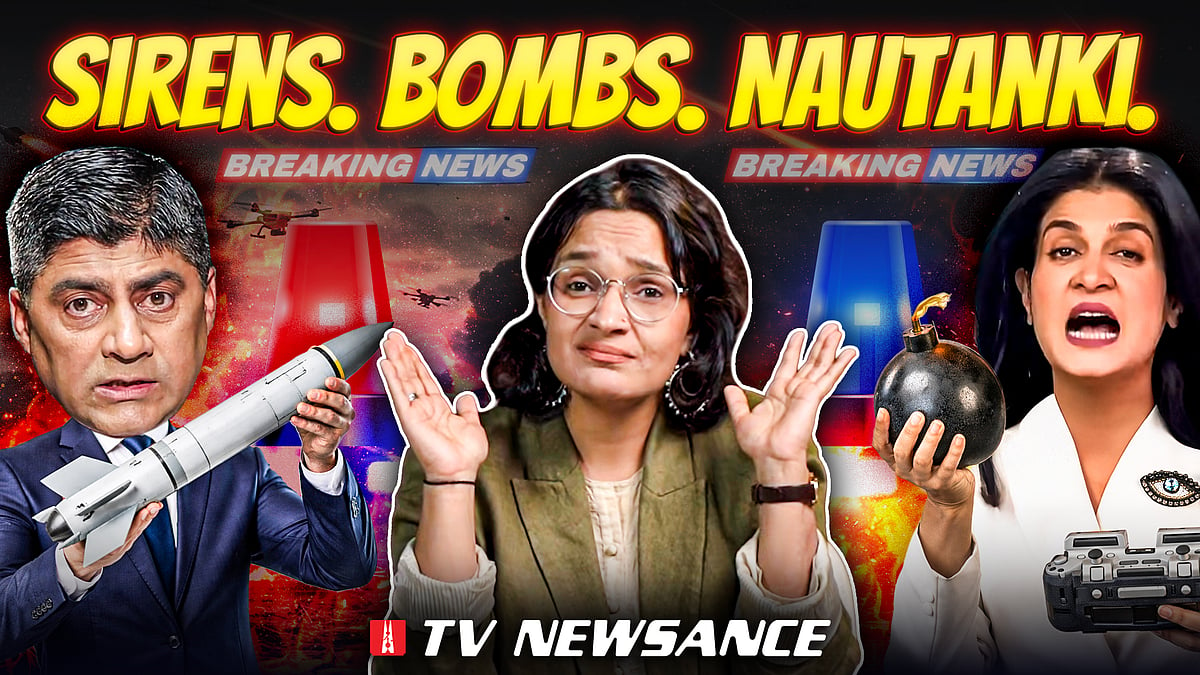 TV Newsance 335 | How TV news went full tabahi mode on the Iran-Israel-US war