The case of the missing Rs 80 lakh crore: Who shrunk India’s consumption economy?
The data finally admits what your pockets already knew.

On February 27, 2026, a new gross domestic product (GDP) series with 2022-23 as its base year was unveiled. This replaced the previous series with a base year of 2011-12. GDP is a measure of the size of an economy. The base year is a fixed year used to compare prices and measure how much an economy actually grows.
While much has been written in the media about this new GDP series, a very basic point has been missed. One wonders why.
The simplest definition of GDP is the sum of private consumption expenditure, government expenditure, investment and net exports (exports minus imports). Private consumption expenditure is by far the largest component of India's GDP.
In 2025–26, the current financial year, private consumption expenditure as per the new GDP series is expected to be Rs 195.8 lakh crore in nominal terms not adjusted for inflation. Private consumption expenditure is the money you and I spend on buying things. A robust growth in private consumption expenditure suggests the economy is doing reasonably well.
Now, as per the old series, the private consumption expenditure is expected to be at Rs 219.6 lakh crore. This basically means that in 2025-2026, the private consumption expenditure as per the new series is 10.9 percent lower than the old series. This is not an isolated phenomenon for 2025-2026.
The new GDP series currently covers four financial years, from 2022-23 to 2025-26. In each of these financial years, private consumption expenditure is lower by around 9.6-11.5 percent compared to the old series.
In 2024-25, private consumption expenditure under the new series was Rs 179.7 lakh crore, 11.5 percent lower than the old series estimate of Rs 203 lakh crore. The figures for 2022-23 and 2023-24 are each 9.7 percent lower.
So, what does this mean?
First, the old GDP series was overestimating the money you and I have been spending on buying things. And this overestimation was huge. The new GDP series has hopefully been corrected for that.
Second, everyone who has been pointing out that all is not well on the private consumption front in India has proven to be right: in fact, the government’s own data shows it now. Indeed, a whole host of real numbers, which are not theoretical constructs like GDP, have been pointing towards this over the last few years.
The domestic sales of two-wheelers – motorcycles, scooters and mopeds – peaked in 2018-19 and haven’t crossed that figure since. From the looks of it, the 2025-26 sales will also not cross the 2018-19 figure.
The domestic sales of small cars also peaked in 2018-19. In 2025-26, the sales are nowhere near the 2018-19 peak, despite the cut in the goods and services tax in September 2025.
The net sales of around 4,700 firms listed on the stock market have been growing at less than 10 percent for close to three years now, though the growth has improved through 2025-26.
The non-suburban traffic of Indian Railways peaked in 2012-13 at 3.94 billion. It hasn’t crossed that number since. It’s expected to be at 3.32 billion in 2025-26.
The mobile phone teledensity peaked in 2017-18. Finally, the volume growth of the Fast Moving Consumer Goods Companies (FMCG) has been nothing home to write about over the last few years. The volume is basically the number of units of products sold.
Third, many economists, corporate executives and those in the business of managing other people’s money (OPM), tried to pass off the consumption growth slowdown as the premiumisation of the Indian economy. But that was basically hogwash.
A small section of the economy was buying more expensive goods than before, but that didn’t mean the Indian economy was getting premiumised. Yes, Apple was selling more iPhones in India, with many youngsters buying it on a loan, but that did not mean that more smartphones were being sold. It’s important to be able to make this basic distinction.
But then the OPM wallahs and corporate executives are trained and incentivised to be in a perpetually optimistic mood. Given that, they can’t help themselves.
Fourth, if we were to add the total private consumption expenditure from 2022-23 to 2025-26, the figure we get under the new series is Rs 80.7 lakh crore lower or 10.5 percent less than the figure under the old series. This is the consumption that has now gone missing. How did this happen? Why was the old-GDP series overestimating the size of India’s consumption economy in such a big way?
As Abhishek Anand, Josh Fellman and Arvind Subramanian point out in a recent working paper titled India’s 20 Years of GDP Misestimation: New Evidence, the formal sector was being “used as a proxy for the vast informal sector” and “the triple shocks of demonetization, introduction of the Goods and Services Tax (GST), and the Covid‐19 pandemic caused the performance of the informal sector to diverge sharply from that of the formal sector”.
In simple terms, what Anand, Felman and Subramanian mean is this: Because India doesn’t have much reliable data on the informal sector, statisticians have been estimating its growth using data from the formal sector (large, registered firms). This works only if both sectors move similarly.
But after shocks like demonetisation, the rather botched rollout of the Goods and Services Tax and the COVID-19 pandemic, the informal sector was hit much harder.
So while the formal sector grew, the informal sector struggled, meaning GDP estimates based on the formal sector did not fully capture what was actually happening in the broader economy. This essentially led to such a huge overestimation.
Fifth, the share of private consumption expenditure in India’s economy has shrunk from earlier levels of 60-61 percent to 56-57 percent.
Sixth, despite all this, consumption growth in nominal terms between 2022-23 and 2025-26 has averaged around 9.5 percent. How does one explain that? The data for the new GDP series start in 2022-23, and hence a statistical illusion of growth has been created.
If the base level of consumption in 2022-23 is now materially lower than what we previously believed, subsequent growth rates can look respectable even if the economy is merely climbing back from a deeper hole. In other words, percentage growth may appear healthy, while the absolute size of the consumption economy is smaller than what was previously assumed.
But this statistical effect will become clearer once a back series – data extending to years before 2022–23 – is constructed and made publicly available. If earlier years are also revised downward – which they are likely to be – it would further confirm that the consumption economy has been battered much more than previously estimated. In that case, the recent growth would look less like a boom and more like a gradual climb back to earlier levels.
Seventh, while statistics might suggest what they do, the politicians have an inherent feel for how the economy is doing. And that explains why a whole host of cash distribution programmes have been launched across the country in the last few years.
The politicians clearly aren’t doing this because of the kindness of their hearts. Of course, they want to win elections. They understand that the consumption economy has been badly battered over the years, and that has affected income levels, given that one man’s spending or consumption is another man’s income.
So the mystery is solved. India’s consumption economy didn’t suddenly shrink. The statistics finally caught up with reality. For years, the formal sector was treated as a stand-in for the informal economy, even though demonetisation, GST and the pandemic had battered the latter.
The numbers looked healthy; the economy on the ground clearly wasn’t. While analysts toasted to “premiumisation” sitting in coffee shops sipping overpriced lattes and pour-overs, the actual consumption engine was quietly coughing up blood in the informal sector.
Now the revision quietly admits what two-wheeler sales, small-car demand, railway traffic and a host of other indicators had been saying for years: the consumption story was weaker than advertised. When the back series eventually arrives, it may simply confirm that a significant portion of India’s consumption boom existed only in spreadsheets and on WhatsApp University.
Vivek Kaul is an economic commentator and a writer.
Small teams can do great things. All it takes is a subscription. Subscribe now and power Newslaundry’s work.
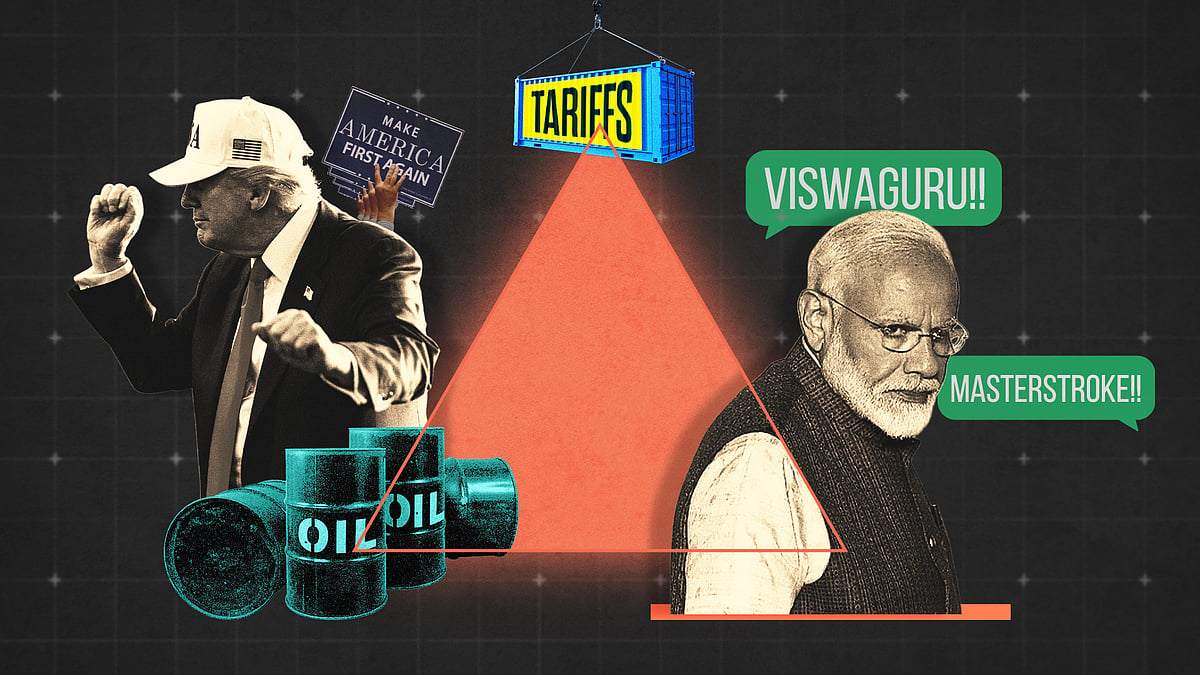 Between MAGA and WhatsApp University: The Impossible Triangle of the India–US trade deal