The Syros paradox: A premium heart in a polarising wrapper
On paper, the Syros has all the markings of a commercial hit. So why is the boardroom graph pointing the wrong way?

The Syros story began quite well, clocking over 5,000 units in the months after its launch. Practical, compact, and well finished, the Syros made it easy to see why it had quickly become a popular choice. Inexplicably, despite all those attributes remaining unchanged, the Syros hasn’t remained the chartbuster that Kia might have hoped. Having used the car for a few days in Delhi, honestly, I’m struggling to understand why.
One reason could be its appearance. Certainly an acquired taste, it is polarising to say the least, much like the Yeti when Skoda had launched it nearly a decade and a half ago. In many ways, the Syros’ boxy silhouette reminds me of the old Czech SUV. I can’t say I liked the look of it from the word go. But it sort of grew on me. I don’t think it’ll make my list of top ten, or twenty, best-looking cars of the decade, but I won’t find it distasteful if I ever find it parked in my garage.
While that is the case on the outside, the inside story is entirely different. It’s instant love. Everything feels plush, the seats feel comfortable, and the twin large screens that dominate the front make the whole thing feel more premium than it really is. There’s plenty of space, too, both up front and at the rear, in spite of its sub-4m length and a wheelbase of 2550mm, which incidentally is quite long for the segment.
Speaking of room, the headroom at the rear is absolutely class-leading, and even turbaned gents will have no difficulty getting used to the back seat. The seat height at both the front and the rear is just right. Easy to get in and get out of. The equipment list is fairly long, too, and the Syros comes across as a well-appointed option for those looking for a compact SUV. Why then are people not lapping this little Kia up?
If the visual aspect of the Kia is one thing that people might have issues with, the very powertrain options the car is available with might be another chink in the Korean armour. It is available with a 1-litre petrol engine with turbocharging and direct injection, or with a 1.5-litre turbocharged diesel engine. That, to my mind, is problematic. To start with, in an environment that is increasingly hostile to diesel engines (sometimes even irrationally), as in the national capital, an oil-burning option may no longer be the ace in the pack it once was. But beyond this, I’d reserve judgment on the diesel option since I didn’t drive it. I had access to the petrol variant kitted out with a lovely 7-speed dual clutch transmission, an automatic, if you like, with all the convenience of an automatic on offer in a city where traffic can be killer.
I actually liked the compact engine quite a bit. It’s punchy enough to feel pleasant. The transmission works really well, with neither jerks when changing gears nor noticeable lag between throttle inputs and gearshifts. In fact, the powertrain combo is fairly responsive, and the little Kia seems eager to get along. However, I don’t think anyone will come close to the 17.68 kmpl that the company claimed for fuel efficiency. In the real world, the drop would be sharp, and I would be hesitant to expect more than 400-500 km on the 45 litres the fuel tank can really hold. I would reckon that the option of a naturally aspirated 1.2-litre petrol might have worked better on that count. As it is, Indian consumers tend to prefer the latter over downsized turbocharged engines, even though, on paper, the latter technology is top-notch.
There’s also the softish suspension at play here, which is great at slow speeds over rough patches of road, but as speeds rise, a certain bobbing creeps in, especially at the rear. Not enough to distract the driver, but just enough to make the rear occupants feel an unnecessary movement. This soft setup doesn’t complement the car’s dynamics either, meaning the punchy engine isn't exactly matched to them, leaving an enthusiast without a smile. It does the job. Adequately. And that’s that.
Finally, there’s the issue of pricing and competition. The Syros operates in one of the most contested spaces in the Indian car market – the sub-4m compact SUV segment. It’s a buyer’s market here, with at least one option from every major mass-market manufacturer. Many of these cost less than the Syros, yet offer not much less than the Kia. As a result, buyers might simply be opting to put their monies in places where they perceive higher value. Is it too late then to turn the Syros’ fortunes around? I reckon a 1.2 petrol option between the diesel and the turbo petrol with direct injection, along with a slightly firmed-up suspension, should do it. Trimming the stickers on each variant wouldn’t be a bad idea either.
Small teams can do great things. All it takes is a subscription. Subscribe now and power Newslaundry’s work.
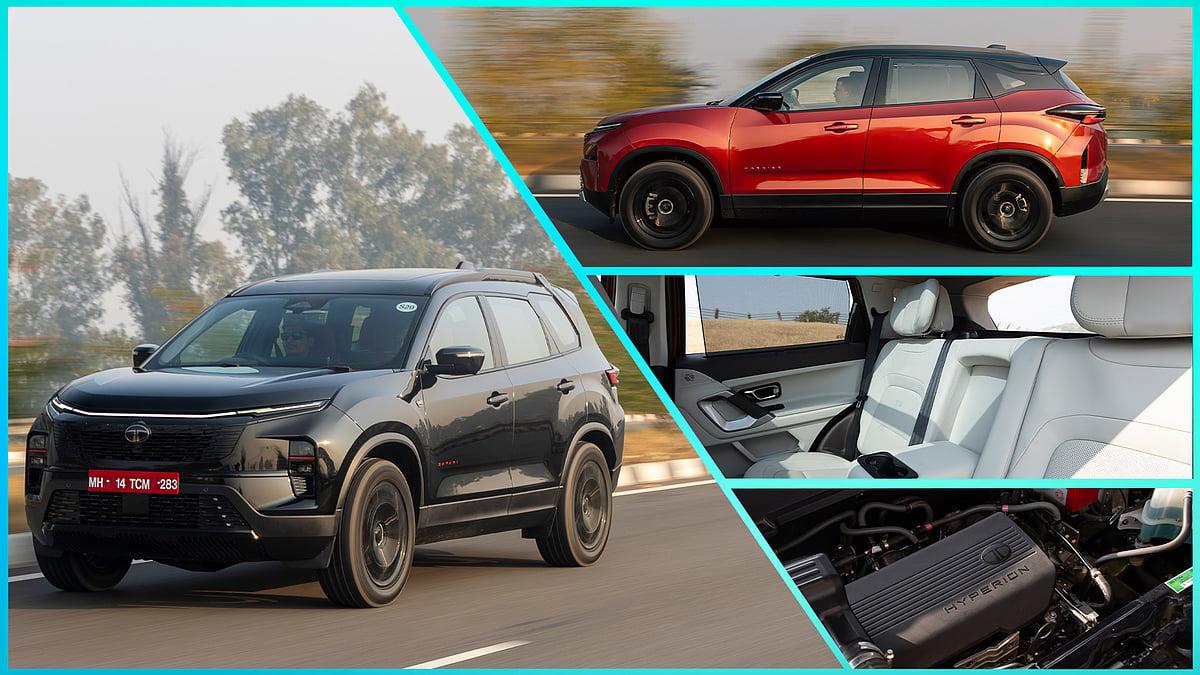 Tata Harrier and Tata Safari 1.5 Petrol: A bold stroke but will it work?