When the bulldozer came for Mahadev’s city
Manikarnika Ghat is rubble. But what broke in Banaras runs deeper than a bulldozer can reach.

On January 9 this year, a bulldozer arrived at Manikarnika Ghat in Banaras – one of the holiest sites in Hinduism – by barge, through the river, because the galis were too narrow for it to enter any other way.
It came for the stone steps first built 700 years ago in 1302 CE. It came for the two circular stone platforms called madhis, mentioned in a 5th century Gupta inscription 1,500 years ago. It collected the rubble after both were drilled down with a high-decibel pile driver, while an increasingly frantic public watched, filmed, and livestreamed. When it was finished, the crew left the way they came – via the river – taking the rubble with them.
Ten days later when I see it, bright blue barricades fence in a plot of mud and dust that has nothing left to guard. The word that officially defines this moment according to the government – is “vikas”.
***
Whether it is the Great Nicobar Project, the latest to be greenlighted; the Aravalli Hills whose standards have been whittled to open up mining; Delhi’s Central Vista where 100 acres of precious public land has been built over by the government; Odisha’s coal-to-chemical Sundergarh; Mumbai’s mangroves; Ayodhya’s central town or Dehradun’s Rispana Bindal Elevated Corridor – whether it is heritage, ecology, ancient urban settlements or tribal habitat – two things define them all.
Their pricelessness and the permanence of their loss.
Built over centuries. Lost to humanity in a few days.
Manikarnika is often said to be older than Banaras itself. In the plain words of Banaras natives: “Yeh dharohar hai” – an inheritance, a legacy, a trust to be passed over generations. Instead, it is just the latest entrant to this terrifying list.
The sight of a bulldozer wielding its bludgeoning arm is no surprise in Uttar Pradesh, since the Chief Minister himself enjoys his celebrated nickname “Bulldozer Baba” – who punishes alleged anti-national “criminals” by demolishing their “illegal” homes on arrest. The Supreme Court has held “bulldozer justice” as a form of “collective punishment” and therefore unconstitutional; yet the practice has not fully ceased. A disproportionate number of those thus ‘punished’ have been Muslims and other marginalised groups.
But no one expected the big beasts would be turned on an ancient Hindu holy site. The surprise quickly turned to shock as the madhis and steps disappeared – to make way for a modern electric crematorium, as part of the ongoing extension of the Kashi Vishwanath Corridor (KVC) project.
The resultant emptiness at Manikarnika, one of the most sacred of Banaras’s 84 ghats, tells a powerful story of stewardship and fiduciary trust.
Its key premise echoes through the city: if the dharohar itself isn’t safe, can the gatekeeper be trusted with the keys?
How development became a dirty word
“Vikas” or “development” was the official reason given for the demolition, as always.
The Ganga floods high here every season, the state of the crumbling buildings neglected for years is incredibly bad, and the messy chaos of 24-hour cremations at Manikarnika genuinely needs a stringent update. This is fact.
The problem is that no one in Banaras sees “development” that way anymore.
The surprising part is, that all through the Manikarnika demolitions, the government remained unaware of this simmering, subterranean local sentiment. The open demolitions indicated that no public discontent was expected.
It also remained equally indifferent to regulatory constraints. Changes are forbidden within 200 metres of the ghat, yet city municipal authorities seemed to have signed off on the destruction of a 700-year-old site. Heritage, law and community were defied without fear of legal repercussions.
What was behind this supreme confidence?
“They took it for granted ki Manikarnika mein waise hi hoga jaise Kashi Vishwanath mein hua tha,” says Vishambhar Nath Mishra, the Mahant of the ancient Sankat Mochan temple and senior professor of electronics engineering at the Indian Institute of Technology - Banaras Hindu University (IIT-BHU).
The Mahant’s reference is to the elephant in the room that lies less than 100 metres from Manikarnika’s bulldozed area – the giant Kashi Vishwanath Corridor that sits like an uneasy spaceship atop Banaras’s galis and ghats. Banaraswasis fall silent when asked about it.
In 2022, during Covid, the government moved swiftly, to build a corridor around the Kashi Vishwanath Temple – the beating heart of Banaras. It used the lockdown to mute protests, opposition, and legal challenges. The corridor became a reality before residents could digest it. Consent was not asked for.
To create this long, flattened corridor, hundreds of homes, several 200-year-old Peepal trees, and a layered maze of galis and their establishments, including “143 pauranik temples”, were razed to create a vast, flat 5.5-acre corridor, high-walled off on three sides in Banaras’s prime heritage zone.
“Uss waqt, log samajh hi na paye ke itna sab hoga – so corridor aise hi ban gaya. Humne socha kuchh attractive banega,” says the Mahant.
Residents were given official compensation and relocated to distant parts while befuddled Banaraswasis were still emerging from lockdowns.
Loss rather than advancement
This new Kashi Vishwanath Corridor was the moment at which the real meaning of “development” became clear.
People began to understand “vikas” as loss rather than advancement - its scorched-earth, flat-levelling demolition taking everything precious with it: neighbourhoods, people, shivlings, and the sense of belonging held deeply dear. That trauma has not left the city.
Four years later, when it comes to Manikarnika Ghat therefore, it doesn’t matter – that the ground is an anarchic hot mess of ash and dust, that stray dogs and sheep sleep on broken steps where the dead are carried, or that the Ganga repeatedly floods two levels of buildings every year.
People don’t want their dharohar – a word used repeatedly, to be destroyed.
‘Banarasi bana chaprasi’: The gap
Yet the state doesn’t understand this loss, doesn’t deem it precious, circumvents dialogue, and drives ahead with yet another demolition at yet another irreplaceable site. A tragi-comic sense pervades the situation.
The authorities believe their shiny new corridor has given them unquestionable legitimacy and popular sanction to carry on with the Manikarnika plan – which has been in the works since 2023. They don’t call them demolitions. They call them “beautification works”.
Yet what the government contentedly thinks is the gold standard is, in reality, a traumatic wound that Banaraswasis must renegotiate and relive every time they walk past it. “Development” is now firmly coupled with “sacrifice” – and only for the citizen. Someone else reaps the benefits.
“Banarsi bana chapraasi,” says a local shopkeeper.
This gap between state intent and popular sentiment was neither anticipated nor calculated in the demolitions at Manikarnika. Expecting the same flummoxed response and ultimate resignation that followed the KVC, the masters of stealth didn’t bother with stealth this time.
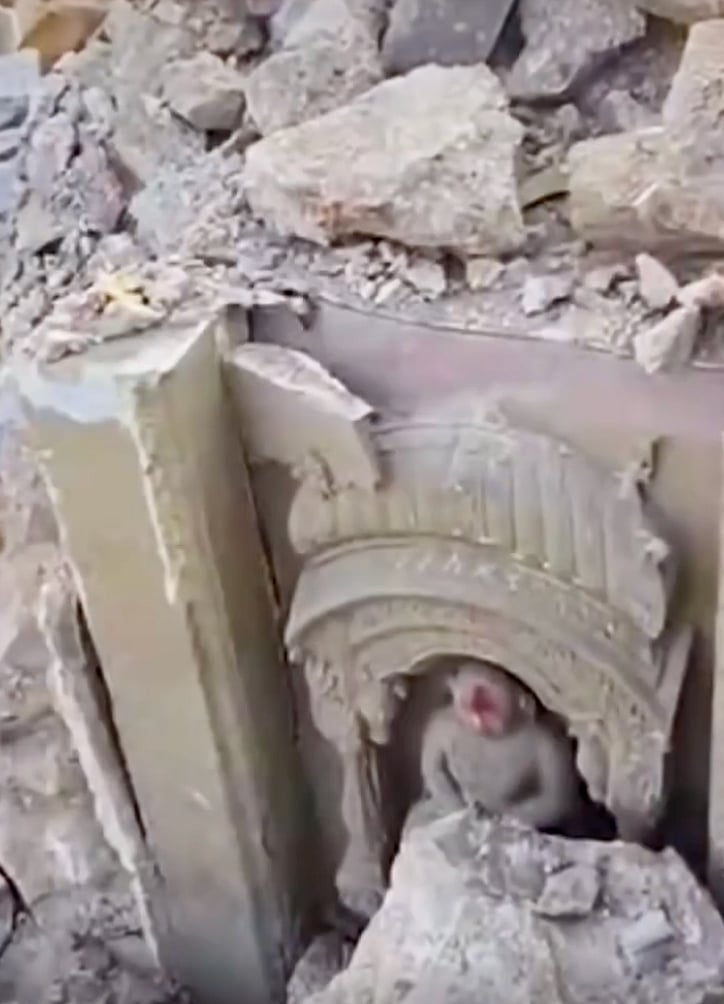
The demolition of the madhis with their sculpted figures of Ma Ganga and Ma Ahilya was done in full public view. The sight of bone-rattling pneumatic drilling piercing through centuries-old stone platforms and goddesses, reducing them to rubble, was witnessed across thousands of reels on Instagram and Facebook. No one representing the state thought the optics could prove difficult.
The emergence of an unexpected reaction
Yet a different result emerged – from a population deeply burned, four years earlier, by the KVC “surprise” wrapped in the shiny packaging of “development”.
It was Rani Ahilyabai Holkar of the erstwhile Indore state who renovated Manikarnika to help the poor cremate their dead. She also rebuilt Kashi’s beating heart, the Vishwanath Temple in 1780 – exactly 111 years after its destruction by Aurangzeb in 1669. In gratitude and respect, she is revered as the “mother” of Banaras.
As images flooded social media and the reactions poured in of shock and disbelief, the Khasgi (Ahilyabai Holkar) Trust, run by Indore’s former royals, rang the alarm bells, condemning “this shameful and disrespectful act” and expressing outrage that the “sacred effigies of Devi Ahilyabai... now lie in the rubble of this haphazard development”.
Trust chairperson Yuvraj Yeshwantrao Holkar arrived on January 14 to take safe custody of any figures that might have survived.
Only then did the scramble for damage control begin in earnest.
In a belated, televised ‘rescue’ mission, the District Magistrate elaborately bowed his head in respect and garlanded two sculpted figures that just days ago had been at the business end of a pneumatic drill – ordered by him.
The Khasgi Trust was then ‘handed back’ custody of two of the four statues, draped in white sheets. Two other sculptures and a missing shivling were either too damaged to be returned intact, or could not be found in the rubble.
Private reassurance vs public arrests
The UP Chief Minister rushed to Banaras – but tellingly, did not come to Manikarnika Ghat. Pandas or priests at the ghat claim he privately gave them assurance that the destruction would be limited to what had already been done. “Unhone isse galat kaha aur apologise kiya ke iske aage kuchh aur nahin hoga,” says Varun, a panda.
But picture hoardings of the new building planned across a vast 3,00,000 square feet on the ghat have made it abundantly clear this is no full-stop demolition. Many of the temples the pandas are custodians of would be facing the bulldozer next.
When pressed to explain his belief that the CM’s promise would be kept, Varun can only repeat his hopes. “Kuchh aur nahin hoga. Yeh ho hi nahin sakta, nahin toh…” he trails off.
The Mahant is not convinced. “Equipment utha ke bhaag gaye,” he says. “Again they will start! They are adamant in erasing the city’s identity and putting their own!”
Once it became clear the ‘development’ narrative wasn’t working, the government’s public response was in sharp contrast to the assurances given to the pandas.
Several of those who had protested at the site and livestreamed on social media were arrested and cases slapped on them to shut down public anger and ensure few would risk upping the ante. In the first few days, no one was willing to speak.
“Banaras mein sukoon ki shanti hoti hai – yeh shanti nahin, sannata hai,” says Varun.
Replacement narratives came racing in. A flood of denials rained down.
The pictures of broken sculptures weren’t real – they were “AI,” said CM Yogi at his press conference.
The figures of Ma Ahilya and Ma Ganga weren’t moortis – merely aakritis or decorative reliefs. “Unhe pooja nahin jaata tha,” said Varanasi District Magistrate Satyendra Kumar – the implication being their loss was not as significant as had been made out.
“Jo kalakriti hatai gayi hai, usko sthapit karne ki punah vyavastha ki gayi hai,” said the MLA Neelkanth Tiwari.
But if this story couldn’t convince its own, how could it convince others?
“Kashi ka concept hi nahin samjhe!” says an angry Mahant. “Kankar kankar mein hai Shankar. Unke liye patthar ho sakta hai, hamare liye poojniya hai. You place value on it only when it is in place. If you put it in a museum, it is a showpiece.”
In Banaras, no one is in any doubt that the ownership of this city is not temporal. This city belongs to Mahadev – not its worldly rulers. He is everywhere or again,“Kankar kankar mein hai Shankar.” No one can usurp that identity, decide from the top down what is right for the city, what its desires are, or the amount of ‘sacrifice’ it can withstand.
This is the turning point where the Kashi Vishwanath Corridor became a liability, its massive presence the visible evidence of what had to be “sacrificed” for “vikas”. Having digested the unthinkable changes it brought to the heart of the city, Banaras has now fully understood that “vikas” is code for a fresh dose of pain.
And it doesn’t seem to have the stomach to digest any more.
This was especially true of BJP supporters who struggled to find a narrative that didn’t scream betrayal – yet having seen everything first hand, didn’t have the heart to swallow the AI story or the stale ‘development’ bait.
Betrayal
Plumbing this sense of betrayal among those committed to the BJP gets easier as you start realising where exactly the wound lies – and how loyalty struggles to patch it, but ultimately fails. All it takes is the scratching of this scab and the repressed anger and grief pour out from people who have seen with their own eyes the casual wantonness of the destruction.
Akshay, a panda whose daily job it is to conduct prayers and rituals, stonewalls when I ask him about Manikarnika. “CM ne keh diya hai ki yeh sab aur nahin hoga – ab kya baat karni hai?” he says. As he starts echoing the standard line about development needing ‘sacrifice’, I ask him a standard question.
“Kashi Vishwanath Mandir jaise?”
“Nahin humne nahin dekha.”
It has been almost four years since the KVC opened. Astonishingly, Akshay – a Brahmin, a panda, who has just toed the official ‘development’ line – has never entered the massive complex that lies a five-minute walk away, defines his neighbourhood, and has become the governing party’s benchmark for development in the state.
“Lekin kyon?”
He ducks his face. Is he crying? Are those tears? I can’t make out because he refuses to show me his face. I’m talking to the back of his neck as he faces the wall. Then he abandons the script completely.
“Man vichilit ho jaata hai. Humein nahin dekhna.”
The same shakiness – the all-is-well front that tries to defend what is indefensible in their own eyes, only to dissolve in minutes into anger and grief – is echoed in conversations with prosperous businessmen, Aghori Babas, Banaras’s Gen Z in the galis, wandering fakirs at the ghats, shopkeepers, peddlers, roamers.
Something has unnerved an army of followers that had outsourced its thinking to IT cell directives. An eye has blinked.
Two words anchor this moment. Manmaani and seva. Impunity and service.
The manmaani is viewed as the government’s wilfulness in forcing something on people that they don’t want. As a reflection on governance, it is a clear expectation of democracy in its original form – where the citizen is at its centre.
In Banaras, no one is in any doubt that the ownership of this city is not temporal. This city belongs to Mahadev – not its worldly rulers. He is everywhere or again,“Kankar kankar mein hai Shankar.” No one can usurp that identity, decide from the top down what is right for the city, what its desires are, or the amount of ‘sacrifice’ it can withstand.
Most of all, no one can build his personal legacy in a city that belongs only to one entity.
“Yeh Mahadev ka sheher hai, koi aur usse apni company jaise nahin chala sakta. Yahan wohi hota hai jo Mahadev chahta hai, kisi aur ki manmaani nahin chalegi,” says a young ascetic from the Aghori Shaivite sect.
The seva is a democratically elected government’s duty to its citizens. If the government doesn’t talk to its citizens once elected, nor feels answerable to them, the reasoning goes that the seva is going elsewhere.
“Sarkar ko hum pahuchayein hain. Agar janta ki seva nahin kar rahi hai toh kis liye bithaye hain?” says Vinod Pandey, a Banaras native for generations and shop owner near the corridor who barely escaped the demolitions.
“Aisa nahin ho sakta ke vikas bhi ho aur hamari sabhyata bhi bach jaaye?” pleads a young IT professional, putting his finger on the pulse of the matter. This simple equation of legacy, heritage, modernity and governance is all that’s required – but it has no takers.
***
Chief Minister Yogi, meanwhile, is interestingly seen as a victim with little say over these Centre-driven projects that bear the imprint of those above him.
“Gujarat lobby jo kehti hai wohi hota hai Banaras mein,” says Pandey. “Dharam ka aadmi hai, dharam ke khilaaf nahin ho sakta.”
Yet there is no rest for the CM’s celebrated emblem – the bulldozer – that bashes on, bringing “development” and “sacrifice” to yet another historic gali, yet another settled neighbourhood.
Even as Manikarnika hogs the headlines, a large section of Dalmandi – an old Muslim-dominated quarter for centuries, with a generous mix of Hindu tenants and shop owners, where Bharat Ratna Bismillah Khan, tabla maestro Pt Lachhu Maharaj, and Nargis Dutt’s mother Jaddanbai, Hindi cinema’s pioneer female composer and actress, once lived – is demolished too, for chaudikaran or road-widening, amid grief, protest and helplessness.
Another day. Another piece of ancient Banaras bites the dust.
This is the first part of ‘Bulldozers in Kashi’, our new reader-powered NL Sena. As Banaras is reshaped in the name of vikas, we’re reporting on who is being displaced and what is being left out. If you think these stories matter, help us report the rest.
 Delhi’s demolition drive: 27,000 displaced from 9 acres of ‘encroached’ land