Noida workers protested for days over one basic demand. Then came the violence
UP CM Yogi Adityanath has said workers must get their due. He also ordered strict action against ‘anti-social elements’.

Since Thursday last week, hundreds of contractual workers blockaded the main road next to the NSEZ metro station in Noida. They stood in the sun demanding one thing: a minimum wage of Rs 20,000.
By Monday, that protest spilled into a wider, more volatile confrontation across Noida’s industrial belt.
Thousands of workers, primarily from the garments sector, reportedly took to the streets across different areas of Phase II, with protests spreading to Sector 62 and causing major traffic snarls. In Sector 84 of Phase I, protesters allegedly set vehicles on fire, with two vehicles reported gutted. During demonstrations, some protesters allegedly vandalised even a police car and office property, and incidents of stone pelting were reported. Police personnel were deployed across affected areas and used tear gas to disperse crowds. Over 50 people have been arrested.
Uttar Pradesh Chief Minister Yogi Adityanath has said workers must get their due and industries must follow labour laws. He, however, directed authorities to take strict action against “anti-social elements” trying to instigate workers.
The escalation came a day after officials from the district administration, police, and the development authority met worker representatives and assured them that their demands would be considered. Gautam Budh Nagar District Magistrate Medha Roopam announced a slew of welfare measures on Sunday, but protesting workers said these left out their primary demand for a salary increase.
Many of the workers were from companies such as Richa Global, Samvardhana Motherson International Ltd and Paramount Products Pvt Ltd. Most of them have factories in Hosiery Complex in Phase 2.
There had also been a general sense of astonishment among the striking workers at how long the protest had gone unnoticed, until it turned volatile.
‘Aren’t they supposed to listen to us?’
“Will they only come here when there is a casualty?” asked Arvind, one of the striking workers. “Isn’t a peaceful protest worth covering? Aren’t they supposed to listen to us?"
Rupesh, one of the participants from labour outfit Mazdoor Bigul, said “the media won't fight our fight”. “If they don’t come, all of us have the media in our own hands. All of us use Facebook, Instagram. So let’s go live,” he told protesting workers.
The protest had received some coverage in prominent dailies though. But workers say discontent had been building for months.
Most protesting workers say they earn close to Rs 13,000 a month. After watching similar protests in Haryana and a minimum wage increase for workers there, the workers at NSEZ factories had been hoping that their own annual appraisals, which usually come around in March or April, would bring a significant raise.
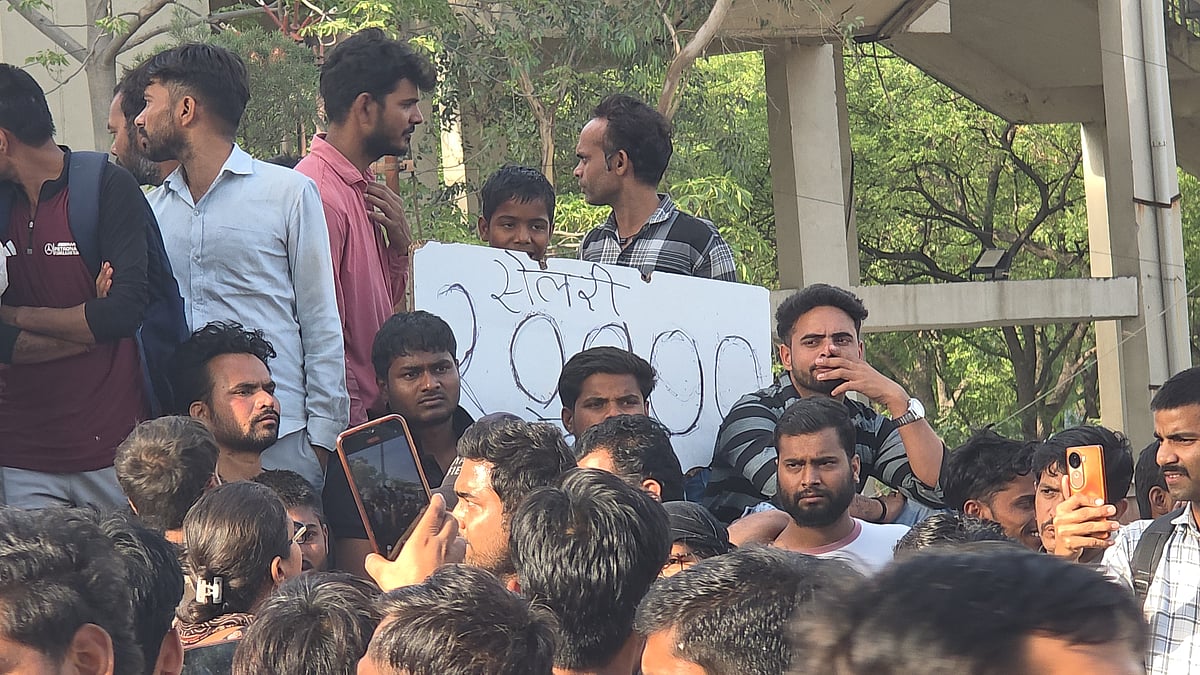
But they were disappointed to see the salaries.
On April 9, a group of 20 to 25 workers from the production team at Richa Global went to meet the HR department regarding their discontent with salaries and the rising cost of living. The response, workers said, was negative. They began protesting inside the factory. The company then put up a notice announcing a wage increase of around 340 to 360 rupees. The workers started protesting again.
By April 10, when workers returned to find the same notice still posted outside the factory gate, half the workforce had gone on strike. By April 11, the factory floor was practically empty.
The cost of living crisis
Most workers in the area pay between Rs 4,000 and Rs 7,000 as rent. Ashiq, a worker at Richa Global, points out that while his wages were increased by Rs 300, landlords raise rent by Rs 500 every year, leaving him worse off.
Anurag shares the same frustration. “There is no real benefit to a salary increment,” he says. “We receive a raise of Rs 250–300, but the landlord always increases the rent by January.” With two children in school, paying roughly Rs 3,500 a month in fees and Rs 5,000 in rent, he is left wondering how to feed his family. This admission season alone cost him Rs 9,000, mostly borrowed.
Prashant Kumar, who previously worked at Ekkaa Electronics, has since left factory work for manual labour. “Is it fair that we work 12-hour shifts in the company, and then spend the rest of our time wandering the streets just to fill our gas cylinders?” he asks. “Are all the people crazy that they are on the street?”
‘Punishing’ conditions inside the factories
Sangeeta, a worker at Richa Global, describes what she calls an unrelenting work environment. “If we are even one second late, our overtime is deducted. We are given no grace period, we must always be on time, always in a rush,” she says, claiming that production targets make it nearly impossible to drink water or use the washroom. "They don't let us step away from the machine for even a second.”
Sangeeta and others also claimed they are compelled to work on their off days, but when auditors visit, they are pressured to say otherwise.
Rambha Devi claims her salary was cut for participating in the strike. Though her payslip shows Rs 21,757 including overtime, only Rs 19,018 was credited. She claims Rs 2,739 was withheld as punishment.
Workers also allege discrepancies in overtime records. Rambha claims she completed 115 hours of overtime, but her payslip shows just 21 hours. Sangeeta reports 80 hours worked, with only 13 recorded.
Richa Global refused to comment when contacted at the number listed on their website.
The Labour Commissioner’s response
Noida Additional Labour Commissioner Rakesh Dwivedi visited the protest site after meeting factory management. He assured workers of double overtime pay, voluntary work on weekly offs, and committees to address complaints of mistreatment.
On the central demand – wages of Rs 20,000 – he said: “We take responsibility to convey this demand to the government. We have obtained written commitments from the companies that when the government implements such a rule, they will be required to pay the increased wages. Give us time to convey this to the government, and give the government time to make a decision.”
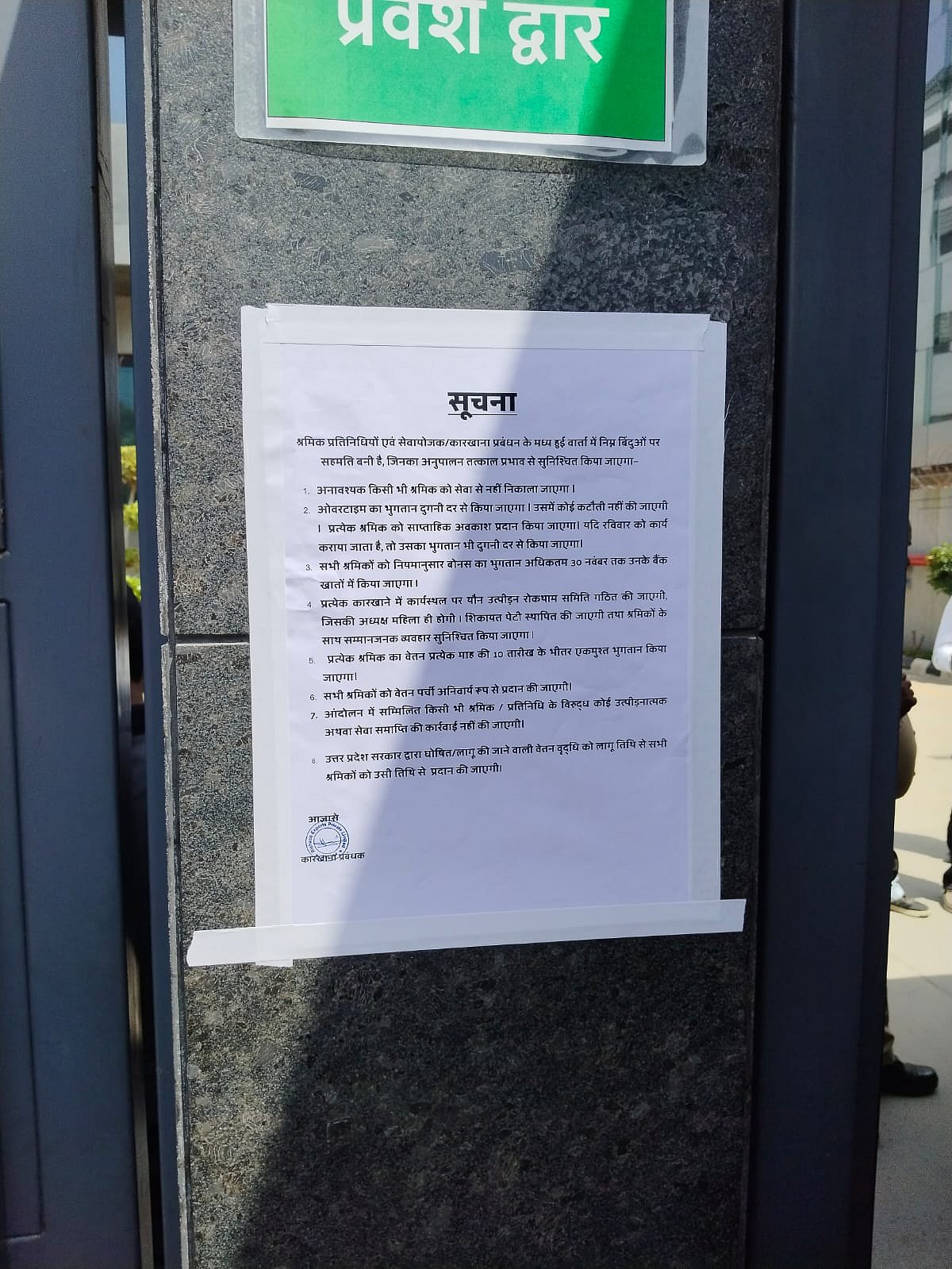
A notice listing eight agreed demands was later posted outside Richa Global. One of these points mentioned that a wage hike will be put into effect the day the state notifies it. The workers remained firm. “We have only one demand, that our salaries be increased to Rs 20,000, and we will keep on striking until that demand is met.”
Elections are not just about who wins, but about the questions that often go unasked – and this time, they matter more than ever. Support our new NL Sena on the five upcoming assembly polls to help us follow the missing voters, the shifting politics, and the stories that could shape India’s future.