Indian firms dumped Rs 1,000 crore of unapproved opioid pills into West Africa’s drug crisis
From licensed pharmaceutical firms in India to informal markets in West Africa, an unapproved opioid has travelled a long and profitable road. Along the way, it has exposed the gaps between regulation and enforcement, and the human cost of a drug trade that rarely faces scrutiny.

This article is the result of a collaboration with Netherlands-based open-source media outlet Bellingcat. Read Bellingcat’s editorially independent coverage here.
Over 60 Indian pharmaceutical suppliers have exported synthetic opioid pills worth almost Rs 1,220 crore – or US $130 million – to West African nations. Most of the destination countries had not approved the drug, and have an opioid abuse problem.
These pills contained tapentadol, classified as a psychotropic substance in India and five times more potent than intravenous morphine. Indian rules cap its manufacture at doses of up to 100 mg for instant-release formulations and 200 mg for slow-release ones. Anything stronger requires a no-objection certificate from India’s apex drug regulator, the Central Drugs Standard Control Organisation (CDSCO).
However, according to records from import-export data provider 52wmb, more than 1,400 consignments of tapentadol were sent to West Africa over three years, from January 2023 to December 2025. Among consignments with known dosages, the majority were above 200 mg, according to export data analysis by Bellingcat – a Netherlands-based investigative outlet focussing on open source data – and Newslaundry.
Most tapentadol pills sent between 2023 and 2025 had the coastal nations of Ghana and Sierra Leone listed as their declared destinations, according to the export cross-checked against records provided by trade data aggregator ImportGenius.
In Ghana, tapentadol – known on the street as “Red” – is driving a surge in abuse, with users slipping into zombie-like states at high doses. Ghana’s Narcotics Control Commission said trafficking has steadily increased over the past three years, with more than 37 lakh 250 mg tablets seized, most traced back to exports from India. The commission said Ghana emerged as both a destination and transit hub while Ghana’s Food and Drugs Authority told Bellingcat it “never issued any permit” for tapentadol “of any strength”. Sierra Leone declared a national emergency over rampant drug abuse in 2024, with tapentadol among unapproved items.
The manufacturing and export puzzle
Of the more than 60 suppliers that exported at least 32.1 crore pills to West African countries, three Indian companies – Syncom Formulations, Puizer Pharmaceuticals and Twin Impex – were listed as the biggest suppliers by cost, their exports collectively accounting for half of all tapentadol shipments analysed during this period.
So how did these shipments get through? The rules, at least on paper, are clear.
The Indian health ministry guidance documents issued in July 2024 placed the onus squarely on exporters, requiring anyone applying for an export NOC to give an undertaking that the medicines “will comply with all the requirements of the importing country including quality standards”. In March 2025, the Union Health Minister said in Parliament that regulatory approval in the importing country was a prerequisite for export NOCs.
Against this backdrop, Newslaundry filed a flurry of RTIs to relevant authorities over several months, trying to establish who had authorised these exports. The companies themselves were also approached to find out if they had permissions.
What emerged is a picture that is hazy, ambiguous and reflective of a serious regulatory lapse.
One RTI reply for CDSCO said only two firms – Torrent Pharmaceutical and Pharose Remedies Limited – were granted approval to manufacture tapentadol for export between 2019 and 2024. Neither appears in the list of 60 exporters mentioned above.
When asked specifically in another RTI if CDSCO granted export NOCs for tapentadol to any of the three top exporters, named Syncom Formulations, Puizer Pharmaceuticals and Twin Impex, the organisation said: “As per the available record, this office has not issued.’’
But RTIs sent to CDSCO’s state zonal offices told a different story. Asked whether they granted permissions to export tapentadol, the Ahmedabad and Bengaluru offices acknowledged issuing 49 and two export NOCs respectively in 2024. But neither did they disclose names of the companies granted these permissions nor the specifics of the countries for which these exports were allowed.
They merely referred to the revised export NOC guidelines issued by the Drug Controller General of India in May and July 2025. Guidelines that still require exporters to submit a document corroborating the drug’s approval by the importing country’s national regulatory authority.
The top 3 exporters
An Indore-based pharmaceutical company in Madhya Pradesh, Syncom Formulations (India) Limited, along with its subsidiaries Vincit Biotech International and Synmex Pharma, shipped nearly Rs 390 crore worth of tapentadol to Sierra Leone, Ghana, Senegal and Benin since 2023, the trade data say. None of these countries approve use of tapentadol.
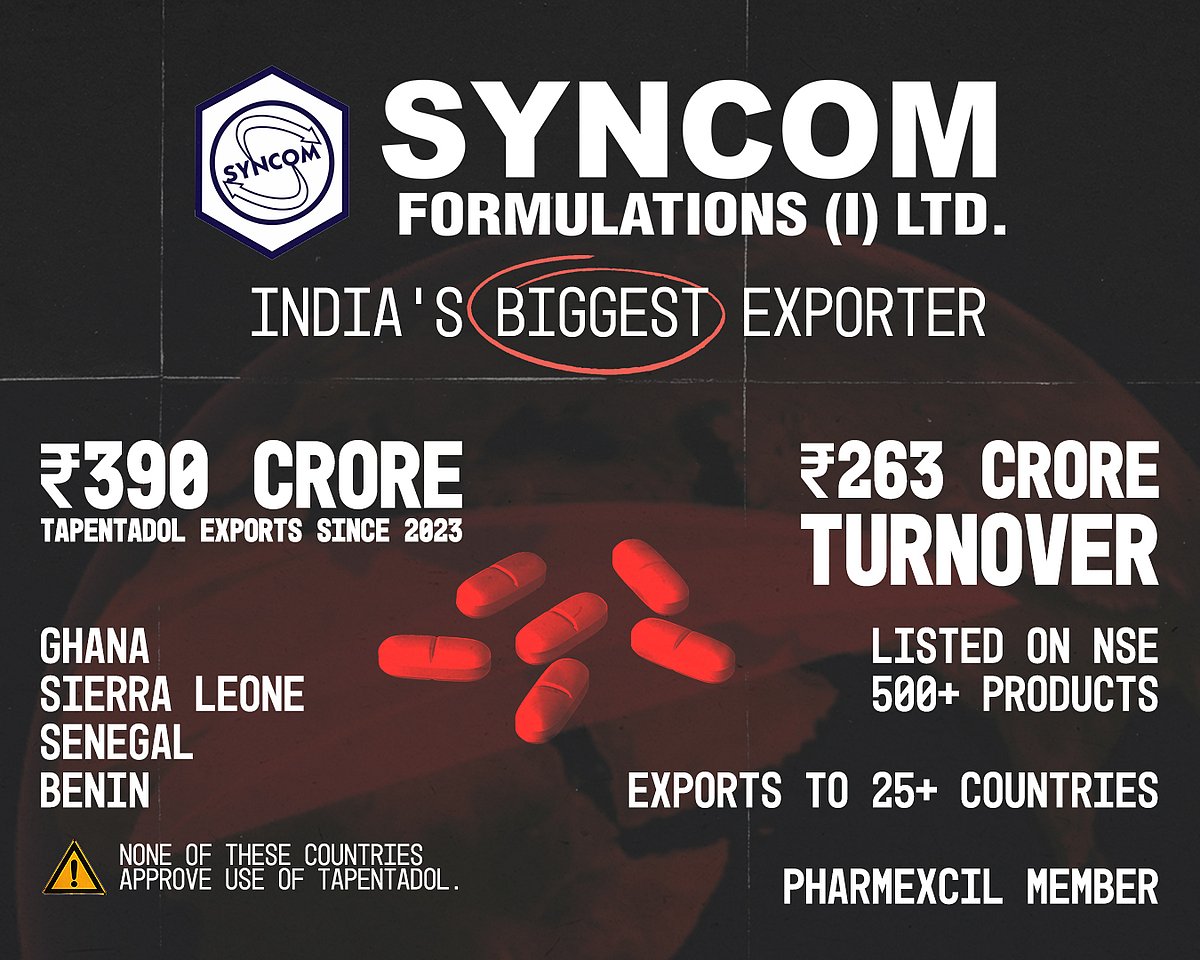
Syncom, which had a standalone turnover of Rs 263 crore in 2023-24, is a listed company with National Stock Exchange of India. It has a manufacturing facility and exports over 500 products to over 25 countries. It is a member of the Pharmaceuticals Export Promotion Council of India (Pharmexcil), a division of the ministry of commerce and industry. A Pharmexcil membership is mandatory for all Indian pharmaceutical exporters.
On its website, Syncom says it is “dedicated to improving people’s lives”. However, until a few months ago, it had listed a combination tablet of tapentadol and muscle relaxant carisoprodol on its international website despite the ban on this formulation by Indian authorities in 2025. In the last fiscal year, the company spent Rs 147 crore on “tapentadol hydrochloride” as a pharmaceutical ingredient – annual reports for the previous years do not refer to this material.
Though these combination tablets have now been removed from Syncom’s website. In an email response, the company said that “the website content may not have been updated promptly to reflect any discontinuation of products, which has thus since been corrected”.
One RTI reply for CDSCO said only two firms – Torrent Pharmaceutical and Pharose Remedies Limited – were granted approval to manufacture tapentadol for export between 2019 and 2024. Neither appears in the list of 60 exporters mentioned above.
The company did not categorically respond to our queries about tapentadol exports but insisted that it abided by all norms. “We manufacture and operate all our products strictly as per our licensed business activities and in full compliance with applicable norms…We rely on the representations by our importers and distributors regarding compliance with their domestic regulations in their own country.’’
Newslaundry’s phone calls to Madhya Pradesh FDA chief Dinesh Srivastava remained unanswered. Questionnaires were sent to Srivastava on November 15, 2025 and Syncom’s additional compliance officer Ankit Bankda on November 17, 2025. This report will be updated if a response is received.
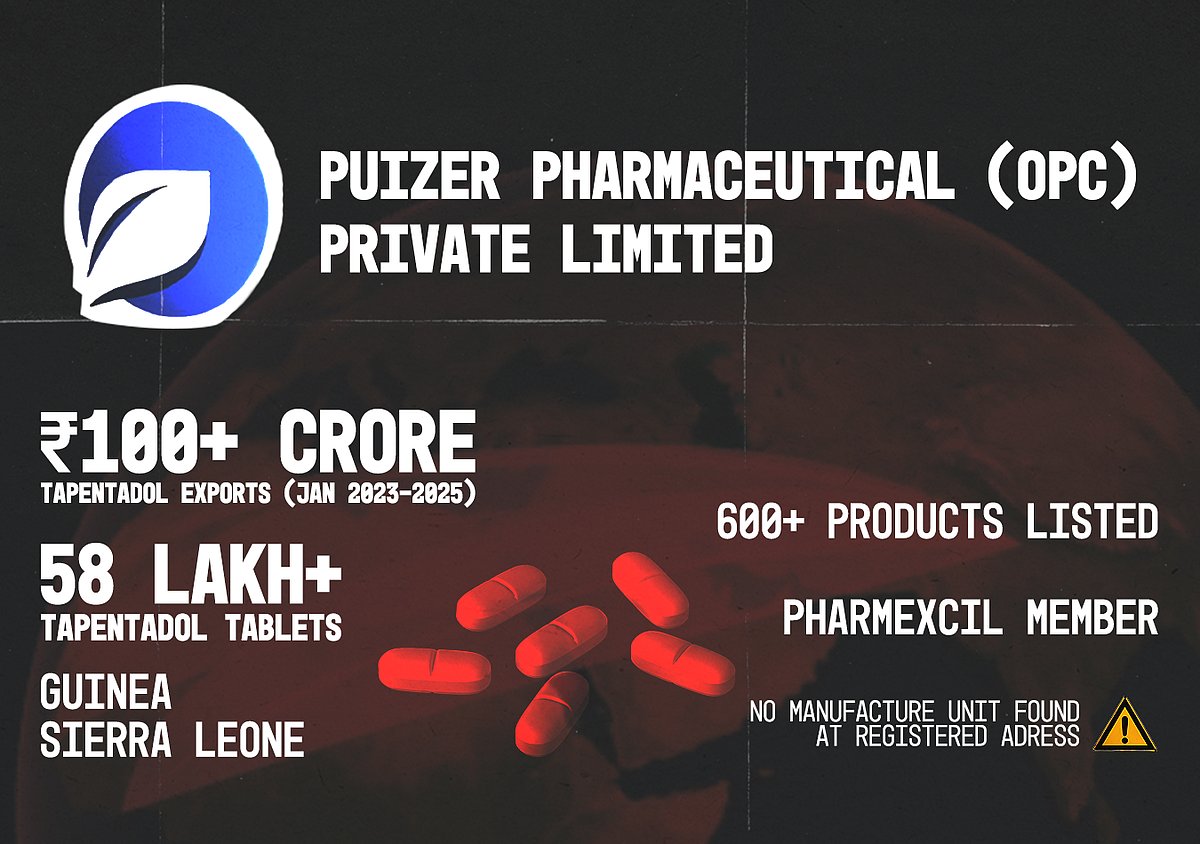
After Syncom, Puizer Pharmaceuticals and Twin Impex rank next among Indian firms by tapentadol export volumes. Each of them exported over Rs 100 crore worth of the opioid between January 2023 and mid-2025, according to 52wmb. Tapentadol exports by the two companies stopped after they were initially approached for comment last year.
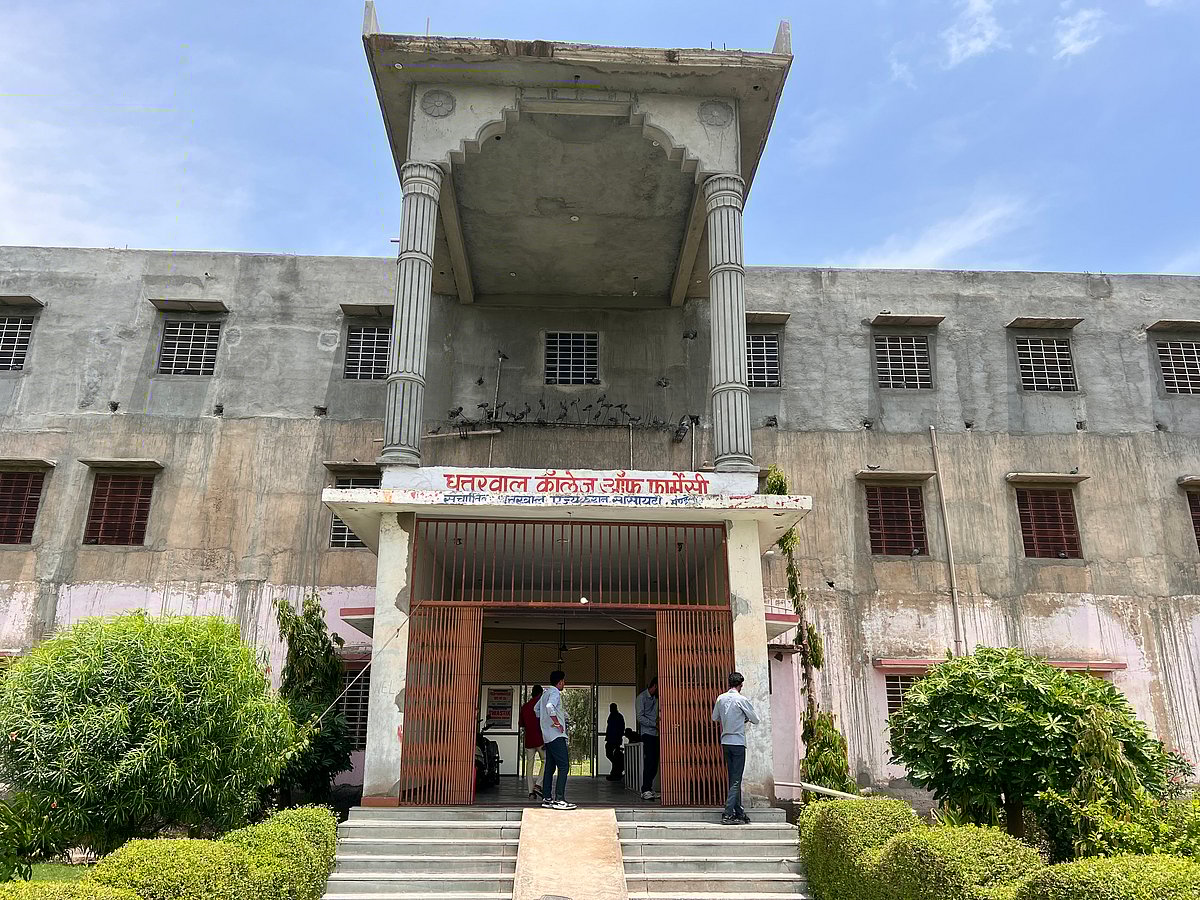
Newslaundry could not locate Puizer’s manufacturing unit but visited its registered office: the Dhattarwal College of Pharmacy, which is affiliated to the University of Rajasthan and has a quiet campus on the edge of an obscure village called Lamba in the state’s Jhunjhunu district. Inside the college compound stood a poster bearing the name Puizer Pharmaceuticals Pvt Ltd, a company that is owned by Sandeep Kumar Dhattarwal and is also a member of Pharmexcil.
A Puizer brochure says the company produces more than 600 products. It shows an extensive list of drugs, including tapentadol. But Puizer’s only recorded export activity in 52wmb’s data is the synthetic opioid: it has airfreighted more than 58 lakh tapentadol tablets to Sierra Leone and Guinea since 2023.
Sandeep Dhattarwal, however, said he had last shipped tapentadol tablets about a year ago and “stopped it when I learnt that this opioid is being misused in those countries”. Asked about export approvals, he said, “I don’t remember exactly about the same as it has been long.” He claimed the “drug must have been approved in those countries” but refused to share documents pertaining to these exports.
Dhattarwal said his company operates from Himachal Pradesh’s Baddi and doesn’t take up manufacturing on its own. “I do third-party so that you don’t need to worry about headaches involved in the manufacturing process,” he told Newslaundry.
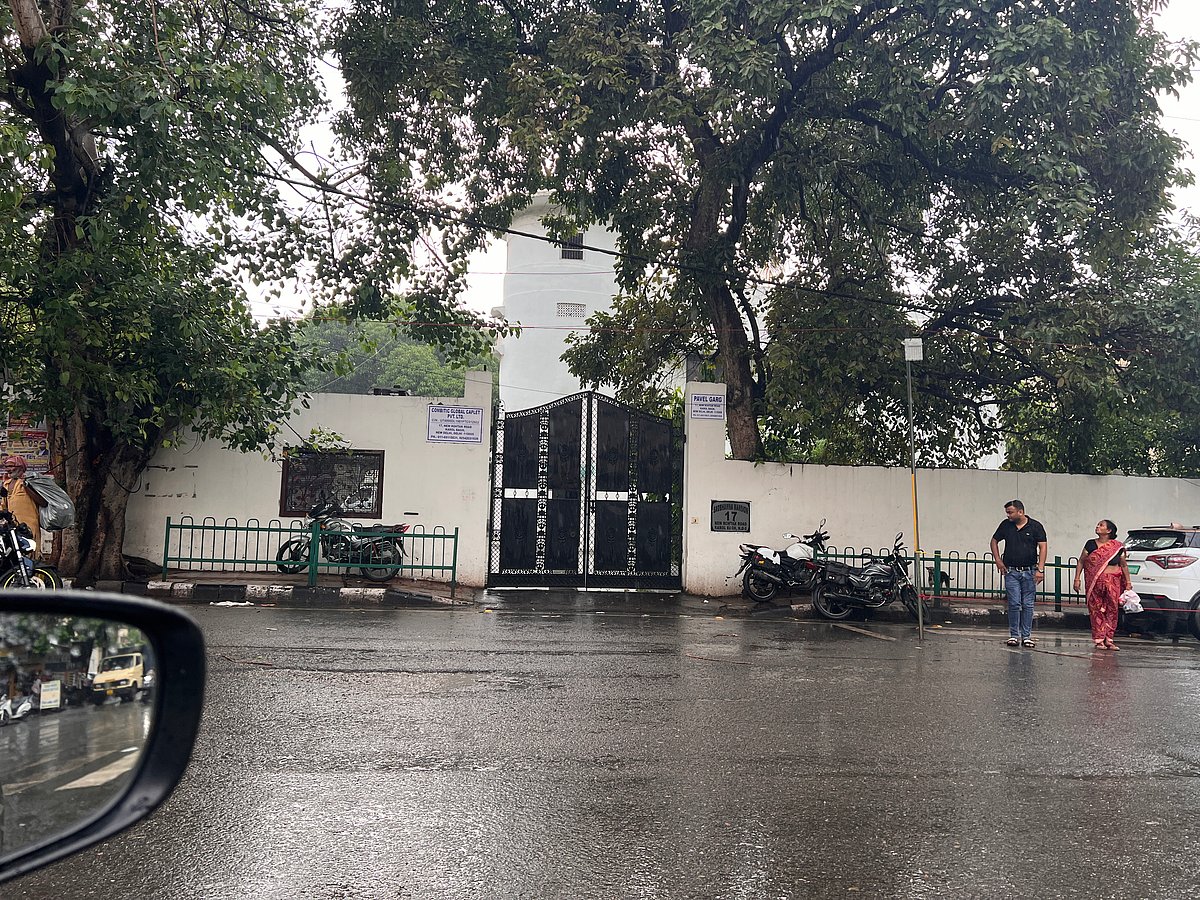
This third-party manufacturing happens at another address listed on the Puizer website, in Haryana’s Sonipat. A visit to this address suggests the facility is run by another company called Combitic Global Caplet Pvt Ltd. It is a setup that can be described as a loanee arrangement in Indian pharmaceutical manufacturing. According to a CDSCO document, Combitic is a ‘loanee’ for Puizer, allowing the latter to use the former’s manufacturing facility.
A senior FDA official explained, “Suppose I have a manufacturing company and you don’t have it. But still you want to manufacture drugs in your name. Then you will take a license with my company. The manufacturing facility and technical portion will be provided by me to your company.”
RTIs sent to CDSCO’s state zonal offices told a different story. Asked whether they granted permissions to export tapentadol, the Ahmedabad and Bengaluru offices acknowledged issuing 49 and two export NOCs respectively in 2024. But neither did they disclose names of the companies granted these permissions nor the specifics of the countries for which these exports were allowed.
Combitic has its own chequered history though. In November 2024, the Ministry of Chemicals and Fertilisers informed Parliament about six pharma companies which were blacklisted by the government for providing substandard drugs to Jana Aushadhi Kendras under Pradhan Mantri Bharatiya Janaaushari Pariyojna. The list included Combitic. In 2010, the company was also found to have supplied fake medicines to Pakistan.
Combitic is owned by one Pavel Garg, who calls himself a “pharmaceutical manufacturer, exporter and real estate developer” on social media. Garg’s home in Delhi’s Karol Bagh is also the company’s registered address. On Facebook, Garg has posted pictures with top BJP politicians, including Union ministers Amit Shah and Manohar Lal Khattar and former Haryana chief minister Nawab Singh Saini.
The third company, Twin Impex, exported tapentadol worth over Rs 108 crore to Sierra Leone, with some pills also sent to Senegal and Ghana. But Twin Impex is not even a member of Pharmexcil. In fact, the Registrar of Companies records show that it was dissolved way back in 2018.
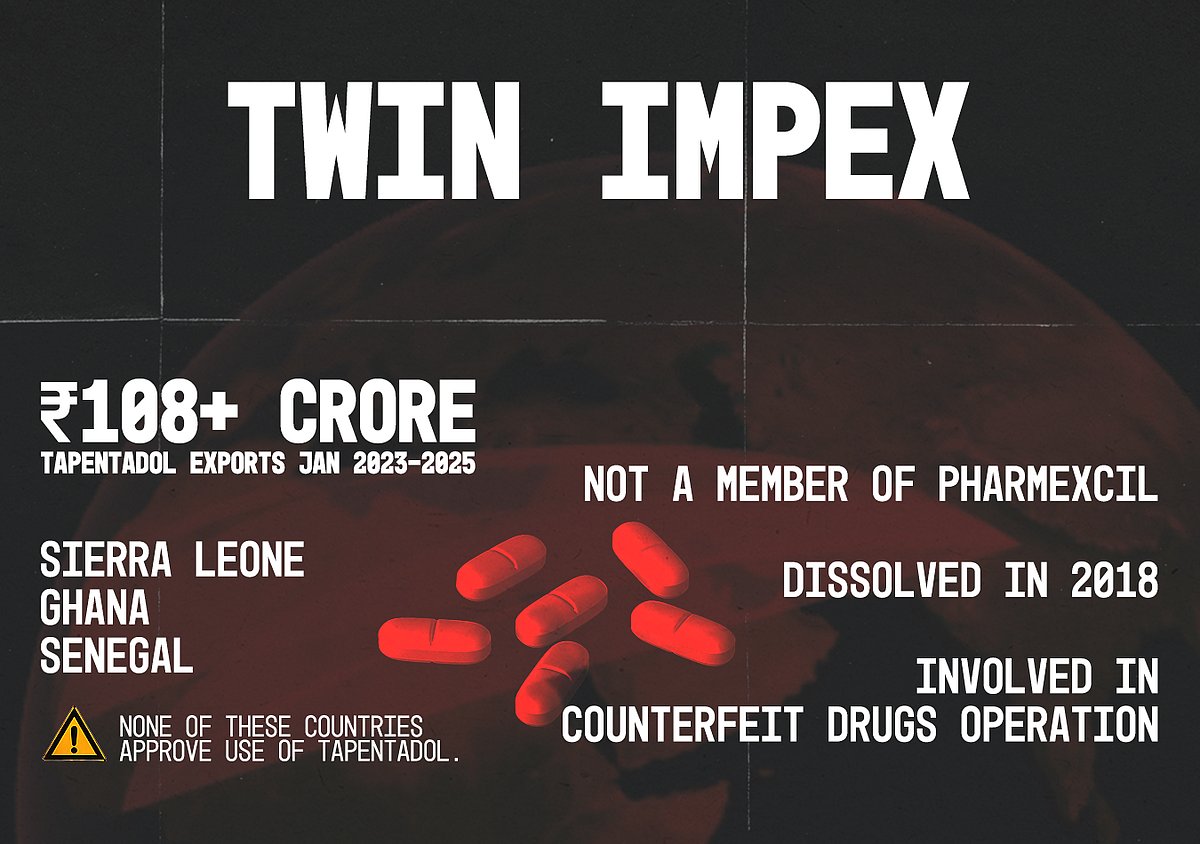
Twin Impex and its director Vijay Devnani were convicted of trademark fraud in 2018 when the Bombay High Court ruled that the company had been involved in a counterfeit drugs operation. The court had called Devnani, among others, “fraudsters” and “habitual offenders” and termed their actions as a blatant disregard for public health and safety.
The other exporters
Among other major Indian exporters were Careium Pharmaceuticals Pvt Ltd, Oncera Healthcare Pvt Ltd and PRG Pharma Pvt Ltd.
PRG Pharma shipped around 7.4 lakh tapentadol pills to Ghana in 2024 and 2025, valued at nearly Rs 62 crore. Curiously, the company is linked to Maiden Pharmaceuticals, whose cough syrup had allegedly killed 69 children in The Gambia. PRG’s balance sheet for the year 2022-23 mentions Maiden Pharmaceuticals as a related party and described the relationship as “enterprises which are owned, or have significant influence or or are partners with key management personnel and their relatives”. PRG director Manish Goyal has a majority stake in Maiden, which in February 2025 renamed itself as CureClip Pharmaceuticals. Naresh Goyal, also a director in CureClip, used to hold 50 percent shares in PRG but now has 5 percent.
Hyderabad-based Oncera Healthcare Pvt Ltd was incorporated in 2022. It has exported tapentadol worth nearly Rs 43.5 crore to West African countries.
Sandeep Dhattarwal said he had last shipped tapentadol tablets about a year ago and “stopped it when I learnt that this opioid is being misused in those countries”. Asked about export approvals, he said, “I don’t remember exactly about the same as it has been long.”
Its balance sheet mainly lists its expenses for “purchase of stock in trade”. This indicates that it is more of a merchandise exporter without having its own manufacturing facility. The company’s ownership has changed within a year. Two owners - Muujahid Baig and Naomi Raul Bhatkar - transferred all their shares to one Ndubbueze Precious Onyechuukwugoziri, who incidentally had given Rs 10 lakh at the time of incorporation.
The other exporting firm Careium has seen a huge jump in revenue since its incorporation in 2021 – from Rs 1.27 lakh to Rs 40 crore within four years. The company supplied about Rs 92 crore ($9.78 million) worth of high-dose tapentadol to Ghana and Benin between 2023 and 2025. Though the company’s website does not list tapentadol among the medicines exported to West African countries. It is owned by one Manish Gupta and Maheshwari Kumar M Mishra, with both holding 5,000 shares each.
Careium was also found to be supplying large quantities of the tapentadol and carisoprodol combination to Ghana in 2024 and January 2025. India banned the manufacture and export of this dangerous mix after the BBC exposé of Aveo Pharmaceuticals in February 2025.
Newslaundry sent questionnaires to Oncera, PRG Pharma, Careium and Syncom on August 29. Queries were also sent to Twin Impex and Combitic on October 15, 2025. This report will be updated if a response is received.
Careium has seen a huge jump in revenue since its incorporation in 2021 – from Rs 1.27 lakh to Rs 40 crore within four years. The company supplied about Rs 92 crore ($9.78 million) worth of high-dose tapentadol to Ghana and Benin between 2023 and 2025. Though the company’s website does not list tapentadol among the medicines exported to West African countries.
India’s drug and pharmaceutical exports have grown to more than Rs 27,000 crore a year, according to Pharmexcil. However, Dinesh Thakur, public health activist and author of the book Truth Pill, highlighted serious gaps in India’s drug regulatory framework that make it possible for potentially unsafe medicines to be manufactured and exported without proper oversight.
“There is no regulatory framework which checks a genuine importer and counterfeit importer between countries. CDSCO has no law or regulations that allows one to check whether the importer is a legitimate entity or not,” he told Newslaundry.
“Oversight responsibilities are split: the CDSCO is supposed to monitor manufacture and sale, but once drugs are made for export, CDSCO has absolutely no regulatory authority to provide oversight,” he said.
With reporting inputs by Sumedha Mittal (RTI) and Prateek Goyal (comment outreach).
Reporting for this was done until November 2025. Pratyush Deep is a full-time reporter with The Indian Express now.