Press freedom index puts focus on newsrooms telling India’s hardest stories
The bulk of this country remains outside the definition of “news” today.

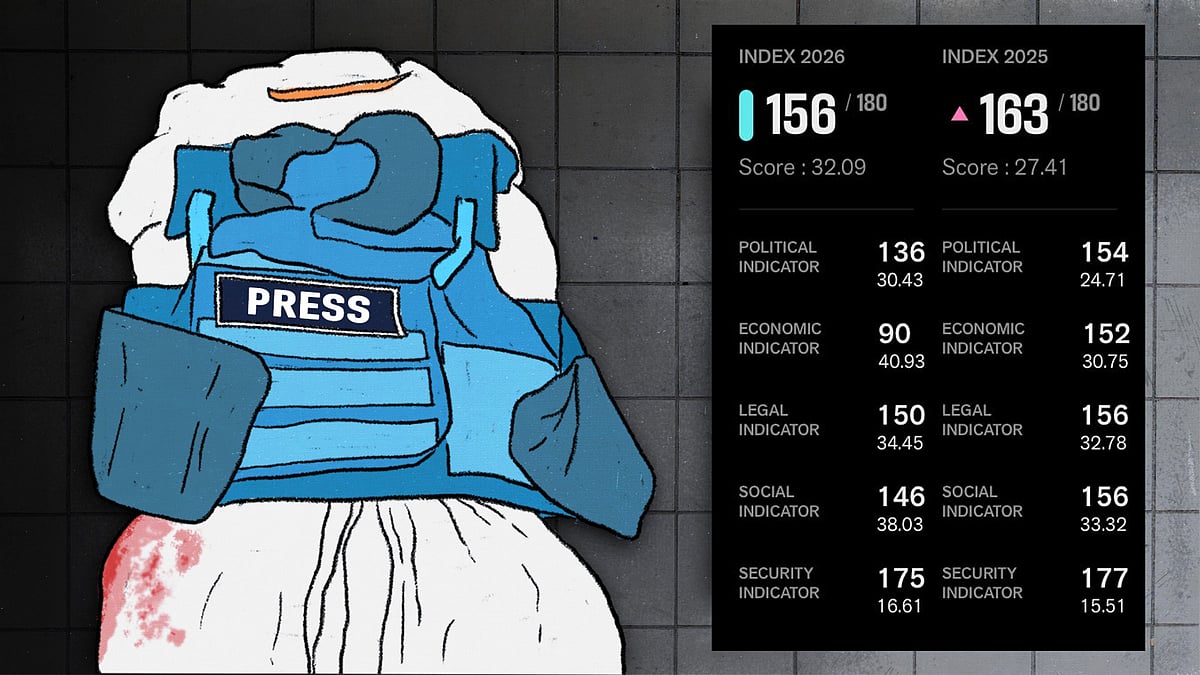
Every year we are informed that India is sinking lower on the World Press Freedom Index put together by Reporters Without Borders. India now stands at 157 out of 180 countries. “So what?” says the government. “We know,” say journalists who have felt the brunt of this decline.
It is worth considering though what “press freedom” means for those engaged in the media – print, broadcast and digital – and especially the journalists who work outside the formal economy of the media as independent journalists.
Press freedom is dependent on many things, including laws made by the government. But protection under law is not enough, even in a democracy as we have experienced in India during the Emergency when all pretence of press freedom was abandoned in the name of national security. Even today, especially in the last decade, the same trope of national security is used to imprison journalists or to bring in curbs that in effect curtail the right of journalists to information.
In fact, this is precisely what the RSF report highlights, the impact of the November 2025 rules the government published for the Digital Personal Data Protection Act (2023). “This new legal framework”, the report states, “directly undermines the fundamentals of journalism by restricting access to, processing of, and publication of certain types of information that could be of interest to the public, starting with administrative documents, public archives, and all other information that could implicate public officials or institutions entrusted with a mission of general interest”.
Apart from such direct intervention by the government that undercuts the very concept of a free media, we also see how this is further emasculated when a powerful executive teams up with private money power.
In India, big money and the executive have been known to come together to suppress reporting on issues that would be uncomfortable to both for decades. This trend consolidated post 1991 and liberalisation when the media, then mostly print media, became commercialised and news was redefined as something that would sell the “product”. That is when we saw the amplification of some and the erasure of others from the news pages. The rich, the politically powerful, celebrities were “news”; the poor, the working classes, the people living on the peripheries were not worth featuring.
That trend has now become an almost accepted feature where, as I argued in an earlier column, the dominant narrative suggested by the government is echoed uncritically by the media (barring a few exceptions). The economically powerful owners go along with this either because their politics matches that of the ruling party or because they are aware of the cost of not doing so given the extent to which the Modi government has weaponised the use of agencies to deal with any opposition.
In sum, India’s declining status on the World Press Freedom Index is no surprise.
Yet, we must consider who pays the price for this decline in media freedom.
The brunt of the decline noted by the RSF is felt by those journalists working outside the frame of mainstream media. In fact, if there is journalism being done the way it should in a democracy, where your camera or your pen seeks out the voiceless, where you report irrespective of whose toes you tread on – big business or big government – because you believe it is a story that must be told, it is the growing tribe of independent journalists in India who are doing this.
They are not backed by any union or association that will come to their aid if they are arrested, bullied, attacked physically or virtually. In fact, even the big publications that they write for often back off when these journalists get embroiled in a court case initiated by a functionary of the ruling party.
Despite this, it is encouraging that scores of independent journalists are not giving up. They continue to report and expose both business and government, and often both. To give just one example, the story of the environmentally devastating projects being planned in the Andaman and Nicobar Islands have been reported mainly by independent journalists for years (read here and here). They finally got noticed by the mainstream, albeit momentarily, when Congress leader Rahul Gandhi happened to visit the islands recently.
The other barometer of press freedom is what the media chooses to downplay or even ignore and why.
Coincidentally, World Press Freedom Day is two days after May 1, universally celebrated as International Workers’ Day, marking the struggle of workers for an 8-hour workday. I doubt if many people, especially the younger generation, are even aware of this struggle and its significance.
But the coincidence also reminds us of the absence of reporting on trade unions, those that have survived despite liberalisation and the dominant contract system that most workers are compelled to accept. These workers are not invisible. They are everywhere, building our infrastructure, constructing private buildings, running the gig economy, working in farms. And then there are those who are virtually invisible, the men and women who work in the homes of the better off Indians at shockingly low pay.
These Indians make it past the barrier of what is considered newsworthy only when they organise, protest, clash with the police, get beaten up and are jailed as the recent protests in Noida highlighted. Though these protests were covered by print, much of the reporting was done by small independent platforms on social media. Such as this where a worker tells a reporter, “We put our children to sleep hungry. We hold them to our chests and sing lullabies, so that they don’t remember their hunger.”
We heard women and men speak about the shocking conditions at their places of work; not just how little they were paid (less than the minimum wage) but the mockery of the annual “increment” that they received. They spoke of how their pay was cut if they fell sick or had to travel for an emergency. And that after years of working in a factory, or as construction labour, there was no compensation if the factory closed or the contract work ended (read here).
We also heard from domestic workers who are unorganised and who are in no position to demand higher wages as there are always people available to work for less. Such is the level of desperation. But to hear the stories of the women who speak of employers who haven’t given them a raise, who cut their wages if they absent themselves from work because of ill health or family emergencies, reminds us that this is India 2026, where those who labour still struggle for a living wage.
Finding meaningful reporting on the working class is like searching for a needle in a haystack these days. Yet, there was a time, when major newspapers like The Hindu, Times of India, Indian Express had a labour reporter, someone whose job it was to report on the conditions of the working classes. That position disappeared around the time that news was redefined as anything that will attract eyeballs.
As a result, our so-called “free” media in India is dedicated only to reporting on those with economic and political heft while the bulk of this country remains outside the definition of “news”.
It is significant that the RSF report zeroes in on the changes made by the Modi government to digital laws that will restrict reporting by the independent journalists who are telling stories that mainstream will not report. Perhaps we should see this as a sign of hope, that despite what appears to be their limited reach, the combined presence of so many feisty independent journalists has made a powerful government uncomfortable.
We take no ads, bow to no government or corporation, and answer only to you, the reader. This Press Freedom Month, pay to keep news free.
 Palestine freer for journalists than India: It’s the Press Freedom Index again