The real reason Modi wants you to stop buying gold
Vivek Kaul takes you inside India’s looming dollar crisis, rupee pressure, and the economic reckoning nobody is fully explaining.

Aapne, sabse pehle, ghabrana nahi hai – Imran Khan Niazi
The obsession of Indian households with owning gold is best explained by the first line of a song from the 1997 Govinda superhit Hero No. 1, which goes something like this: “Sona kita sona hai”.
Of course, this is a rather laboured joke – playing on different meanings of the word sona – and which, if you start getting into the nitty gritty, doesn’t quite work.
But beyond this wordplay and trying to be funny in what should be a very serious column, it is safe to say that India remains obsessed with owning gold. A 2023 estimate made by the World Gold Council – a lobby of gold mining companies – puts the gold owned by Indian households at 25,000 tonnes.
This estimate was made about three years ago. So, it is only fair to say that household gold ownership would have increased since then. The point is that Indians own a lot of gold and continue to obsess over buying more.
In this environment, comes Prime Minister Narendra Modi’s statement: “For a year, be it any function, we shouldn’t buy gold jewellery.” Along with this, PM Modi also appealed to people to cut back on overseas travel and international destination weddings, and to increasingly use metro, public transport, and carpooling.
But it’s PM Modi’s point about gold that seems to have caught the nation's attention. Indeed, this statement about gold tells us a lot about how the Indian economy is structured and how that structure is being tested due to the war in West Asia.
India’s continued love for gold
India imports almost all the gold that it consumes. These imports are paid for in dollars. In 2025-26, the country imported gold worth $72 billion. This was 58 percent higher than $45.5 billion in 2023-24.
Of course, the higher gold import bill was also a function of its rising price. In 2025-26, India imported 721 tonnes, compared with 795 tonnes in 2023-24.
Now, there are good reasons for households to buy gold at the individual micro level. But the same logic doesn’t seem to hold when these household purchases are added up at the macro level.
At the macro level, household purchases of gold are often seen as economically ‘useless’, given that gold is too expensive for significant industrial use and that precious dollars are spent importing it.
This highlights a classic behavioural conflict: while the macro-economy views gold as a 'useless' drain on dollars, for the individual, it is a perfectly rational hedge. As the rupee depreciates, buying gold isn't just an 'obsession' – it’s also a defensive manoeuvre to protect one’s purchasing power.
In normal times, this gold obsession doesn’t matter much. In a manner of speaking, the country can afford it. But the current time isn’t normal. The war in West Asia, along with other reasons, has changed things. There is significant pressure on the rupee against the dollar, with the Indian currency depreciating by over 5 percent from late February onward.
How does gold fit in here?
Gold is bought by spending dollars. The same is true when Indians go on holiday abroad or have international destination weddings. This creates demand for dollars in an environment where their supply remains rather iffy.
Why is that the case? Foreign institutional investors (FIIs) have been selling out Indian stocks. When they sell, they get paid in rupees. They convert these rupees into dollars to take money out of India. This creates a demand for dollars.
In 2025-26, they net sold stocks worth Rs 1.81 lakh crore ($19.7 billion). In 2026-27, they have already net sold stocks worth Rs 84,282 crore ($8.9 billion). So, FIIs have been taking dollars out of India.
Over and above this, the net foreign direct investment (FDI) into India (FDI by foreigners into India minus FDI by Indians overseas) hasn’t been inspiring either.
From April 2025 to February 2026, in the last financial year, the figure stood at $6.3 billion. It was at $959 million in 2024-25. It was close to $43 billion in 2019-20 and $44 billion in 2020-21. Clearly, as many dollars aren’t coming in through this route as was the case in the past.
Further, in the aftermath of the war in West Asia, remittances from the region are likely to be negatively affected. Of course, the dollars earned by Indian IT companies and other service-based companies help, but the sales growth of IT companies has been tepid of late.
The rising prices of oil and natural gas, which are paid for primarily in dollars, also create a higher demand for dollars. The price of the Indian basket of crude oil has jumped 58 percent from $69 per barrel in February 2026 to around $109 per barrel as of May 12, 2026.
In 2025-26, India imported 89 percent of the crude oil it consumed and nearly half of natural gas. These import levels cannot differ by much in 2026-27. So, with higher prices, dollar outflows to buy oil and gas will only go up.
Put simply, in 2026-27, India’s current account deficit – the gap between the dollars flowing out of the country and the dollars flowing in – is likely to widen sharply. In this scenario, when the demand for dollars is more than their supply, their price in rupee terms increases, which means that the rupee depreciates: it loses value against the dollar. India then needs more rupees to buy dollars. This has all kinds of impacts.
Control the controllable
First, in an environment where households buying gold isn’t appreciated at the macro level, and there is a need to preserve foreign exchange (read US dollars), the purchase of gold needs to be discouraged. Which is precisely why PM Modi said what he did, waiting for the state assembly elections to get over. The customs duty on gold has also been increased. This has pushed up prices, and the hope is that will deter people from buying gold and help preserve foreign exchange.
Second, using the same logic of trying to discourage spending dollars, international holidays and weddings should be discouraged as well.
Third, the higher prices of oil and gas mean their use must also be discouraged to preserve dollars. Which is why PM Modi suggested using public transport, carpooling, and metros. Companies also need to encourage remote work.
Fourth, while oil marketing companies (OMCs) are paying higher prices for oil, petrol and diesel pump prices haven’t been increased. This basically means that these companies are selling petrol and diesel at a loss.
The petroleum minister, Hardeep Singh Puri, said that OMCs are losing Rs 1,000 crore per day on petrol and diesel sales. This is why the consumption of petrol and diesel needs to be discouraged to limit losses.
B Ashok, a former chairman of the Indian Oil Corporation, one of the OMCs, in a column in The Indian Express, points out that the central government – which has cut the excise duty it charges on sale of every litre of petrol and diesel, in order to not totally burden the OMCs – has given up on taxes worth Rs 30,000 crore between March 15, 2026 and April 30, 2026.
Fifth, fertilisers are something that almost no one seems to be talking about. Ajay Vir Jakhar, Chairman of the Bhartiya Krishak Samaj, in a recent column in The Economic Times, had pointed out that a “bag of urea that costs a farmer Rs 266.50 costs [the] government of India Rs 4,184.” In that sense, the central government subsidises the farmers and bears the cost in the annual budget.
A report in Mint points out that urea prices have gone up 81 percent in the last two months. Urea is the most used fertiliser in India. This means that the total amount of money that the central government will need to subsidise urea will also have to go up.
A moneycontrol.com news report says that due to the war in West Asia, the monthly subsidy requirements during April to June 2026 are expected to be Rs 10,000-15,000 crore higher than in 2025.
A significant share of the fertiliser that India consumes comes from West Asia. India is the world’s largest importer of urea. According to S&P Global, a financial information provider, India imported 10.2 million metric tonnes of urea in 2025, of which more than 41 percent came from West Asia. So, in addition to higher prices, the government also has to replace the fertiliser that comes through the Strait of Hormuz.
Sixth, given the cut in excise duties on petrol and diesel, the central government is collecting lower taxes on their sale. Further, the bill for fertiliser subsidy is also likely to go up. Also, if the war in West Asia continues, the general economic slowdown will slow the growth of the overall tax revenue the government hopes to collect. The falling stock market will also lead to lower collections of taxes on capital gains – something the government has thrived on over the last few years.
This means that the government’s fiscal deficit – the difference between its projected expenditure for 2026-27 and its projected revenues – is likely to rise unless it cuts expenditure, which will have its own repercussions.
In this scenario, the dollar-rupee exchange rate becomes very important. The more the rupee depreciates, the greater the fertiliser subsidy bill and the higher the loss on the sale of petroleum products.
The government cannot cut the fertiliser subsidy because it would be an anti-farmer move. At the same time, any such move will lead to higher food inflation.
Seventh, a weaker rupee will feed into imported inflation. This will make imported products and commodities more expensive, push up inflation, and eventually force the Reserve Bank of India (RBI) to raise interest rates to control it.
Eighth, for these reasons, the government does not like the idea of continued rupee depreciation. The direct impact is that it pushes up subsidies and OMC losses, and the indirect impact is that it slows tax collections. It also pushes up inflation.
One way to control this is for the RBI to sell dollars and buy rupees. This helps ensure an adequate supply of dollars in the market, preventing the rupee from depreciating sharply or at least slowing its decline.
But the RBI does not have an unlimited supply of dollars. It can print rupees, but it cannot print dollars. Dollars have to be either earned through goods and services exports or flow into the country through foreign investors, remittances, and loans.
In that sense, the RBI (and, by extension, the government) has very little control over the supply of dollars. But they can have some control over the demand for dollars. And as the greatest living person from the city this writer comes from, once said: “Control the controllable”.
So, what does all this mean?
First, there are no short-term solutions. Let those in the business of managing other people’s money (OPM) not fool you about this.
Second, the RBI can only intervene so much in the foreign exchange market to prevent or slow down the rupee’s fall. Its foreign exchange reserves stood at $728.5 billion as of February 27, 2026, before Israel and the United States attacked Iran. They have fallen more than 5 percent to $690.7 billion as of May 1, 2026.
Indeed, as of February 6, 2026, before the war in West Asia began, India’s foreign exchange reserves were sufficient to cover imports of goods and services for 9 months. As of March 13, 2026, they still stood at 9 months. But by April 10, 2026, they had fallen to 8.7 months.
By the time the data for May and June comes out, chances are the import cover would have fallen further. This will happen because the RBI has been selling dollars to defend the rupee. Given that the RBI cannot create dollars out of thin air and that import cover is falling, more needs to be done to defend the rupee.
Of course, this does not mean the RBI will stop selling dollars to defend the rupee, given that the dollar-rupee exchange rate is as much a political issue these days as an economic one. Indeed, the political narrative around it over the years has made this exchange rate a matter of pride for many Indians. And the RBI has to take care of that as well.
Third, enter moral suasion: PM Modi has directly appealed to us to slow down on buying things with dollars. Be it gold, petrol, diesel, foreign holidays, international weddings, or even edible oil. Moral suasion is essentially a tactic used to influence economic behaviour through persuasion, rhetoric and moral pressure rather than strict regulation.
As PM Modi said, “If every household reduces the use of edible oil, it is a huge contribution to patriotism.” In 2024-25, India imported vegetable oil worth $17.3 billion. In 2025-26, this figure was at $19.5 billion.
The question is: how much can Indians really cut down on edible oil, given the deeply held national belief that the amount of oil in a dish is directly proportional to how tasty it is?
Fourth, if the crisis in West Asia continues, moral suasion as a tactic may simply not be enough. In April 2026, before PM Modi made the statements he did, petrol consumption had risen 6.4 percent compared to April 2025. Diesel consumption was up 0.25 percent.
To slow consumption growth, petrol and diesel retail prices will have to rise. The trouble here is that retail prices have remained flat for a while now: Even during periods when oil prices fell substantially, the benefit wasn’t passed on to end consumers.
So, increasing retail prices doesn’t gel well with the broader economic narrative that has been built. Nonetheless, this will have to happen sooner rather than later. Petroleum Minister Puri did say: “[The OMCs] are taking a loss to insulate the consumer. (But) At some stage, the government would have to take a call.” The stage for a price hike is being set.
Fifth, as has happened in the past whenever the rupee has rapidly depreciated against the dollar, there is once again growing talk of the RBI issuing dollar bonds. The idea is to attract dollars into India and shore up foreign exchange reserves.
The trouble is that interest rates in the Western world are at significantly high levels. Given this, the RBI will have to offer extremely high rates of return on these bonds to attract money. So, one is really not sure how feasible this option is.
Sixth, another option for the RBI is to raise interest rates. Higher rates are likely to attract dollars into Indian bonds, thereby helping shore up foreign exchange reserves. Of course, this also means that Indian borrowers will end up paying higher EMIs.
For this to happen, the RBI Governor, Sanjay Malhotra, needs to quickly get over the idea that the Indian economy is going through a rare Goldilocks period. Of course, other policy options can make spending in dollars more difficult. The government can raise import duties on luxury goods and even tighten the Liberalised Remittance Scheme limits on the amount Indians can send abroad.
But all such moves will run counter to the overall economic narrative of a strong Indian economy that has been sold to the public until now.
Seventh, given the current situation, it’s hard to believe that things in West Asia will change. Indeed, even if the situation in West Asia were to improve, it is highly unlikely that Iran will let go of its control on the Strait of Hormuz. There will be no return to the status quo. This basically means that India needs to be on good terms with Iran.
That, in turn, may require India to pursue a far more balanced geopolitical posture – including moderating its overt tilt towards Israel – than current domestic political narratives encourage. It would also mean pushing back against the manufactured narratives that thrive so effectively on “WhatsApp University”.
Eighth, for FIIs to return to Indian stocks and infuse dollars into the Indian economy, stock prices may need to fall to levels where valuations – based on current and expected future earnings – become attractive again.
FIIs are leaving because Indian stocks are expensive relative to other markets, and the falling rupee erodes their returns in dollars. Again, these are not things that the government has much control over.
Ninth, moral suasion as a tactic works when branches of government are seen cutting back. A nice start to this would be for the big politicians to cut down on the entourage of cars they travel with. This can set an example for smaller politicians, and the message can spread down the hierarchy. Of course, this is easier said than done, especially in an era where making reels to project power is so important.
What lies ahead
First, the government has said that India has 60 days of crude oil, 60 days of natural gas, and 45 days of LPG rolling stock. There is a nuance to this.
The Strait of Hormuz remains largely shut. According to data from the US Energy Information Administration, around 20 percent of the world’s crude oil, petroleum products, and liquefied natural gas passes through the strait. As a result, supplies of both oil and natural gas continue to remain disrupted.
More importantly, before the war began and while the strait was still open, huge quantities of oil and gas were already in transit to destinations across the world. Those shipments helped cushion the immediate impact on the availability and pricing of petroleum products.
But by now, most of those deliveries have largely run their course. The Economist points out: “By April 20th, the last few oil tankers to cross Hormuz before the war began reached their destinations.”
Given this, sourcing oil and gas and fertilisers – 30 percent of which pass through the strait - will become more challenging. And India is hardly the only country that does not produce enough of these commodities domestically. So, competition to secure supplies is likely to intensify.
As the banker Uday Kotak put it: “We have not seen the impact in the last two months of the Middle East war in terms of energy price transmission. It’s coming. And it’s coming big.”
Second, the prices of goods and services will rise in both direct and indirect ways, as oil and gas become more expensive and the rupee remains weak. (For a detailed understanding, click here.) Beyond this, an El Niño-driven harsher summer and a weaker monsoon are likely to push up food inflation. This is likely to force the RBI to raise interest rates. EMIs will rise in the months ahead.
Third, inflation and the slowdown of economic activity will slow economic growth. Even the corporate, brokerage, and investment banking economists, whose main KRA is to keep building a positive economic mahaul – for want of a better term – are also saying the same thing now. Of course, such statements are being very carefully worded.
Fourth, the government will earn lower taxes. This will lead to a higher fiscal deficit, forcing it to borrow more. When the government borrows more, there is less money for private borrowers. This pushes up interest rates and hence, EMIs. Of course, the government can always come up with new taxes and bring back old ones. But that will have its own set of impacts.
Fifth, veteran banker KV Kamath, in an interview with The Economic Times in March 2026, had said: “I would think whether [the war in West Asia] lasts a few days or a few weeks – that's what is being discussed. I look forward to normalisation. I don't think this is something that will endure or create lasting issues.”
As any historian worth their salt could have told Mr Kamath, it’s easy to start a war, but very difficult to stop one. Further, everyone who has ever started a war has done so believing they would win quickly. Sadly, it’s never as simple as that.
So, retired bankers should stay retired and not give us gyan about the war. But the larger point here is that if the war continues, the Indian economy will see lasting impacts. For starters, the country will have to figure out how to produce more oil, gas and fertilisers domestically, so as to be less dependent on others.
Sixth, for India to be less dependent on dollars, we need to be less dependent on outsiders, particularly China. India runs a goods trade deficit with China, the gap between what India imports from China and what it exports there. In 2025-26, this deficit crossed $112 billion, up sharply from $44 billion in 2020–21. Close to two-thirds of Chinese imports are in just four sectors: electronics, machinery, computers, and chemicals. India needs dollars to buy these imports.
What this reveals is a deeper production dependence. Many Indian companies appear to believe that it makes economic sense to import from China rather than build equivalent manufacturing capabilities in India. This means the Indian private sector must change its overall approach to building manufacturing businesses. And this isn’t something that can be solved overnight.
To conclude, India’s problem, ultimately, is not our love for gold; it is the need for dollars. A country that imports most of its oil, a large share of its fertilisers and edible oil, and runs a huge trade deficit with China cannot remain insulated when the global environment turns hostile.
The war in West Asia has merely exposed this vulnerability more clearly. Which is why PM Modi’s comments were less about gold and more about conserving foreign exchange.
In that sense, the government is also trying to manage the economy through moral suasion, given that it may not want to weaken the WhatsApp University narrative that has taken many years to build. Also, most policy changes take time to have a ground-level impact.
The trouble is that moral suasion can only work up to a point. Economics eventually overwhelms rhetoric. And bad jokes only work well when mixed with good arguments.
Vivek Kaul is an economic commentator and a writer.
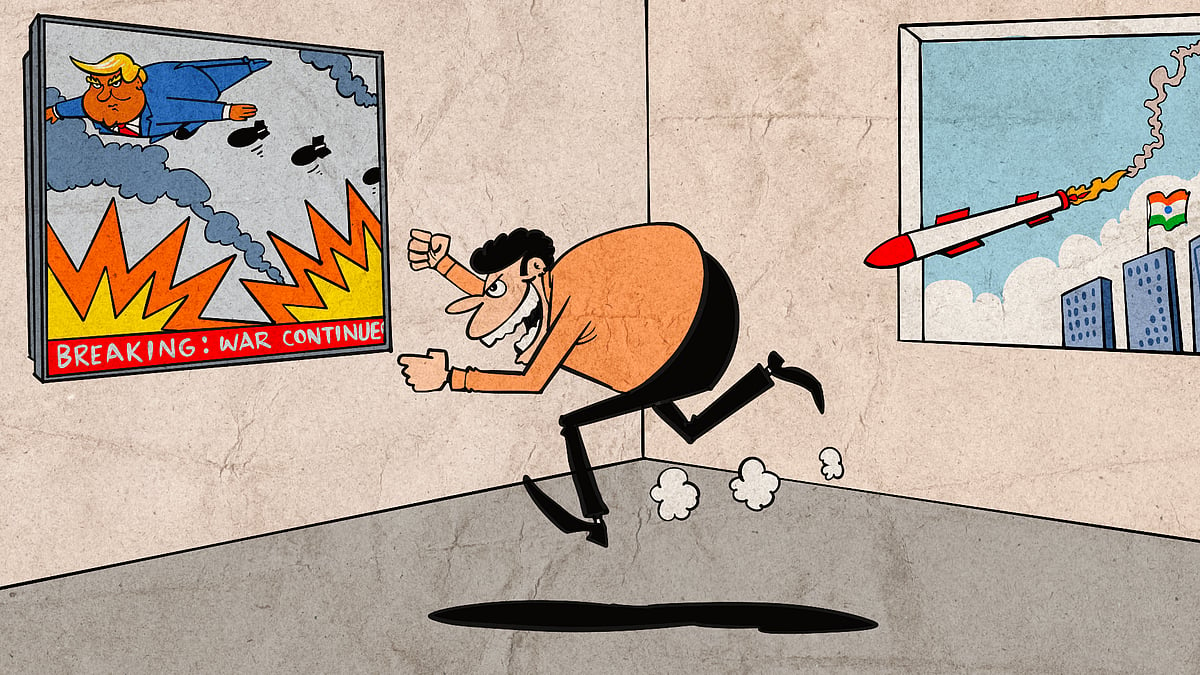 God on their side, the bill on ours: Counting the real cost of the war in West Asia for India