CJP can endure the meme cycle. But can it articulate what kind of India it’s fighting for?
The CJP is barely a week old. Holding it to the standards of a fully-formed political organisation is unfair at the moment.

The Modi government has decided that the Cockroach Janta Party (CJP) is a ‘threat’ to national security. Earlier this week, its X handle with approximately 200,000 followers was withheld in India under Section 69(A) of the IT Act after the Intelligence Bureau flagged its content as a national security risk, citing with alarm that it was “gaining traction among young people”, according to a report in The Indian Express.
Its Instagram account, with more than 21 million followers, is reportedly next. The party is barely a week old.
Their origin story is genuinely remarkable. When Chief Justice Surya Kant said unemployed youngsters who find no place in the legal profession — some turning to media, social media, RTI activism — are “like cockroaches” who “start attacking everyone”, Abhijeet Dipke, a 30-year-old Boston University graduate, fired back: what if all cockroaches come together? Within 72 hours, over one lakh people had signed up. Within 48 hours on Instagram, the follower count crossed three lakh — and kept climbing past the BJP's.
What are the eligibility criteria to join? Unemployed. Lazy. Chronically online. The slogan? Secular, socialist, democratic, and lazy. To use a favourite term of Modi and his supporters, it was a ‘masterstroke’ of political communication, turning an insult into an identity.
That the insult landed on a Dalit man – and that the casteist abuse directed at Dipke online has been vicious and swift – is not incidental. It is the story of Indian democracy in a nutshell: a Dalit man uses his constitutional right to speak, and is told he is a parasite by strangers on the internet. His response to organise rather than retreat is not nothing.
Dipke’s anger at the CJI is also legitimate. As he told one channel: “Doesn’t the Constitution, which he swore to protect, say that every individual – irrespective of his educational qualification or social status – has the right to speak up, has the right to freedom of expression?” The CJI’s subsequent clarification – that he was only referring to those with fake degrees – made things worse, not better, argued Dipke. It implied that the right to dissent is credentialed. That is a poor position for the custodian of the Constitution to hold.
The party’s stated demands are not fringe positions either. Ending post-retirement benefits for judges to protect judicial independence. Women’s reservation at 50 percent, not the BJP's conditionally offered 33 percent. Accountability for paper leaks that have broken the aspirations of millions of students who wanted to become doctors.
These are legitimate grievances, competently articulated. The one exception worth flagging is the demand to charge a Chief Election Commissioner with UAPA for deleting legitimate voters from the rolls. The intent is understandable, and given the number of people, especially Muslims, who were unfairly disenfranchised in the recent Special Intensive Revision (SIR) exercise in West Bengal, the anger behind it is entirely justified. But any person who believes in civil liberties knows that UAPA is precisely the kind of law that should not exist in our statute books at all, let alone be expanded in its application.
What is the CJP?
Which brings us to a more pertinent question: What do we call this thing? Is the CJP a political party? It has a manifesto and a Google form. A meme party? It has cockroach costumes and a Yamuna cleanliness drive. A satirical pressure point? A new political front? A Gen Z venting session with ambitions? It’s tough to say who they are at this moment.
The honest answer is that nobody, maybe including Dipke, knows yet. And that ambiguity is not necessarily a flaw. Every political movement, at its beginning, is unclassifiable. The question is what it chooses to become.
It would be too easy and too convenient, especially for those in power, to be dismissive. The CJP is barely a week old. Holding it to the standards of a fully-formed political organisation is unfair. The anger that created it is real, the issues it raises are urgent, and the speed of its growth possibly reflects something genuine about the mood of a generation that has been ignored, patronised, and told to shut up. But honest solidarity means asking hard questions. And there are several.
A convenient protest aesthetic
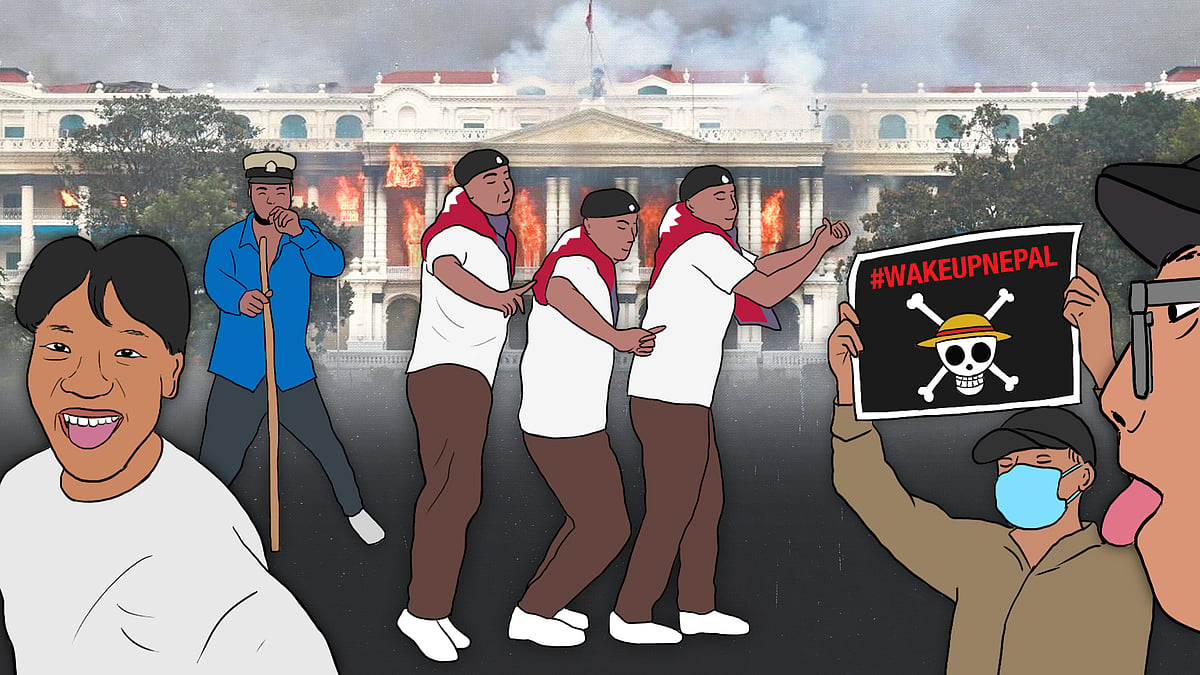
Start with the movement’s self-image. Dipke has been emphatic, across his interviews with the formal media and content creators, that India’s Gen Z will not – and should not – be compared to protesters in Nepal or Bangladesh. “Do not insult or underestimate the Gen Z of India by making such comparisons,” he said on X. “They understand their constitutional rights and will express their dissent through peaceful and democratic means.”
This sounds measured. But look at what he is actually saying. The Gen Z protesters in Bangladesh brought down Sheikh Hasina’s 15-year authoritarian government. In Nepal, protestors threw out a regime of corrupt politicians. No one celebrates wanton violence.
But these were young people who actually undertook the real work of organising, getting down to the streets, looking down the barrel of a gun held by armed police and changing their governments in a bid to improve their material conditions.
Whether those movements have the intended consequences remains to be seen, but what’s not in doubt is their intent and execution. To hold them up as an example of what Indian Gen Z shouldn’t aspire to is a strange form of ambition-setting. It reveals something about the CJP’s instinct: to stay legible, respectable, and safe, which may be wise. But it is worth naming.
It also reflects a hangover of the Gandhian aesthetic of what a protest should look like. As a Buddhist from Ladakh who saw his people peacefully protesting for over four years for legitimate constitutional demands with scant media attention – with few exceptions, of course – it took the violence of September 24, 2025, for them to actually care.
Four people were killed at the hands of the police and paramilitary forces and it was the darkest period for Ladakhis in my lifetime. Unfortunately, it took the events of that day to catch the attention of the Indian media and educate many about our real problems.
As a Buddhist, I abhor violence, but when material conditions reach a pitiable stage given that more than a third of young Ladakhis are unemployed, our land threatened by rapacious capitalists, and the Modi government’s refusal to give us genuine political representation – things reach a boiling point and spill over.
What does it stand for?
However, the harder question for the CJP is ideological. What does it actually stand for?
Reading Dipke’s interviews carefully, a familiar grammar emerges. Accountability. Anti-corruption. Institutional independence. Good governance. Clean politics. These are real concerns, but they are also, notably, not an ideology.
Professor Neera Chandhoke, a former political science faculty member at the University of Delhi, writing about the AAP’s trajectory in The Wire, identified this tendency with precision. Post-ideological parties, she argued, “give importance to ‘what works’ rather than ‘what should be’, eschew philosophical doctrines in favour of pragmatism and short-term solutions, and abjure taking principled positions on gross violation of human rights, wellbeing, dignity, justice, or equality.” The magic wand, she noted, in AAP was corruption – a concept that, like governance, is not actually a political term. “For politics is always contested. And no one will contest the undesirability of corruption.”
Dipke worked with AAP for a couple of years and talks about being inspired by their health and education model. The CJP’s DNA, in its current avatar, carries that lineage visibly, not in any conspiratorial sense, but in aesthetic and ideological terms. It carries the same energy of an outraged, urban, and educated public. It proposes the same anti-establishment framing without a clear vision of what establishment it wants to build.
The AAP experiment should give us pause here. Chandhoke noted that Arvind Kejriwal refused to take principled positions on Article 370, the CAA protests, the Shaheen Bagh sit-in, the attacks on JNU students, and the North-East Delhi riots. A party built on moral outrage at corruption fell quiet, repeatedly, when the currency of that outrage was most needed. “What is the point of organising a political party if it cannot protest against the destruction of civil society and civil liberties?” asked Chandhoke.
To be fair, the CJP has not yet faced those tests. It is a week old. But the absence of a clear ideology is not a neutral position. It is a choice that comes with consequences. A party that defines itself by what it is against, rather than what it is for, is a party that will fracture the first time it is asked to take a side.
There is also the question of whose frustration is being centred. Political commentator Sarayu Pani notes on X that the CJP resembles a segment of Vijay voters, i.e. “depoliticised urban youth seeking political engagement”, but without the “geographically rooted” ground network that gave Tamilaga Vettri Kazhagam (TVK) actual electoral weight.
Instagram creator Akshay Chandra Madhav sharpens this further: “My critique is how quickly online visibility gets treated as mass political representation.” The CJP’s viral reach, he argues, is predominantly urban, English-speaking, and phone-owning. Meanwhile, Dalit youth, Bahujan youth, Adivasi youth, farmers and labour movements have been organising for years — facing arrests, FIRs, and institutional repression — with “complete media erasure and social media algorithmic invisibility.” These ground struggles don’t have the aesthetic of ‘cool rebellion’.
As Madhav asks: “What about the youth who have been fighting unemployment, caste violence, land dispossession, precarious work for years now? They have been on the streets since forever. Why won’t we register them as the frustrated youth?”
Suffice to say, the CJP didn’t invent frustrated youth. It made their frustration consumable. And there is a difference. Online politics, as Madhav puts it, “often wants the emotional intensity of a movement without the obligations of movement-building.”
Looking ahead
None of this is to say the CJP will fail. It may surprise us all. Dipke’s honesty about being in the “very initial phase”, his acknowledgement that hundreds of volunteers are already building state-level chapters, and his refusal to position himself as a singular leader are all marks in his favour. Predictably, the government’s ban on the X handle has done more for the CJP than any manifesto point could.
And if the IB genuinely believes that a week-old party run by a Boston University graduate is a national security threat, it has both overestimated the CJP and underestimated what suppression does to movements that live on the internet.
But survival is not the same as winning. And going viral is not the same as building real power.
Famously, cockroaches can survive anything. The harder question is not whether the CJP endures the meme cycle, but whether it can articulate what kind of India it is actually fighting for, not just who it is against or what it’s angry about. We need to know what it believes, what it will refuse to compromise on, and when the moment comes, who it will stand with. That is when we will know what the Cockroach Janta Party really is about.
We take no ads, bow to no government or corporation, and answer only to you, the reader. This Press Freedom Month, pay to keep news free.
 From doomscrolling to dissent: Story of Gen Z’s uprising in Nepal