The Cockroaches are restless: Anatomy of a 22-million-strong meme movement
A meme page. Twenty-two million followers. A national security threat. What the Cockroach Janta Party tells us about a generation that played by the rules and lost.

Let’s be clear. The Cockroach Janta Party is not a political party. It started as satire – its founder has said so many times, and he said so again when I spent an hour chatting with him for a Newslaundry interview.
Here’s how it began: Abhijeet heard the CJI’s comments after a workout, it enraged him – “how could someone be so bitter” – and he thought to himself: why don’t we all just become cockroaches? He tweeted, gave a call to action for cockroaches to unite, and made a cheeky page. Then an Instagram channel. And then something he hadn't planned for happened.
It didn’t matter that the CJI later clarified. What landed was the contempt underneath – the suggestion that young people trying to do something, activists, people simply trying to kick up a storm, were the problem. There is something historically illiterate about that framing.
The instinct to challenge, to refuse, just general shit-stirring, to take pangas – that is not delinquency. That is youth, however jobless or waylaid. And the CJI expressing such contempt for it at this precise moment, when an entire generation was sitting with the knowledge that the examinations they had sacrificed years for were compromised, was the perfect storm. It made Abhijeet the lightning rod for what we’re now calling the Gen Z angst against the system. I don’t think he thought it would be this big. And I suspect he’s a little shaken by all this – as anyone would.
We’re talking about 22 million people gathered together in a week who want something done. What exactly, how, they don’t know – but something must change
So who are the cockroaches?
Abhijeet told me his page is mostly followed by Indians aged between 17 and 28 years in metropolitan cities – Delhi, Bangalore, Mumbai, Kolkata. Twenty-five percent women. As someone who has spent years in the media, that number is not nothing. Most legacy outlets, with all their infrastructure and decades of audience-building, have failed to crack female viewership at that scale. The fact that a meme page built on political satire managed it, tells you something important about what young women in this country are feeling. For a girl from Bulandshahr in a farming family, cracking a government exam is not just a career. It is the one legitimate argument she has against an early marriage, against her life being decided for her while she’s still in her twenties.
But the more telling number is the one that doesn’t show up in the analytics. Abhijeet says the bulk of this following is apolitical. Not just disillusioned – apolitical. These are not people who voted and felt betrayed. These are people who may have never voted, who were raised by parents who told them, firmly, to focus on their exams and to stay out of campus politics. The transaction seemed straightforward: study hard, clear the exam, build the life.
India, for all its chaos, has always held out that promise. Every examination cycle produced its topper – a rickshaw puller’s son who works against all odds and makes it. These were not just feel-good stories. They were the load-bearing myth of the republic: that the system, however imperfect, would reward effort.
That myth is cracking. Since 2022, reporting from state universities across the country, I have not found a single exception – parents, students, faculty, all of them talking about paper leaks, privatisation, fees that ordinary families simply cannot pay, degrees that open no doors. There is no accountability. And there is no one to be angry at, or rather, everyone who might be held accountable has been insulated from it.
We have a habit of deriding Gen Z. But consider what it actually means to be 25 in India right now. You do not have genuine job prospects with this new beast called AI. This week we had the headline of IIT Bombay placement rate dipping to 70 percent. The formal economy is not absorbing you. And the cultural atmosphere in which you are trying to build a life is one of sustained, low-grade suffocation – a media landscape in which the television your parents watch tells them, every night, that the real threats to India are love jihad and the enemies of Modi. Earlier, even when politicians were what they were, mainstream media served a function. It gave anger somewhere to go. It absorbed frustration before it could harden into something else. That is one of journalism’s oldest jobs. It is a job that much of the Indian media no longer does.
So the pressure built. And into that vacuum, almost by accident, walked Abhijeet and his cockroach page.
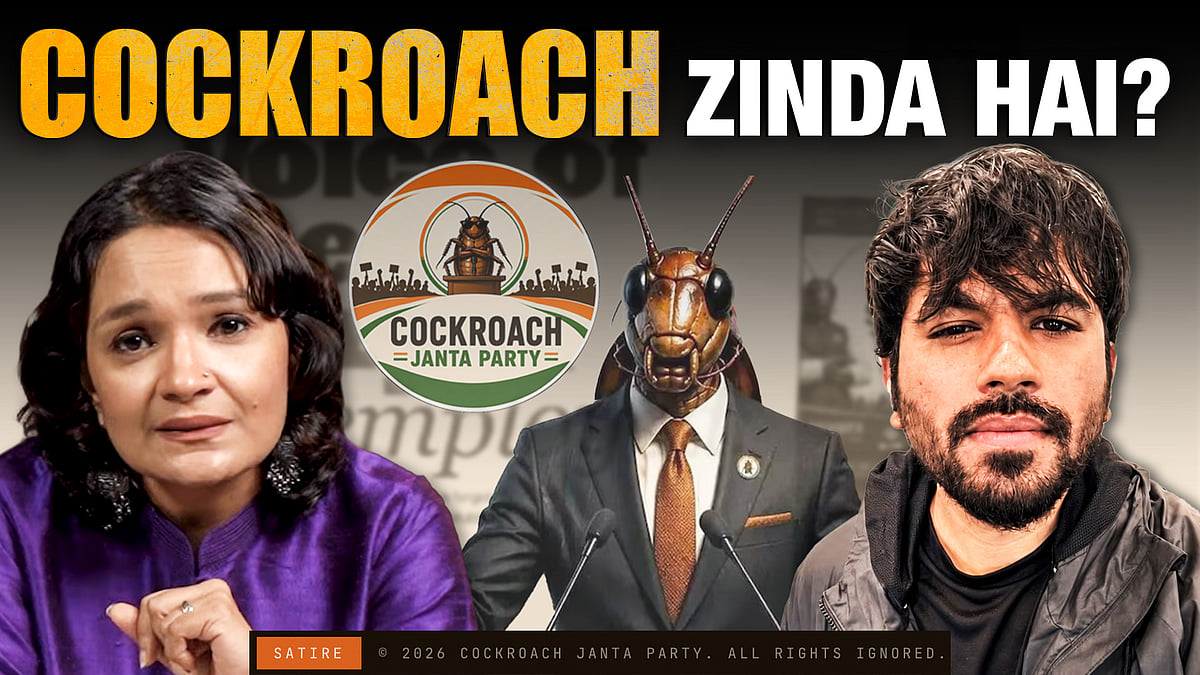 ‘I started a joke…now I get death threats’: Cockroach Janata Party founder speaks
What struck me in our conversations was something Abhijeet kept returning to: his followers want something done. Not something specific – they haven’t arrived at demands or a programme. But the hunger itself is intense and real. This is not cynicism. Cynics don’t show up. These people are showing up. At least on comment sections.
Which is precisely why what comes next matters, and why it is also so hard. This is the first proper social media youth movement in the age of AI, and the speed of the rise brings its own distortions. For a generation raised on content, trained to equate virality with meaning, numbers like these (22 million!) are intoxicating.
The competing interests are already visible: those who want to go viral, those who want proximity to something that feels important, those who genuinely want change, and those who are simply furious and need somewhere to put it. TV anchors who would not have returned Abhijeet’s call six months ago are now lining up. They know – put Cockroach Janta Party in the headline and you get the numbers.
And here is what makes this structurally unlike anything that has come before it in Indian political discourse. Abhijeet was a nobody before this. The following did not come because of him – it came because of the idea.
The IP preceded the party.
Cockroach Janta Party is a meme-ified mirror held up to a specific, widespread despondency, and what people saw in that mirror was themselves. The idea, in other words, is bigger than its founder. That is both its greatest strength and its most serious vulnerability. At this point, almost anyone could have registered this party and captured this moment. The question is whether Abhijeet can grow into it.
Perhaps the most immediate thing cockroaches could do is become a pressure group. Pick issues. Highlight what mainstream media ignores. And – I mean this – take your parents’ phones. Half an hour. Disrupt the algorithm. Your parents are living inside a sealed information bubble. Break it open. Subscribe them to something that challenges it. Begin the longer, harder work of convincing them to ask questions of power rather than simply receive its messaging.
That requires organisation. Surveys. A core group that can hold the competing interests together. None of it is easy, and none of it happens without time.
In an ideal democracy, Abhijeet would have that time. He could build this carefully, without the threat of being labelled anti-national, without accounts suspended, without some babu noting somewhere that he represents a security concern.
He should have the space to figure out what this is and what it could become.
The fact that he doesn’t – that the state’s first instinct, at this scale of dissent, is to deem a meme page a national security threat rather than engage with what it represents – is, in the end, the most honest measure of where this democracy actually stands.
We take no ads, bow to no government or corporation, and answer only to you, the reader. This Press Freedom Month, pay to keep news free.