Bengaluru market vendors hired to train AI robots that could replace them
Instawork, a San Francisco-based staffing company, is paying Bengaluru market vendors to wear head-mounted cameras and record their work to train AI robots. The same project also has similar roles based out of private Airbnbs in the city.

On a Tuesday morning in Bengaluru’s New Thippasandra market, Nagraj is doing what he does every day. The owner of a small grocery shop, he is sorting stock, attending to customers, keeping his shop in order. The only thing different today is what he’s wearing on his head.
A small camera, fitted into a headband, sits just above his forehead. It records everything – his hands reaching for goods, customers passing money across the counter – the ordinary choreography of a day’s work. Somewhere, on a server he has never seen, in a format he cannot read, that footage is being used to teach a machine.
“They gave us the cameras so a robot can learn what humans do,” Nagraj told TNM. “All I had to do was my regular work while wearing the camera.”
He has been doing this for five days. He had been paid for two days by then.
New Thippasandra market in east Bengaluru is not the kind of place that usually figures in conversations about artificial intelligence. It is a dense, working market housing vegetable vendors, tailors, cloth shop owners, the everyday commerce of a city neighbourhood. But in May, representatives from a company called Instawork began moving through its lanes, approaching workers with an unusual proposition.
Wear this camera while you work. Do what you normally do. We will pay you for your time.
Workers told TNM that Instawork’s representatives explained the project verbally, distributed the equipment — iPhones fitted on headbands and chargers — and they agreed. No contract was signed. Nothing was put in writing. The arrangement, as far as most workers here understand it, rests entirely on a spoken agreement made one morning in the busy market.
Instawork is a San Francisco-based company founded in 2015. Its original business was digital staffing, with an app-based platform matching hourly workers with short-term shifts. It now has over seven million workers in its network and has raised more than USD 160 million from investors including Benchmark, Greylock, and TCV. Its India office is based in Koramangala, Bengaluru.
Instawork’s project at New Thippasandra is egocentric data capture, which involves visual information recorded from the wearer’s point of view.
An Instawork employee we spoke to said his work begins with identifying suitable locations and occupations where diverse day-to-day activities can be recorded. The project, he told us, is running for three months across multiple cities in India.
The end use of the footage, he explained, is to train AI systems, specifically humanoid robots learning to navigate and operate in physical spaces.
Lack of contract
To build a robot that can fold a shirt, pick up a tomato without crushing it, or locate a product on a shelf, AI systems need to understand how human hands and eyes work together. That requires training data, millions of hours of first-person footage showing fine motor movement in real-world environments. It is painstaking to collect, difficult to generate artificially and, in places like India, very cheap to obtain.
The workers at New Thippasandra were told this, in broad terms. They were told that future AI systems need to learn from human movement. They were told their footage would train robots. Several told us they were also told that the robots being trained might eventually do the kind of work they currently do.
Sushmitha, a tailor who owns a cloth shop in the market, was among the first to agree to the project. She had been wearing the headband for six to seven days when we spoke to her.
“An AI company approached us and asked us to wear the headbands and record,” she said. “They pay us for it anyway, so we agreed.”
When asked if the company told her that the robot she is helping train might one day take over her job, she said, “Yes, they have informed us.”
And was she okay with that?
She paused. “Doesn’t feel okay. But we are getting paid for it now, so we are doing it.”
When workers at New Thippasandra first agreed to the programme, the pay was Rs 300 per hour for five hours of work, amounting to Rs 1,500 a day. Within days, that rate began to drop.
“Six days ago, they were paying us well. Rs 300 per hour,” Sushmitha said. “They have reduced it now. Others were saying it’s been reduced to Rs 100.”
By the time TNM visited, the rate had settled at Rs 200 per hour for most workers, though some reported being told it had dropped further. No worker we spoke to had been informed in advance that rates would change. No written rate was ever agreed upon.
The pattern of high initial rates to recruit workers, followed by quiet reductions once enough people have signed on, is familiar from other gig economy platforms. What makes this case distinct is the absence of any written agreement workers can point to. There is no document stating what rate was promised, no terms under which it can be changed, and no formal process for disputes.
Clifton Rosario, National Vice President of the All India Central Council of Trade Unions, said, “If you are entering into any kind of arrangement with somebody for services to be rendered, you’ll have to have some kind of a written contract so that the terms and conditions are there on paper and all parties are bound by it,” he said. “But more than that, is there full disclosure? Is it actually informed consent that they’re taking?”
On the question of whether workers’ verbal agreement makes the arrangement legitimate, Rosario was categorical. “There’s an important principle in a constitutional democracy, which is that people cannot waive their fundamental rights. A street vendor saying they agreed does not determine the legality or otherwise of such an arrangement.”
He went further, invoking Article 23 of the Constitution (right against exploitation) and a 1982 Supreme Court judgement. “Force does not mean physical compulsion. Forced labour, in constitutional law, can also be by virtue of your circumstances. Poverty has been identified by the Supreme Court as one such circumstance. Here also, you look at the price rise, the cost of living, the harassment street vendors face daily, the constant fear of eviction. When somebody comes and gives you a hundred rupees and tells you to do a couple of things, you’ll accept it. That does not make it legitimate.”
Data collection roles based out of AirBnbs
While vendors at New Thippasandra were recruited verbally, paid by the hour, and given no written agreement, Instawork has been hiring for the same programme on LinkedIn. They call it a “high-growth AI data collection project”.
A job listing posted by Instawork’s Bengaluru office describes positions for Data Collectors and Annotators at a location in Marathahalli. The role offers a fixed monthly salary of Rs 25,000, structured morning and evening shifts, a dedicated supervisor, trainer, and full training before the first day of work.
The work location, the listing states, is “Airbnb / Kitchen Setup."
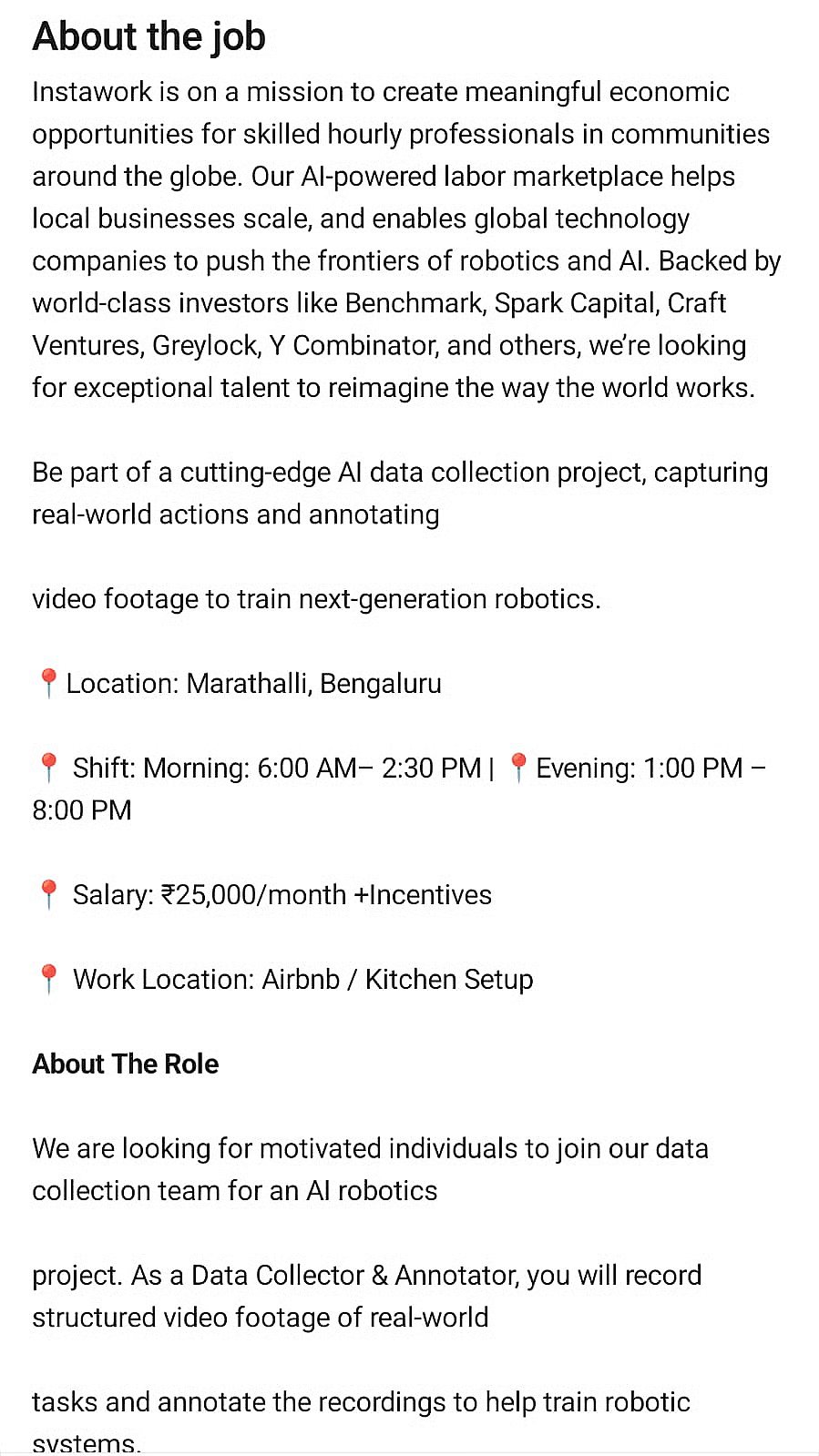
Workers in this programme are asked to perform scripted household and kitchen tasks — arranging objects, handling appliances, placing ingredients — while narrating their actions on camera. They follow a prescribed task list, state commands audibly, and repeat the same task for an entire shift.
TNM was unable to independently verify the locations of these properties.
Instawork’s data collection project advertises for workers on LinkedIn, but does not publicly disclose where recording sessions take place.
Clifton said that the implications of unregulated data collection in private spaces go beyond wages and contracts. “The moment you take people into an Airbnb, that becomes a workspace,” he said. “What if there is any kind of sexual harassment that takes place there? Or any other form of exploitation? Then who is responsible?”
Who benefits
The demand for egocentric training data has been building for years inside AI research labs, but 2026 marks a sharp acceleration. A report by investment firm Stellaris Venture Partners estimated that robotics labs will require between 100 million and 1 billion hours of first-person video over the next two to three years. That requirement has spawned an entire industry of data collection companies, many of them operating in India where informal workforces are large, labour costs are low, and regulatory oversight is limited.
Several Indian startups have built their entire business around this demand. Humyn AI and FPV Labs are among those creating tailored egocentric datasets for robotics firms. Ishank Gupta of Humyn AI has publicly said that existing data repositories do not meet the needs of robotics labs, making custom collection a priority. Objectways, a data services company with offices in Tamil Nadu, has transitioned its services to include egocentric video collection for embodied AI. Awign runs a network of over 1.5 million gig workers across more than 1,000 cities, capturing over 1,000 hours of 4K first-person footage every day using head-mounted iPhones and GoPros.
Instawork’s move into this space is part of that broader shift. Starting as a digital staffing agency, it is now in the business of collecting human expertise, digitising what workers know and feeding it to the machines being built to replace them.
What is happening at New Thippasandra has already been quietly taking root across India too.
Earlier this year, head-mounted cameras appeared in garment factories in Haryana and Maharashtra. A report by Scroll identified one site as a Gurugram factory operated by Pearl Global Industries, a major apparel manufacturer with operations across 10 countries. A factory in Maharashtra was using headbands belonging to a startup called Egolab.AI, which describes itself as India’s largest first-person POV data aggregator.
Instawork’s response
In response to questions from The News Minute, an Instawork spokesperson said the company’s data collection programme “supports frontier robotics development and deployment with an active population of contributors across multiple markets, including New Thippasandra in Bengaluru.”
On pay, the spokesperson said rates “vary based on multiple factors such as time and location” and that “all contributors review the applicable rate and work requirements for each engagement prior to accepting any opportunity”.
The workers we spoke to told a different story.
Nagraj had not been informed that his pay would be reduced. Sushmitha said the reduction happened without warning. Neither had signed anything that set out what rate they had agreed to or under what conditions it could change.
On data rights, the spokesperson said Instawork “provides contributors with a process to withdraw from the programme and request deletion of their data, consistent with applicable law”.
None of the workers TNM spoke to were aware that any such process existed.
Nagraj will come back tomorrow. He will put on the headband, sort his stock, and attend to his customers. The footage will travel to servers, to models, to machines being trained to do what he does.
This report was republished from The News Minute as part of The News Minute-Newslaundry alliance. Read about our partnership here and become a subscriber here.
 Rs 3,350-cr MoU, 70,000 jobs: A Yogi govt AI investment deal is now under fraud cloud
 Your favourite viral column might have been written by AI. Now what?
  ‘Will AI replace me?’: Anxiety grips tech workers amid mass layoffs, slowing recruitment