Is the Cockroach Janata Party threatening the system, or just letting off steam?
What makes the Cockroach Janta Party’s dissent so digestible for the state?

While addressing the crowd gathered at the Cockroach Janata Party (CJP) protest at Jantar Mantar on Saturday, founder Abhijeet Dipke invoked the famous Spiderman quote: “With great power comes great responsibility.” It is worth holding him to that standard, and asking what CJP has done right, and what it has missed.
The CJP’s founding was an internet accident – a satire that became too real too quickly. Its Instagram handle gained a following of 22 million, far surpassing the ruling BJP. But would it translate into an offline presence? This is what people wanted to know and see happen.
Such questions were somewhat answered on June 6, the day Dipke returned to India. CJP’s first protest concluded as a sweaty mess of dissent on a Saturday afternoon. Since then, Dipke has led protests in eight different cities across the country. He was even slapped during one of them.
They then returned to Delhi on Saturday (June 20), turning the protest into an indefinite sit-in – one the police have allowed to continue despite it being illegal. Their main demand – the resignation of Education Minister Dharmendra Pradhan – is yet to be met.
The slow start
Dipke has found himself with a historic opportunity, and has been courageous enough to try to turn it into a movement to “change the system”. That is not a small thing.
Start with the first protest. The translation of 22 million followers into an offline crowd was weak at best. Only around 4,000 people showed up, and many of them were there not because of CJP’s pull but because student organisations like AISA, SFI, KYS, and Disha had put out the call. The rest were a smaller core of genuinely outraged, first-time protestors.
There was no stage, no loudspeaker, no mics, until those accustomed to the template made efforts to arrange the same. Even then, the victims of paper leaks or CBSE’s digitisation failure, or even the left organisations did not get the space to speak.
Permission was granted until 5 pm. And yet, the organisers packed up by 3.30 pm and left. If Dipke had insisted on staying at Jantar Mantar, we may have seen visuals of detention, and the crowd may have doubled in size as the sun set. But no such daring was attempted until recently.
Good cop, good cop
The most striking thing about the CJP protests is the absence of confrontation.
When right-wing agitators and YouTubers tried to disrupt proceedings, police quickly removed them. Hindutva hate could not penetrate CJP's protest — making it indeed a bubble.
Protesters handed roses to police officers. Officers accepted them. The atmosphere often felt less like a confrontation with the state, and more like a supervised expression of frustration.
This is not how the Indian state has treated most mass mobilisations in the last decade.
Farmers were stopped at Delhi’s borders with trenches and nails. Anti-CAA protesters were branded anti-national. Student leaders were jailed. Environmental activists have faced FIRs and surveillance. Even peaceful gatherings routinely attract prohibitory orders, detentions, police action and a relentless media smear campaign. In recent years, protesters have been called everything from tukde-tukde gang to Pakistani before they've finished uttering their first slogan. The fact that the usual suspects on TV news — an extension of the government machinery — chose to ignore CJP almost felt generous.
On the first day of the protest at Jantar Mantar, a reporter colleague of mine noticed the transparent plastic lathi the ITBP guys had in their hands and remarked, “This must not hurt a lot.” To this, the personnel and I chuckled, knowing the damage it does.
The joke captured something important. The lathi was present. The power was present. The state simply had not felt the need to use it. Perhaps the greatest compliment one can pay CJP is that it has managed to bring politically-disengaged young Indians onto the streets. The greatest criticism one can make is that the state does not yet seem particularly worried that they are there.
Safety valve theory
As one widely shared post on X put it, CJP is increasingly playing the role of a “safety valve” – one that helps the outraged express their anger without actually resulting in systemic change; releasing the excess steam while allowing the masses to “cook in their own juices”.
A mass movement cannot be sustained on anger alone. This, however, is not a mass movement yet.
A protester, who works in advertising and asked not to be named, viewed the police’s cooperative attitude as evidence that the agitation posed little challenge to the authorities.
“This feels like a controlled blast. You let people’s anger burst out and then carry on as usual. The moment you step out of these barricades with this many people and mics, it’s going to be a problem. We all know that.”
He argued that the protest remained confined within limits acceptable to the state. “It’s convenient for both the police and the protesters. The government can say, ‘We’re allowing you to protest,’ and then ignore the demands being raised.”
The protester acknowledged improvements since the June 6 demonstration, particularly the greater space now being given to students and victims of paper leaks. But he felt the movement was still overly dependent on a handful of leaders.
While Umar Khalid has been in prison as an undertrial for over five years, his name is still relevant – in the protest, and among the voices against the Hindutva ideology. Referring to him, the protester said, “There are leaders that inconvenience the authorities and those that don’t. The ones that do, like Umar Khalid, are inside.”
He added, “The mic keeps coming back to the stage. It’s very controlled who it goes to. If more people aren't brought into decision-making and organisation, then this remains a launching pad for a few leaders rather than becoming a broader movement.”
He also questioned whether the campaign’s central demand was sufficient. “If Dharmendra Pradhan resigns, they’ll be able to claim a victory. But the leaks will continue. Pradhan is just a pawn in the system. He’ll be replaced by somebody else and the cycle will go on.”
With great power comes great expectations
On the second day of the sit-in, SFI had put up its own banner with its own set of demands, and members were stationed nearby selling bookmarks and booklets.
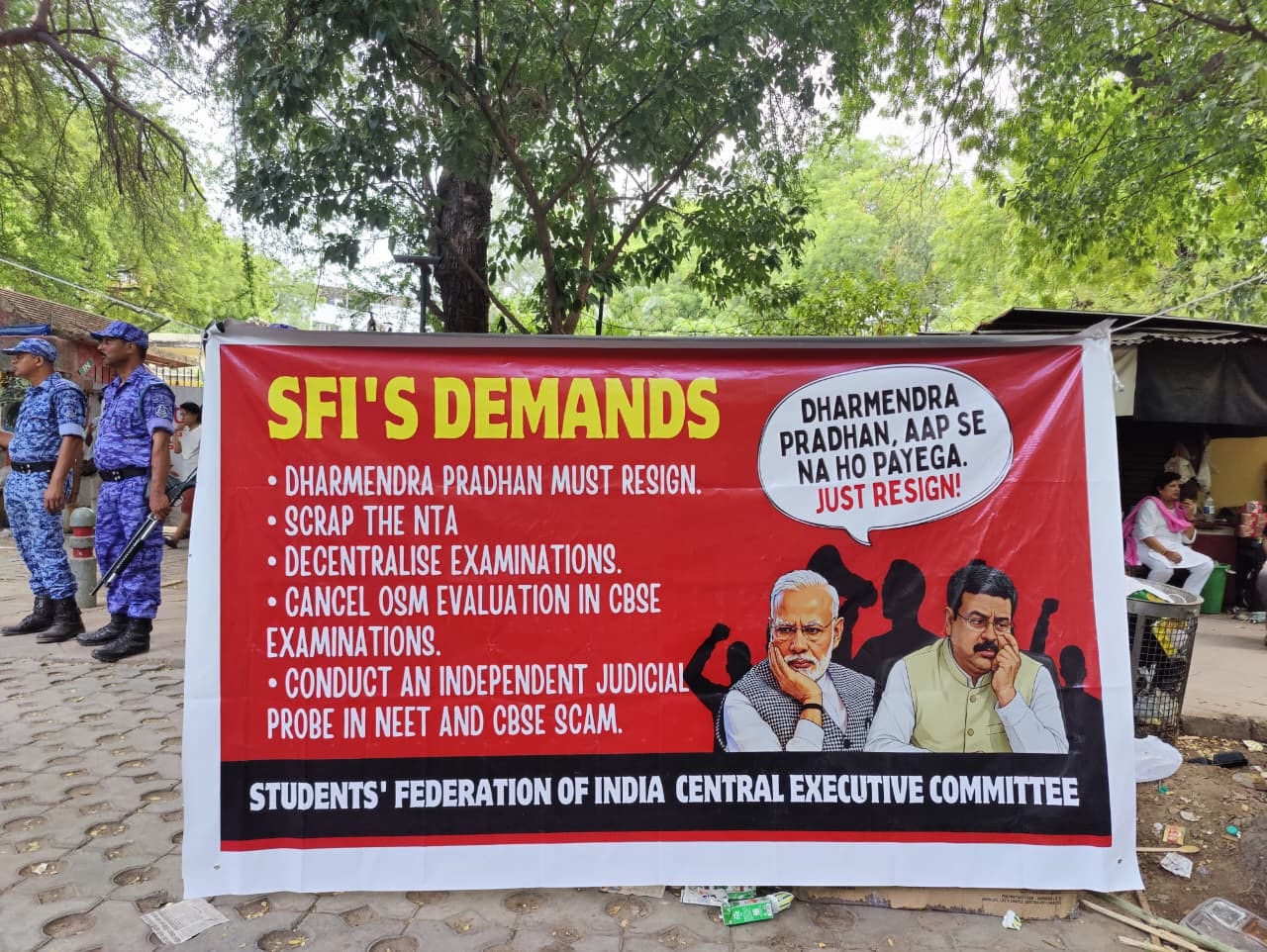
Mehina, a 26-year-old PhD scholar in English Literature at Delhi University and an SFI state committee member, was quick to draw the line between the two.
“There is a huge difference between CJP and SFI,” she said. “SFI has existed since the 1970s and has led student movements on the ground for decades. CJP is a platform that emerged spontaneously and has managed to bring together the anger of students.”
That anger, she argued, was being aimed too narrowly. “We often hear that CJP is apolitical and that its only demand is Dharmendra Pradhan’s resignation. This is where we fundamentally differ. We want his resignation too – it would send a message. But it should be symbolic, not the end goal. The public education system has been in crisis for years, and we cannot reduce that to one individual's resignation.”
She was equally direct about the risks of spontaneity itself: “The problem with spontaneous movements is that we don’t know where they will go. We don’t know where CJP itself will be two years from now.”
Still, she credited CJP’s leadership with growing more politically literate. “Earlier they were not interacting much with left organisations, but they have realised the importance of doing so. They are reaching out not just for mobilisation but also for guidance. I appreciate that.”
For Mehina, the deeper problem isn’t CJP — it’s the fragmentation of the opposition itself. “Everybody in the opposition is divided. Different movements are divided. There is a tendency to think, ‘That is their movement, we won’t be part of it,’ or ‘This is our movement and they shouldn’t be part of it.’ We are not going to achieve anything like that.”
“We need united fronts, larger alliances, and a common approach to holding this government accountable,” she said. “That is why we are here – not just in solidarity, but as part of a movement we have been involved in for many years.”
A veteran’s view
A feminist activist who has participated in and led several movements, including protests following the 2012 Nirbhaya gang rape, disagreed with the view that CJP’s demands were too narrow.
“In any protest, demands emerge in stages. They cannot begin with systemic change,” she said. “This is a specific demand for accountability, and that does not mean the movement should end there.”
“This is a government that has taken zero accountability for anything since 2014 – nobody has resigned for any disaster. Even the slightest dent on that will be huge. It is an abnormal government that only communicates from one side. The resignation will make it a government that is forced to negotiate,” she added.
“Peaceful forms of protest are crucial,” she said. “One should not fall into the trap of allowing the government to sabotage the movement or portray it as violent.”
At the same time, she said, “The only thing I would suggest is that they interact with as broad an audience as possible. Those conversations can help guide the movement and perhaps even help identify its next steps. The fear of giving space to more leaders should be dropped. Bring more people into decision-making,” she said.
According to her, expanding participation and broadening demands need not come at the cost of unity. “Let there be wider demands because these demands will not be met in one sitting,” she said. “But on the ground, people should remain united.”
‘Not here for Abhijeet Dipke’
Bewesh, a 25-year-old freelance designer from Sikkim, has travelled to multiple CJP protests at his own expense. Wearing a “Save Manipur” t-shirt, he was the protester who threw an Indian cricket team jersey at Dipke during the June 6 demonstration in Delhi – that Dipke then wore.
For Bewesh, the movement’s greatest achievement has been its willingness to provide a platform to people and causes that often struggle to find national attention.
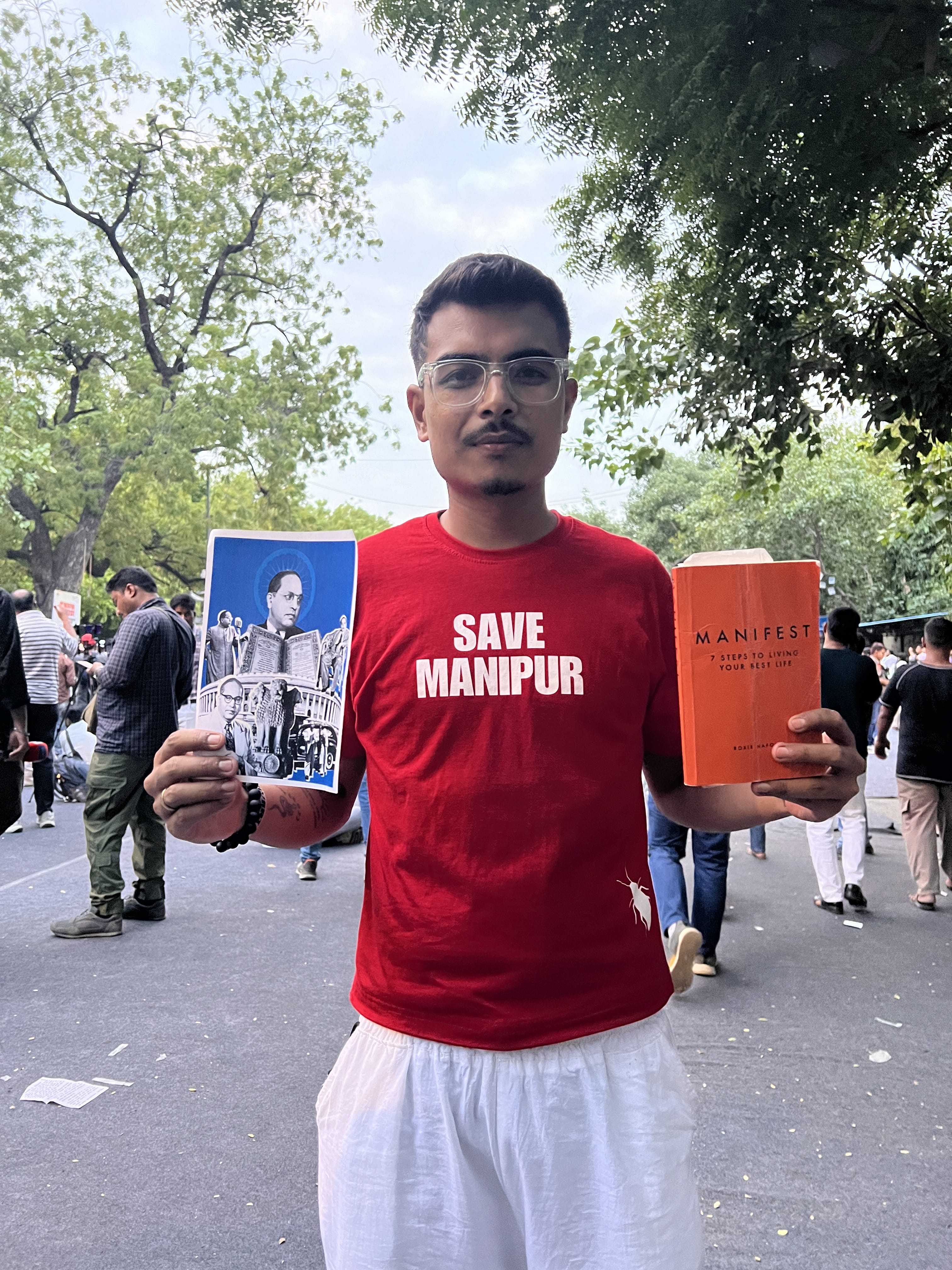
“I have hopes from CJP because they gave me a platform to talk about Manipur,” he said. “When I spoke about Manipur at one of the protests, the entire crowd chanted for Manipur. Till then, I felt Indians don’t care about us. But I was wrong; many simply don’t know what is happening there.”
Three years after ethnic violence first erupted in the state, Bewesh said he was now trying to build a campaign (India for Manipur) of his own to keep attention on the issue. “Three years is a very long time. People need to keep raising their voices.”
Unlike some critics who questioned whether CJP was becoming a launching pad for a handful of leaders, Bewesh said personalities were not what drew him to the protests.
“I am not here for Abhijeet Dipke or Saurav Das or CJP,” he said. “I am here because this is a movement for every young person in India.”
At the same time, he felt the movement would need to expand beyond a few visible faces if it wanted to grow. Recalling messages he had received from people in other states asking when protests would reach their cities, he said CJP needed local organisers across the country.
“People from Siliguri were asking me if there would be a protest there. People from Himachal were asking the same thing,” he said. “They need teams and organisational committees in every state that can mobilise people.”
Whether the movement grows, he added, depends not only on its leaders but also on its supporters. “That’s on me and other people too. It's my duty to raise my voice and their duty to support it.”
‘You have to stand with people’
Jaya Priya, 25, spent Sunday handing out water bottles to protesters. A volunteer since CJP’s first demonstration on June 6, she’s preparing for the UPSC exam and holds a master’s degree in History from Miranda House, Delhi University.
Where others picked apart the movement’s strategy, Jaya pushed back on the instinct to critique at all. “First things first — the system has been flawed for years, and it was difficult to raise our voice. Now one voice has risen, and we must support it openly.”
Growth, she argued, isn’t CJP’s job alone. “People say they support us from home, but that's not enough. You have to come to the ground physically. You have to stand with people.”
She gestured at the crowd around her. “We are students. The parents of affected students are here too. These are the people standing at this protest, not anti-nationals or terrorists. We just want the government to hear us.”
Small teams can do great things. All it takes is a subscription. Subscribe now and power Newslaundry’s work.
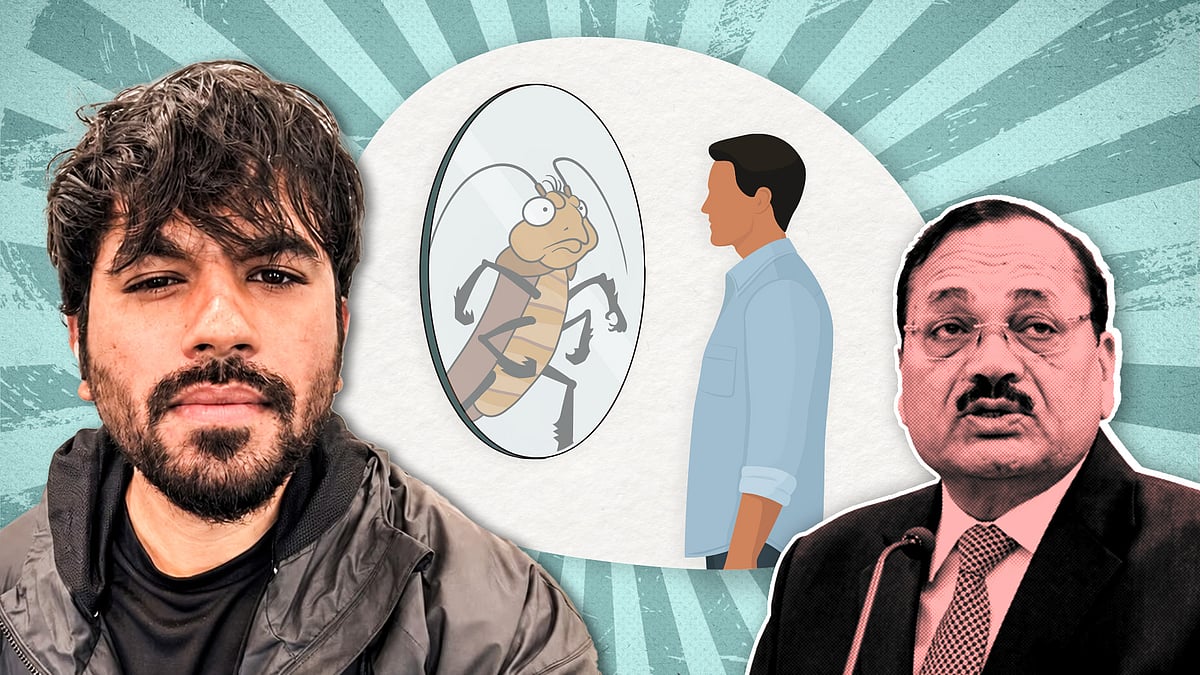 The Cockroaches are restless: Anatomy of a 22-million-strong meme movement
 CJP can endure the meme cycle. But can it articulate what kind of India it’s fighting for?