Lucknow to Jantar Mantar: India’s youth are screaming, but who is listening?
From the ashes of a fire tragedy in Lucknow to the CJP protest in Delhi, the youth are calling out a broken ‘New India’. Why is the press refusing to connect the dots?

Fifteen young people were suffocated to death. They were professionals. They were employed by a gaming studio. They worked in a room with no ventilation. In a building with only one exit, without even the minimum fire safety protocol.
This happened not in a small town or in a remote part of India. It happened in Lucknow, the capital of India’s biggest state, Uttar Pradesh. A state whose Chief Minister’s face can be seen alongside the Prime Minister’s almost every day in newspapers in full-page advertisements, where they boast of how the state is making rapid progress.
Perhaps Indians are now so inured to such avoidable disasters that we read about them and move on. After all, people are killed every day in India when fires break out even in recently constructed residential towers, when chemicals leak in factories, when slabs fall on workers in construction sites, and now with the advent of monsoons in cities like Mumbai, when commuters walking through filthy, flooded streets fall into open manholes.
Yet, the Lucknow tragedy stands out for what it represents. As Kaushik Das Gupta rightly points out in his article in The Indian Express, “tragedy after tragedy has not driven home the basic lesson that when commercial expediency intertwines with weak enforcement, human safety is compromised.”
The reports of the fire detail the extent of the compromises made in this building. But this is not the only one. Walk around your city, and you can spot hastily constructed structures in crowded areas, some barely finished, that are occupied by businesses, the ubiquitous “coaching classes”, and even personal residences.
Only when there is a tragedy, when at least ten people are killed, is there a furore, and demands for accountability. But as we know, the problem simply doesn’t end. Until the next disaster.
Another article in the Express by Adarsha Kapoor, an urban designer, pinpoints one of the possible reasons for this cavalier approach by builders and municipal authorities towards safety: “In recent years, as part of the government’s ‘ease of doing business’ initiative, compliance requirements for smaller-occupancy buildings have been relaxed. While this has simplified approvals, applicants often fail to realise that they remain responsible for ensuring their buildings comply with the fire-safety provisions of the National Building Code. These include minimum access widths, refuge areas, fire staircases, and installing fire-safety equipment.”
For the media, the Lucknow tragedy is a wake-up call. With almost half the population of India now living in urban centres, big and small, reporting on cities requires focus and knowledge of laws and regulations so that questions can be asked before a disaster, not just after it happens. At least the bigger metropolitan cities get some media coverage. Our small towns epitomise the total absence of planning and regulations, and there is little to no focus on them, except when a big enough disaster occurs.
The other aspect of the Lucknow fire is the human one, the young people killed in it. There were heartbreaking reports of some of them phoning their parents, begging them to intervene and save them.
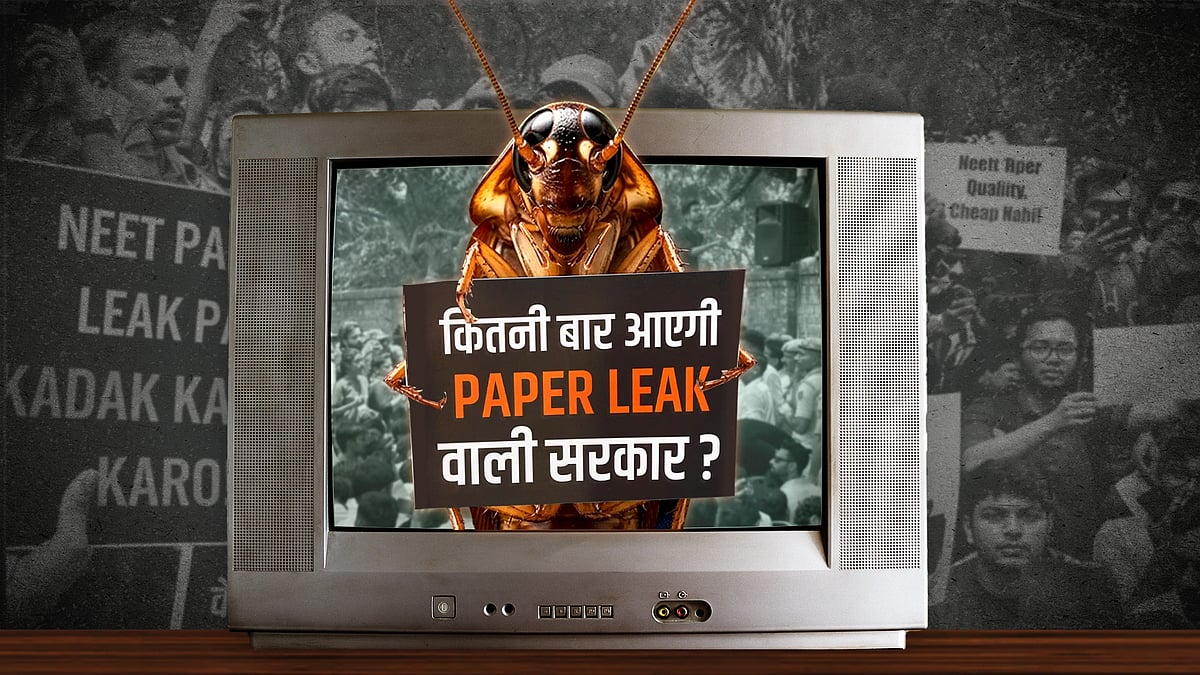
Currently, as several young people camp out in New Delhi’s Jantar Mantar demanding the resignation of Union Education Minister Dharmendra Pradhan over the NEET paper leak, the country’s young demographic is trying to convey a message to leaders and the media.
The 15 killed in Lucknow represent this demographic, of young aspirational Indians, who used new opportunities that have opened, such as animation. Most of them would have invested in training and then been excited when they found a job at a gaming studio. None of them would have stopped to question why the place had no windows and only one exit.
The frustration over the cancellation of the NEET examination after the leak has also forced us to hear the voices of this generation, mostly on social media. It was particularly disturbing to watch videos of some students who went for the re-test of the NEET on June 21 being denied entry because they arrived a few minutes late.
Yet the media is not taking the time to reflect adequately on this accumulation of frustration and anger among youth, most of whom are politically unaffiliated, and many of whom are now stepping out and speaking up for the first time.
Of course, we also need to acknowledge that this generation does not turn to established media for news, nor does it expect it to reflect their views. The latest Reuters Institute Digital News Report 2026 points out that “social media and video networks are for the first time the single most widely used way of accessing online news (used by 54% of all respondents), ahead of news organisations’ own websites and apps (51%). This shifting composition of news consumption is happening among all age groups.”
With access to social media and other digital platforms, young people who are agitated about the state of affairs are making their voices heard. In fact, amid the gloom, perhaps the only encouraging aspect of the recent developments is the clarity and fearlessness with which many of these young people, especially young women, are speaking up (here, here, and here).
However, we must question whether getting avenues to vent and articulate your frustration is enough to bring about policy change. Do they end up speaking to their own kind, young people who share their views? Do governments really pay any heed to what appears on social media, except when it directly implicates an individual in power?
What these last weeks, with the emergence of the Cockroach Janta Party, and the anger and frustration expressed over exam leaks, as well as tragedies like the one in Lucknow, make clear is that the youth demographic in India cannot be ignored, even if the majority, especially those belonging to marginalised classes and castes, hesitate to speak out. It is the big story that the media needs to follow.
It is also evident that our systems – education, urban regulations, industrial safety and more – are broken in this so-called ‘New India’.
And yet, apparently, our rulers don’t seem to see this. As Das Gupta writes:
“It is difficult to believe that politicians who claim to have spent years on the ground and speak in the name of a New India cannot grasp a simple truth: Every student driven to suicide by the academic system’s uncertainty, every young life crushed under the rubble of a collapsing building, every person killed in an inferno takes a toll on public trust in institutions. Each tragedy tells young Indians that the system cannot keep its promises about the demographic dividend. What more will it take for those in power to act with urgency and apply meaningful corrections?”
Complaining about the media is easy. Why not do something to make it better? Support independent media and subscribe to Newslaundry today.
 In the red and on their knees: Why corporate media tolerated its own ruin under Modi
 Mainstream media is losing a generation. Cockroach Janta Party is merely a symptom