Designed to eliminate, not select: A student’s account of the NEET ordeal
From a gruelling registration process to question papers that reward only rote learning to the hassle of simply making it on time to an exam centre, NEET is designed to keep medical aspirants from their dreams, writes one student.

What is the real purpose of this torturous path? Is NEET designed to identify the country’s most capable and deserving medical aspirants, or has it been designed to eliminate the dreams of as many students as possible before they even have a chance?
The arduous process begins long before we even enter the examination hall. It starts with the registration process itself. It took me an entire day just to submit my NEET application form.
When you open the registration website, you are met with a reassuring message that the process has been "made easy" and can be completed in "three simple steps". Once you begin, you realise that each step branches into dozens of sub-sections, instructions and more forms.
The sheer number of requirements is overwhelming. Many of the fields are worded so confusingly that we often struggle to understand what information is even being requested. Instead of feeling guided through the process, we are left second-guessing and overthinking each step, scared that one small mistake could destroy our chance of writing the exam.
It often feels like the process has been made convoluted just so that as many applications as possible can be rejected.
Let’s say you manage to make it through the gruelling process of registering for this exam. Once you begin preparing, you wonder if the intention is to test students' understanding of concepts or to determine their capacity to rote-learn information.
When you go through previous years' question papers, they do not appear to be designed to test students' logical thinking and scientific reasoning but rather if they can remember the vaguest names, formulas and information from a random line in a textbook.
This is why there are so many coaching centres that focus on making students memorise every single line of the book — It’s what works for the current exam’s design.
Coaching centre students perform the best and score the highest ranks because NEET is designed to ensure that students don’t think for themselves and have no intellectual curiosity.
I have known students who clear NEET with exceptional ranks but fail in the first year of their medical course because they are unable to truly grasp concepts. They are like people who can read and write a language but don’t understand the meaning of the words in front of them. They do not even have a basic foundation in the sciences they read about day and night.
This should worry all of us because the purpose of medical education is to create doctors who can reason, analyse, and make life-changing decisions. With NEET, it’s become clear that understanding concepts is optional, but memorisation is essential.
Now we reach the next stage – the exam centre. The goal seems to be assigning centres as far away as possible from the address you’ve provided.
I'm not talking about the absurd cases, such as when a Nagpur student was assigned a centre in Abu Dhabi. Even when you are assigned one in your own state, the centre is at least 1-2 hours away. If they can’t assign centres according to our address, why waste so much of our time making us fill out details they have no intention of using?
Next let’s move on to the commute to the exam centre.
The exam starts at 2 pm. The centre closes at 1 pm. You, obviously, will plan to arrive at least an hour before. You’ll also want to keep traffic or road closures in mind. With exam centres assigned at least 1 to 2 hours away, you’ll have to leave early to be on time. You’ll have to wake up earlier than that to get ready and have breakfast.
The exam itself takes 2 to 5 hours. Security checks when you leave the exam hall can take another 30 minutes to an hour. By the time you leave, it’s at least 6 pm.
This means that from early morning to around 6 pm, NEET students are forced to write the most important exam of their life with barely any food. How ironic to make medical students follow unhealthy eating habits.
When I sat for NEET, the queue for frisking, before entering the hall, was so long that you couldn’t tell where the line ended. It took an hour for me to reach the front of the line. You are not considered to have entered the centre until frisking is completed.
Some schools manage to make proper arrangements, but they’re the exception rather than the rule. Most of my friends have instead experienced packed exam centres overwhelmed with parents and students. Students aren’t allowed in if they are a minute late.
Worsening matters, most exam centres do not provide drinking water to students. The less said about the condition of the washrooms, the better.
Another problem students face at the exam centres is the lack of provisions to safely store personal belongings. Students who use public transport have nowhere to deposit their bags, documents or money. They are expected to drop it off on the footpath.
I’ve seen girls crying in fear because a small gold nose stud or earring has to be left at a bush or tree. How can these students be expected to focus on an exam in this emotional state?
Inside the centre, there is often barely any signage to guide you to the right hall. The invigilators seem to have no training on how to conduct exams. They don’t even remain silent during the exam. Snacks, biscuits and juice are provided for the invigilators, which they eat in front of the students.
When you leave the centre, there is little planning or crowd control. Parents rush around searching for their children. Some climb trees or shout in the hope of finding them. It’s a mess.
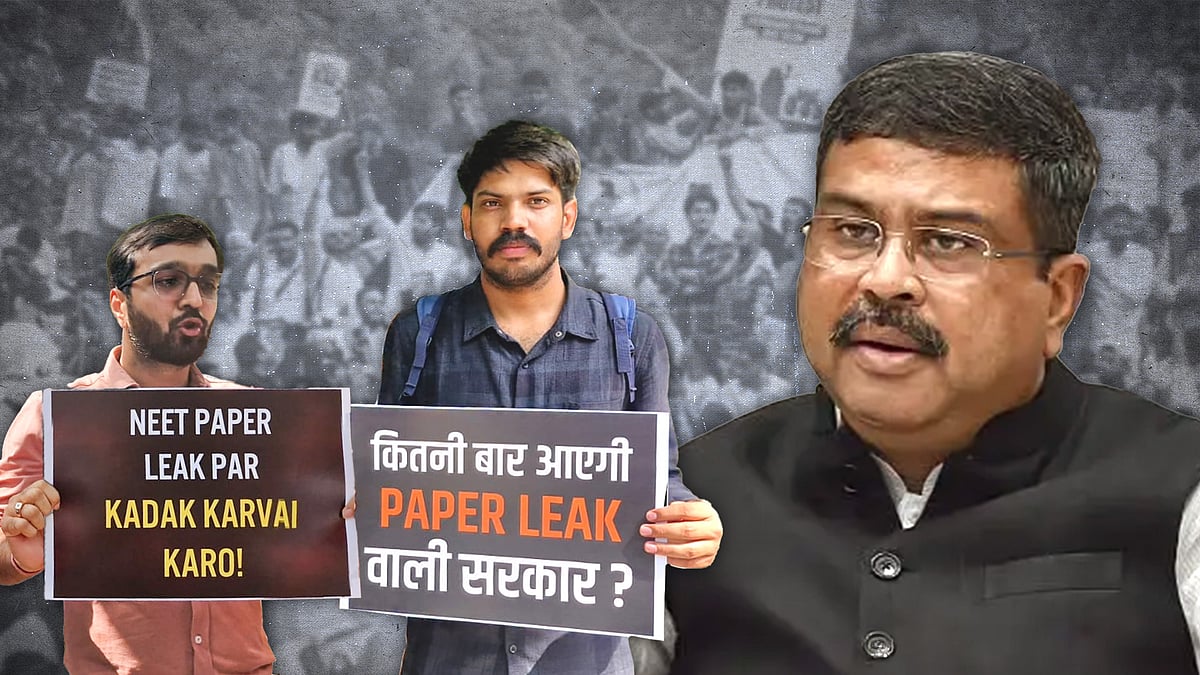
After enduring all this, you find out that the paper has been leaked. Then you discover that multiple leaks have happened. If a house gets robbed once, the thief is at fault. But if a house is robbed 25 times, something is wrong with the security system.
Despite leaks and so many other problems, the same man, Education Minister Dharmendra Pradhan, remains in charge. At this point, they are just playing with students’ lives.
There have been so many NEET-related suicides, but I think those deaths should be considered murders when those in charge keep allowing it to happen.
Now that so many people are pointing out flaws and mishandling, cases are being filed against them, accusing them of spreading rumours. Instead of putting in efforts to stop leaks, the Union government is trying to prevent the public from finding out about the leaks.
We’re told the Indian Air Force (IAF) will transport question papers. But not once has the paper leak been found to have happened during transit. How does this solve the problem, then? This is the equivalent of putting a band-aid on your knee after you’ve been punched on the nose.
Knee-jerk reactions will not fix the massive issues in the system and give us the best doctors of tomorrow. Ultimately the pressure that this system and NEET put on everyone is psychologically, and often literally, killing more students than the patients medical aspirants hope to save one day.
This piece was republished from The News Minute as part of The News Minute-Newslaundry alliance. Read about our partnership here and become a subscriber here.
 343 posts since May, but India’s exam crisis barely exists in the education minister’s timeline
 I had to leave India to become a doctor. NEET exposed a system I already knew