Missing in print: The Telegraph ignores its former editor’s ordeal
While press associations, politicians, and social media outrage over R Rajagopal’s SIR ordeal, the newsroom he led for seven years has barely breathed a word.

For four days now, the passport troubles of R Rajagopal, former editor of The Telegraph, have consumed social media and drawn the attention of the Editors Guild of India, the Press Club of India, opposition politicians and a clutch of senior journalists.
In that time, The Telegraph’s print edition has not carried a single line on the case, not even as a routine news brief, despite it involving a man who spent a total of 29 years in the newsroom, 7 of which were spent as editor between 2016 and 2023.
The only acknowledgement has come in a solitary online report that covers the letter Kerala chief minister V D Satheesan wrote to his West Bengal counterpart on the issue.
The silence was first flagged by journalist Krishna Prasad on X, who noted that, despite the “intricacies of the case” drawing national attention, Kolkata’s own paper of record had nothing to say about its former editor’s predicament.
In a note Rajagopal wrote, which caught traction on X (formerly Twitter), he stated that in March 2026 his name was struck off the Ballygunge constituency electoral roll in Kolkata during the Special Intensive Revision (SIR) exercise because Election Commission officials could not trace his name or his late father’s in the 2002 voters’ list. His father was a Gandhian and a former state secretary of the Gandhi Smarak Nidhi in Kerala. His appeal is now before a tribunal, and in the meantime, he could not vote in the recent West Bengal assembly election.
The deletion has since snowballed into a passport crisis for him. Though Rajagopal completed his biometric formalities for renewal on March 19, Kolkata Police sent an adverse verification report citing his absence from the electoral rolls, and as of today, his renewal remains stuck. He was summoned to the Regional Passport Office in Calcutta “immediately”, but the earliest appointment he could secure is July 17. This meant that he could not travel to San Francisco in April for his daughter’s wedding, despite holding a valid 10-year US visa.
Rajagopal has been careful not to portray himself as a lone victim, writing that if someone who spent a career in journalism can run into this wall, “one can only imagine what the truly marginalised must endure”. He said he deliberately did not approach any newspaper about his case, adding that editors and journalists who know of it but choose to look away “should not be in the profession”.
The Press Club of India and the Editors Guild of India have both weighed in on the matter.
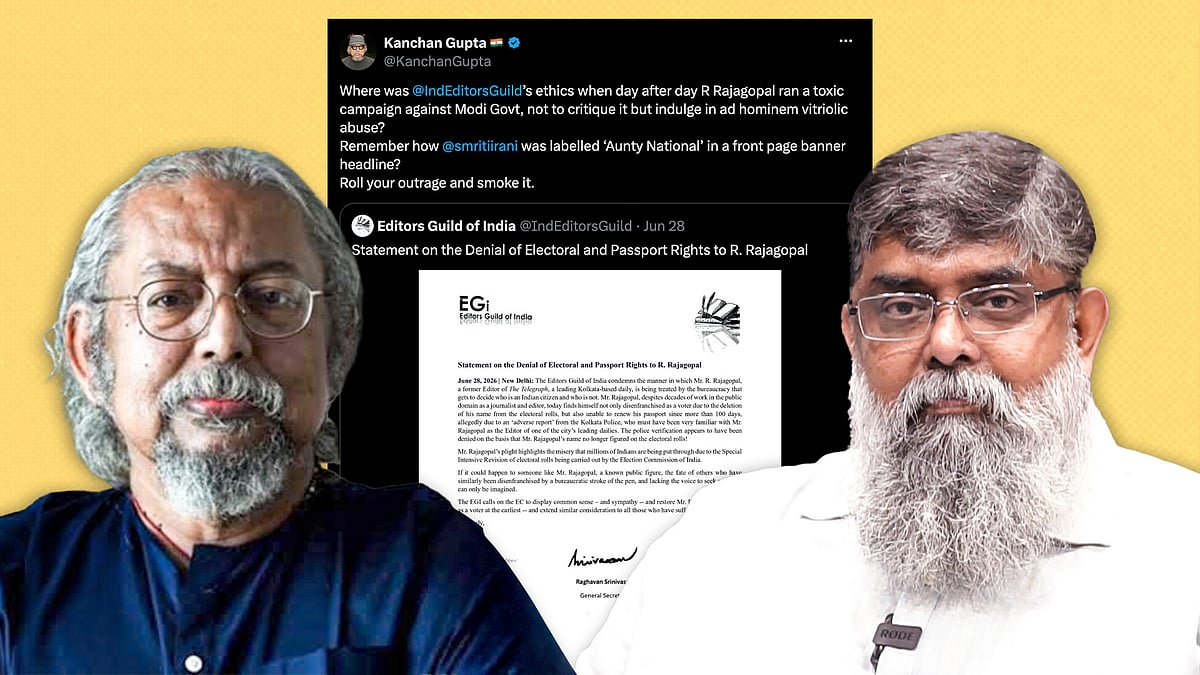
On Sunday, the Guild said that Rajagopal’s case highlights the wider misery inflicted by the SIR exercise, warning that if a public figure of his stature could lose his voting rights this way, ordinary citizens were likely faring worse.
The Press Club followed suit on Monday, disclosing that Rajagopal isn’t an isolated case. Senior journalist and author Samrat Choudhury also had his passport impounded on Passport Seva Divas (June 24) over an adverse police report, despite holding an Indian passport since 1993, appearing on Meghalaya’s electoral rolls, and having renewed it under Tatkal as recently as 2022.
However, not everyone has been sympathetic to Rajagopal’s case.
Kanchan Gupta, a former journalist now serving as a senior adviser in the Ministry of Information and Broadcasting, dismissed the Guild’s concern as selective, invoking Rajagopal’s past coverage of the Modi government as editor of The Telegraph, including a headline that referred to Union minister Smriti Irani as “Aunty National”, and suggesting the outrage over his passport was misplaced.
That tweet drew pushback.
Small teams can do great things. All it takes is a subscription. Subscribe now and power Newslaundry’s work.
 Press club flags another passport case after govt adviser tries to shift focus to old headlines
  Deleted from the rolls, barred from the world: A former editor’s SIR ordeal