Hum do, humare teen: Why wanting more babies and having them are two different things
Indians are having fewer babies. This shrinks the window to boost the economy before the population ages and growth slows.

Hum do hamare ho do, paas aane se mat roko
– Indeevar, Jurm, 1990.
Come on baby light my fire
– The Doors, 1967.
India has come a long way from the 1970s and the 1980s when the slogan hum do hamare do was plastered on walls across the country, to 1997, when the then minister of state for health and family welfare, Renuka Chowdhury, declared that “one is fun,” and, more recently, Janhavi Nilekani arguing that “three-child families need to become a mainstream choice”.
From India having a lot of babies to India having fewer babies to India now being told that it needs to have more babies, the story has come full circle.
Dear reader, if you are the kind who still reads newspapers or follows what used to be referred to as the mainstream Indian press, you would know that during the course of June 2026, a small-scale industry writing on India’s falling fertility rate, seems to have emerged. I have decided to join that bandwagon.
There are two recently released government reports which suggest that India’s total fertility rate continues to decline.
The first is the rather complicatedly titled Sample Registration System Statistical Report (SRSSR) 2024. The second is National Family Health Survey (NFHS-6), 2023-24.
In simple English, a falling fertility rate basically means that the average Indian woman is having fewer babies than she was in the past.
As per SRSSR 2024, the total fertility rate (TFR) has fallen to 1.9. As per the NFHS-6, the TFR has fallen to 2.
This basically means that on average 100 women now have 190 or 200 babies, during their child bearing years, depending on the report that one chooses to look at.
What does this mean? India’s total fertility rate is now lower than the replacement rate of 2.1 babies per woman.
The replacement fertility rate is the average number of children each woman needs to have for one generation to replace the next without the population growing or shrinking. It is typically around 2.1 children per woman. The extra fraction of 0.1 is because a few girls will not survive up until their child bearing age.
This basically means that if 100 women on average have 210 children, and this trend continues over the decades, the population will eventually stabilize and continue to remain stable.
In the Indian case, the TFR now is 1.9 or 2, which is lower than the replacement rate of 2.1.
India’s TFR has been falling for a while now. It fell from 5.2 children per woman in 1971 to 4.8 in 1981, 3.6 in 1991, 3.1 in 2001 and 2.4 by 2011, with each successive census recording a lower figure.
In November 2021, the government had released the phase II findings of National Family Health Survey 5 (NFHS-5), which stated that India’s TFR had declined from 2.2 to 2. So, close to five years back, we knew that India’s TFR was already lower than its replacement rate.
So, why all the hungama now? The Economist happened to do a long and detailed piece on this phenomenon, and that led to the small scale industry emerging.
Nonetheless, an average Indian woman having fewer babies will have serious repercussions which will play out slowly over the next few decades.
Will India’s population decline?
The simple answer is not immediately. A decline in TFR does not translate into an immediate population decline due to something known as the population momentum effect.
Even though the total fertility rate has fallen below the replacement level, the number of women entering their childbearing years will continue to rise because fertility rates were much higher in the past.
Take the case of China. Its TFR fell below the replacement rate in 1991, three and a half decades back. But its population kept growing. It peaked only in 2021, three decades later, at 1.41 billion, and has been shrinking at a very gradual rate since.
Nonetheless, the TFR in China has now fallen to 1. It is expected that if things don’t change the Chinese population will reduce to around 700 million by the end of this century.
So, when will India’s population start shrinking? As per United Nations’ World Population Prospects 2024, India’s population in 2026 is expected to be around 1.48 billion.
The population growth will keep slowing down in the decades to come and India’s population will peak at 1.7 billion around 2061. So, like was the case with China, it will take a few decades for the population to peak and then start shrinking.
In 2100, it is expected that India will have a population of around 1.51 billion, very close to where we are right now.
Of course, like all long-term forecasts, this forecast is also based on certain assumptions. These numbers are what are referred to as the median forecast.
Under the low-fertility forecast, which assumes that an average Indian woman has fewer babies than is currently projected, the country's population is expected to peak at 1.55 billion in 2045.
Basically, India has around two to three decades before its population peaks. Why does that matter? We will come to that.
Why are Indians having fewer babies?
If you are the kind who likes to go down Instagram rabbit holes, like I do, you will know that there is a whole genre of over the top reels which are trying very hard to be funny, around the topic of mothers-in-law asking their daughters-in-law to have kids, and the daughters-in-law resisting it.
Of course, one look at our own families should tell us that every generation is having fewer kids.
My paternal grandparents had five kids. My maternal grandparents had three. My parents had two. Me and my younger sibling haven’t had any.
Now, there are multiple reasons for this.
First, for families living in extreme poverty, having many children has often been a rational survival strategy. Children contribute to household income through work, and when infant mortality is high, parents have more children knowing that not all may survive into adulthood.
As living standards and the standard of healthcare improves, more children survive and live to be adults. This reduces the need to have more kids and the family size begins to shrink.
India’s infant mortality rate has been falling over the years. As per SRSSS 2024, it stood at 24, meaning that one in every 42 infants die within one year of their life.
The rate was at 39 in 2014, implying that one in every 26 infants died within one year of their life. It was at 57 in 2006, meaning that one in every 18 infants died within a year of their life.
At the same time falling poverty levels and improving health standards have also had an impact. As the SRSSR 2024 points out: “In case of about 95.4 percent live births, the mothers have received… medical attention at delivery either at [a] government hospital or at [a] private hospital in 2024.”
These factors have worked towards women having fewer kids.
When it comes to poverty, the states with the most poverty are having the most kids.
The TFR is the highest in Bihar, where it stands at 2.9, implying that 100 women on average have 290 children. Bihar is the poorest state in India with a per capita income of Rs 69,321 in 2024-25, or less than Rs 6,000 a month.
Bihar is followed by Uttar Pradesh at 2.6, Madhya Pradesh and Rajasthan at 2.4 and 2.3, respectively.
Delhi with a per capita income of Rs 4.93 lakh in 2024-25 had a TFR of 1.2. Kerala with a per capita income of Rs 3.1 lakh had a TFR of 1.3.
The relatively well-to-do peninsular Indian states had lower TFRs. But so did West Bengal which had a TFR of 1.3 at a per capita income of Rs 1.63 lakh, showing that there are exceptions to every rule.
Second, the increasing ability of women to read and write plays a major role in reducing the TFR.
As Hans Rosling, Ola Rosling and Anna Rosling Rönnlund write in Factfulness – Ten Reasons We're Wrong About The World - And Why Things Are Better Than You Think: “The data shows that half the increase in child survival in the world happens because the mothers can read and write.”
Among other things this includes the fact that the mothers “can read the instructions on that jar of pills”.
How does the evidence stack up in the Indian case? Bihar with an illiteracy rate of 18% for women in the 15-49 years age group, has the highest TFR.
Uttar Pradesh with an illiteracy rate of 13.6% is second. Rajasthan and Madhya Pradesh have illiteracy rates of 13% and 11.6%, respectively.
Jharkhand which has an illiteracy rate of 14% has a TFR of 2.2, which is lower than states like Rajasthan and Madhya Pradesh, but higher than the overall TFR of 1.9.
Of course, like most trends at the overall societal level, this trend isn’t 100% correct, but it’s broadly true.
At the overall national level, the TFR for illiterate women is 3.2, implying that on average 100 illiterate women have 320 children. The TFR for literate women is 1.8.
Not surprisingly, as the education level increases, the TFR decreases. The TFR for women who are graduates and above is 1.6, which is half of that of illiterate women.
In fact, even some education makes a difference. In 2011, the TFR for women without any formal education was 3.1. It had fallen to a replacement rate of 2.1 by 2024.
For those with below primary education the rate has fallen from 3 to 2.1, during the same period.
In Bihar, the state with the highest TFR, the TFR for illiterate women is 4.2, whereas that for graduates and above is 2.2. In Uttar Pradesh it is 3.8 and 2.2, respectively.
This shows that in poorer states even the educated women tend to have more kids.
As Charlie Robertson writes in The Time-Travelling Economist: “When families have lots of children, the children become the parents’ “savings”. By the time they become teenagers [they] are hopefully earning an income… Eventually, they become your pension and can provide housing when you’re old.” The point being that when families are poor, they look at children as future savings.
Third, the mean effective marriage age for women has gone up over the years. It was at 19.3 years in 1990. In 2024, it was 23.1 years. This has led to the average age at which women give birth to their first child going up to 28.4 years. It was 26.5 years in 2011.
Fourth, in many countries, the collapse of the institution of marriage has also been blamed for women having fewer kids. But that isn’t true for India. In 1991, the proportion of married females was 45.7%, while the proportion of widowed/divorced/separated women was 8.1%.
Hence, in 1991, for every 100 females on average in the population, 54 women were married/ widowed/divorced/separated.
In 2024, the proportion of married females was 49.6%, while the proportion of widowed/divorced/separated women was 5.4%.
So, in 2024, for every 100 females on average in the population 55 women were married/ widowed/divorced/separated.
Clearly, things haven’t changed much on this front. Indian women are still getting married at the same rate as they were more than three decades back. They are just having fewer kids.
Fifth, more women entering the workforce also tends to be a reason for families having fewer kids. This doesn’t really apply much to India at the aggregate level.
Data from the World Bank shows that in 1990, the female labour participation rate – that is the proportion of women in the age group 15 to 64 years who are employed or are actively looking for a job – stood at 32%. It was at 35% in 2024.
The government’s Periodic Labour Force Survey puts that ratio at 40% in 2025. The NFHS-6 says that nearly 31 in every 100 women in the 15-49 age bracket worked in the last 12 months and were paid in cash.
Clearly, the proportion of Indian women going out to work isn’t high and hasn’t really changed much over the years.
Despite these factors, families are having fewer kids. Why? As the Roslings write: “Once parents see children survive… both the men and the women instead start dreaming of having fewer, well-educated children… More energy and time is invested in each child’s education. It’s a virtuous cycle of change.”
So, instead of dividing their limited resources on more kids, the parents want the best for one or two kids. This is referred to as the quantity-quality tradeoff – if a family has many children, each child usually gets less money, attention, and opportunities. With fewer children, the assets and efforts required to raise them well, get consolidated.
Why does this matter?
If you are the kind who gets your education from the WhatsApp University, then families having fewer children and that leading to population growth ultimately slowing down, seems like good news.
I mean all these years we have been told that India has a lot of problems because of its very high population leading to not enough resources being available.
The trouble is that there is more to the whole thing than just this. And it’s something known as the demographic dividend.
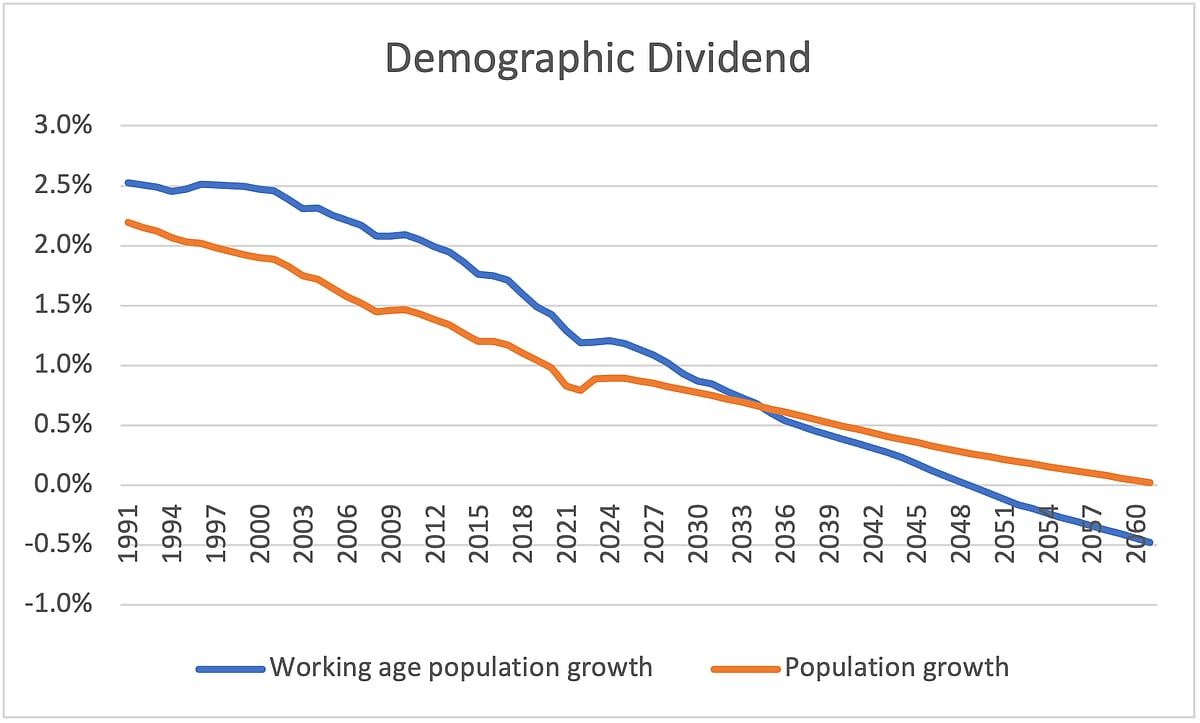
It is a period of a few decades when, thanks to a falling total fertility rate – that is women having fewer babies – a country's working-age population (those aged 15-64) grows at a higher rate than its overall population.
As more young people enter the workforce, find jobs, earn incomes and spend money, the economy is expected to grow faster than before, lifting more people out of poverty. In theory, this is how things are expected to pan out.
How do things look for India? Take a look at the following chart. It plots the one-year population growth from 1991 onwards against the one-year growth in working age population (15-64 years).

Sign up to read this story for free
Make an account to continue reading this story. For free! We will email you a weekly newsletter written by our reporters, linking our best stories.
Sign up for freeAlready have an account? Login