‘Where do we go?’: Jadavpur’s railway hawkers live in fear of the next bulldozer
The Calcutta High Court is set to hear petitions challenging railway eviction notices on Wednesday.

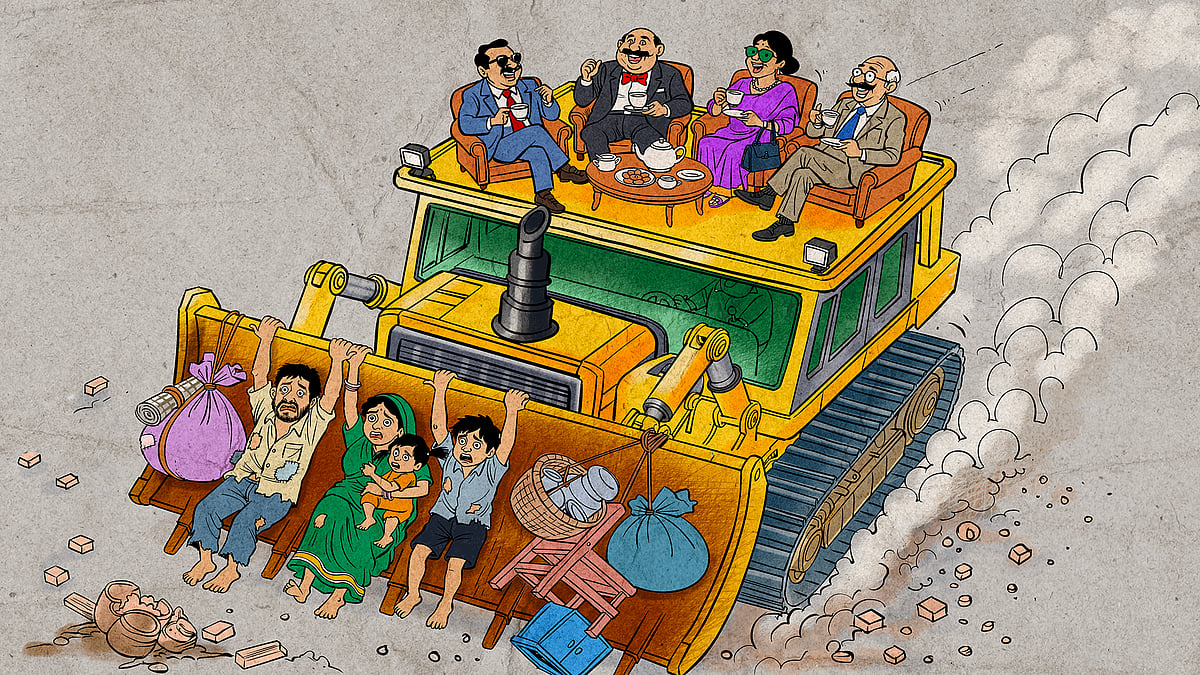
“Where do we go?” asks Saraswati Naiya, who has spent the last 35 years selling fritters from a small stall on Jadavpur’s railway platform for 35 years. She stares at the empty space where around 40 “illegal” establishments once stood before they were demolished on June 7. More than 300 other makeshift businesses still exist on the station’s premises, and among their owners, the same question hangs in the air.
“I don’t know what I will do if the shop gets uprooted. No one will give me a job in this state. Feeding people is what I’ve done all my life. What do I do now?” asks Saraswati, who is disabled and the shop her only source of livelihood. She says she has heard nothing from the government about their plans of rehabilitation.
Within weeks of the BJP government under Chief Minister Suvendu Adhikari taking office, a ‘zero tolerance’ anti-encroachment drive spread across Kolkata – Howrah, Sealdah, Dum Dum, Park Circus, Topsia, Kasba – reaching Jadavpur by early June.
At a press conference on June 12, Adhikari said public convenience took precedence over the occupation of public land. Nobody, he said, has the right to encroach on footpaths, but stopped short of committing to rehabilitation, saying, “Hawkers can move to unused markets and spaces. I shall consider your case from a humanitarian aspect if you are sitting on vacant land,” he said, according to The Telegraph. Officials have also cited the Central government’s Amrit Bharat Scheme, aimed at redeveloping railway stations, as one reason the drive can’t wait.
According to media reports, a batch of petitions challenging railway eviction notices across Kolkata, including at Jadavpur, remains pending before the Calcutta High Court. The court has extended its interim protection against further eviction while the matter is heard by Justice Partha Sarathi Sen. The case is next scheduled to be heard on July 15. The petitions were earlier heard by Justice Hiranmay Bhattacharyya, who sought clarification from the Railways on the procedure it intended to follow in carrying out the evictions.
According to hawker unions, the demolition drive in Jadavpur proceeded despite verbal assurances from Railway authorities on June 2 that no evictions would take place until later that month. Bulldozers arrived on the intervening night of June 7 and 8 in a joint operation by Eastern Railway, Kolkata Police, the Government Railway Police, and the Central Reserve Police Force.
Around 35-40 structures, including makeshift homes and shops on railway land were demolished during this demolition drive, according to The Wire. There was an attempt to stop this demolition drive as several hawkers, joined by CPI(M) leaders and its trade union outfit CITU, rushed to the station around midnight. During the protests, CPI(M) leader Srijan Bhattacharya was detained by Kolkata Police, and later on party workers staged a dharna near Jadavpur university.
“It was mostly the sand-and-stone chip depots that were taken down. I haven’t heard from those traders again,” said Bhabesh Biswas, the owner of an accessory stall, speaking to Newslaundry.
What separates Jadavpur’s hawkers from most others facing eviction across Kolkata is a gap in the law itself. Street-side vendors are covered under the Street Vendors (Protection of Livelihood and Regulation of Street Vending) Act, 2014, which guarantees a survey before eviction, a certificate of vending, and a right to an alternative site if relocated. Railway hawkers are not.
Section 1(4) of the Act excludes any land under the control of the Railways – a carve-out Parliament’s own Standing Committee on Urban Development flagged before the law passed in 2014, recommending it be addressed. That recommendation was never adopted. That gap is what makes Jadavpur’s platform hawkers removable in a way pavement vendors elsewhere in the city, for now, are not.
More than 300 stalls and other establishments sell their wares on the Jadavpur railway platform – and the same concern echoes among them.
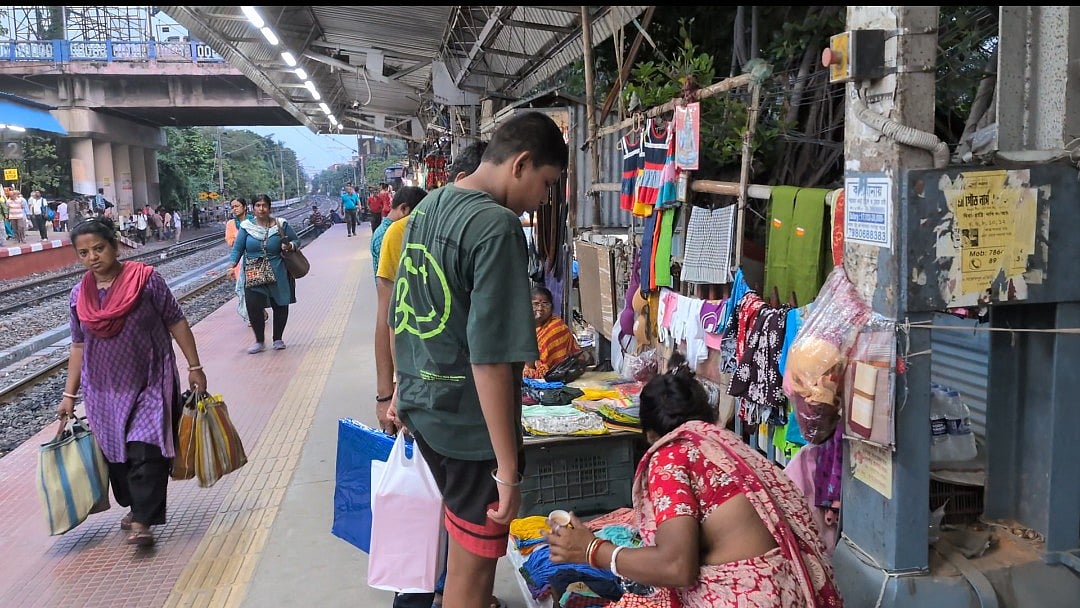
Bhabesh, for example, has to support a family of six children, all solely dependent on him. He says that railway hawkers like him show up to work in fear of finding their shops demolished. He recalled the fear of watching the demolition unfold, even as people protested. “It’s just a matter of time before we’re next,” he says.
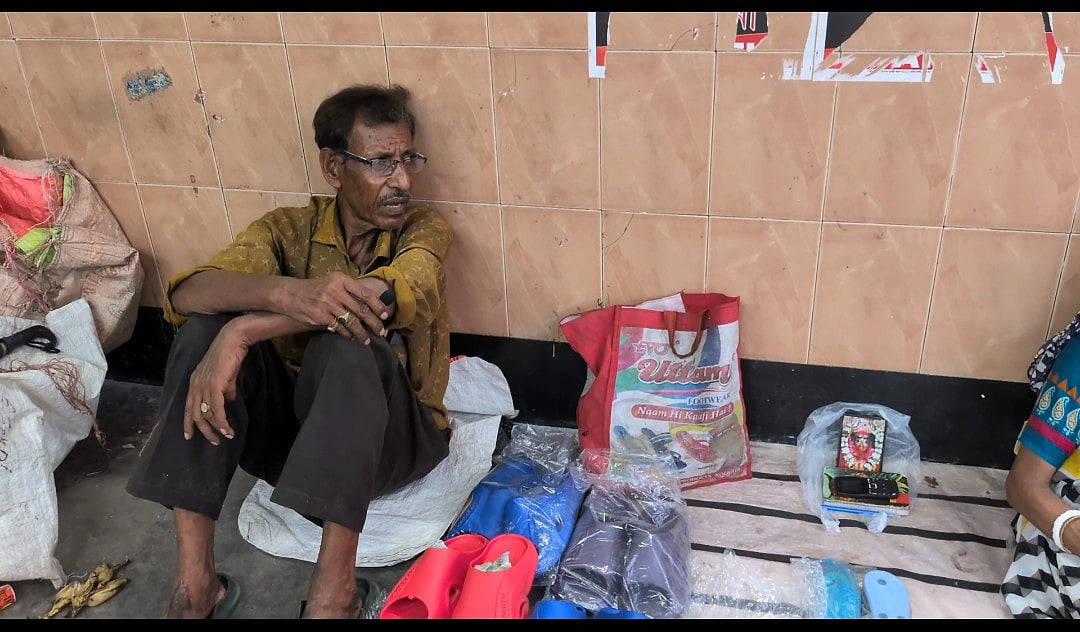
A few stalls down from Saraswati Naiya’s stall, sits Abdul Sattar, who doesn’t even have a stall to his name. He spreads a mat on the pavement next to the lavatory and waits with his slippers and shoes, hoping for a day’s sale. “Railway land is not separate from us. This is where we have spent all our lives. And, suddenly we’re being asked to leave.” He places his only demand before the government – to rehabilitate him and others like him before such anti-encroachment drives are conducted. “We’re not moving, simply because we don't know where to go.”
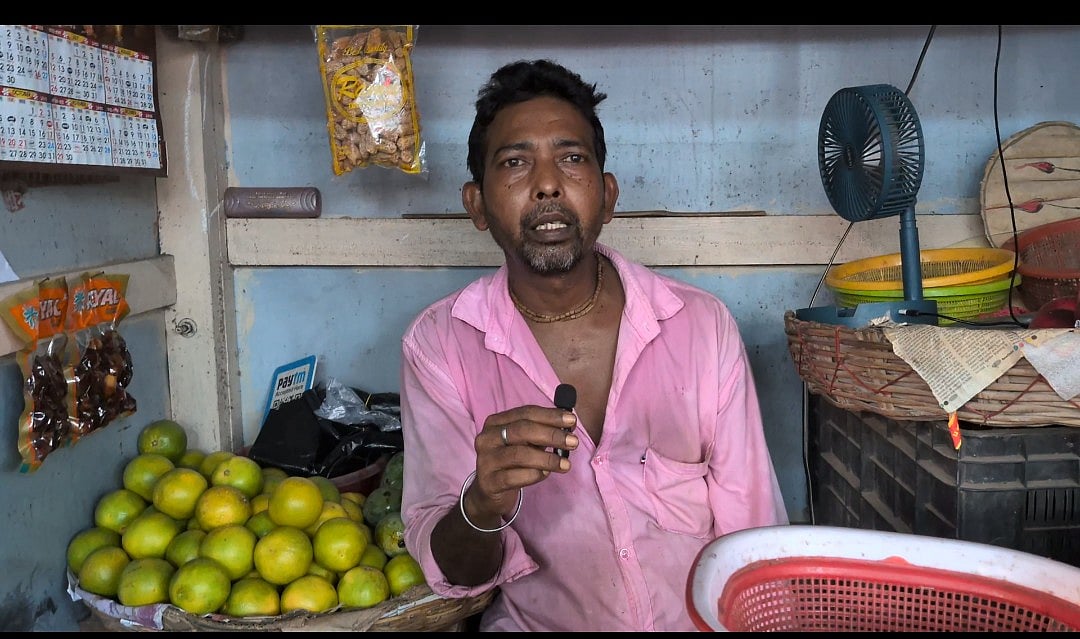
Another hawker on the Jadavpur platform who sells fruits in a makeshift stall, Tapas Chaudhury, seems to be aware of this gap. “People like us probably don’t feature in the government's vision of development. We are mere intrusions,” he says.
Disappointment with the new government was palpable. “What we had in mind while voting in this new government was, ‘Paltano dorkar, chai BJP sarkar’ (We need change. We want the BJP). Little did we know that they would immediately start eviction drives against poor people like us,” says Tapas.
A gap in the law?
It is not the first time that a government has carried out an eviction drive. The Left Front ran a comparably large eviction drive – Operation Sunshine – in 1996; the Trinamool administration later cleared hawkers from New Town, Salt Lake, and Sector V. Then what is so different about this time? “Earlier, it seemed like our resistance mattered. This time, protests seem to be fruitless. The government is determined,” says Abdul.
But, as Tapas notes, “Ei sarkar amader pete lathi marlo. Ar amrai tader deke anlam”. (This government has kicked us in the stomach. And we were the ones who brought them to power.)
Shaktiman Ghosh, general secretary of both the Hawker Sangram Committee and the National Hawker Federation, has spent decades fighting evictions like this one. “They are not covered under the 2014 Act,” Ghosh says, because the Act was never written to protect them – Section 1(4) leaves no ambiguity on that. For a street-side hawker, the Act guarantees a survey before eviction, a certificate of vending, and – if relocated – a right to an alternative site. None of it touches the railway platform at Jadavpur.
“Hawking is a constitutional right,” says Ghosh, pointing to the Supreme Court’s 1985 ruling in Bombay Hawkers' Union v. Bombay Municipal Corporation, which held that hawking falls under the right to trade or do business under Article 19(1)(g) subject to reasonable restrictions. But four years later, in Sodan Singh v. New Delhi Municipal Committee, the court clarified that hawking is protected under Article 19(1)(g) alone, not as a right to life under Article 21, and that no hawker has a fundamental right to a particular spot on a public street.
“It is not even about legality. On humanitarian grounds, should a person be denied the right to a livelihood? Shouldn’t rehabilitation for the ones displaced be a basic right?” Ghosh asks.
What makes railway hawkers so vulnerable to evictions in the first place is a different law. Section 144 of the Railways Act, 1989, makes hawking without the railway administration’s authorisation an offence on railway premises. The same provision allows an authorised railway servant to remove an unauthorised hawker from railway property. Separately, Section 147 empowers railway staff to remove persons who trespass on railway property or refuse to leave. Neither provision expressly provides for a prior hearing before removal.
Taken together, the two laws leave railway hawkers doubly exposed – excluded from the one statute that would protect them, and named directly in the one that permits their removal without a hearing.
Smita Pandey, Municipal Commissioner of the Kolkata Municipal Corporation, said the civic body has no role in railway eviction drives. “We don't have anything to do with the Railways. It’s under the Central government’s jurisdiction and they have their own forces, the RPF. They don’t even ask us before conducting their operations," she said.
PTI reported that Asit Saha, president of the Hawkers’ Joint Action Committee, met Chief Minister Suvendu Adhikari at his “Janatar Darbar” on July 4 and was assured that no eviction drives would be carried out across the state until after Durga Puja in October. While the railways is empowered to evict encroachers, according to railway officials quoted in media reports, rehabilitation is the state government’s responsibility.
Speaking to Newslaundry, Saha added that the assurance was verbal. According to him, Adhikari said the government was opposed to permanent structures on public land, not to hawkers themselves, and that “regulation” of hawking would continue. Saha said the chief minister had assured him he would discuss the issue with the municipal affairs minister.
Rehabilitation for railway hawkers was also raised during the meeting, despite the fact that railway land falls under the Centre’s jurisdiction, not the state’s. But Saha said no concrete plan has yet been proposed. So, how does all of this reflect on the ground?
“We are ordinary people. It is all very confusing for us. We depend on the television for news,” says Tapas. “They don’t need to come with bulldozers and lathicharge us if they just give us a small space to conduct our businesses.”
None of the hawkers interviewed disputes the government’s authority to evict them – only its silence on rehabilitation.
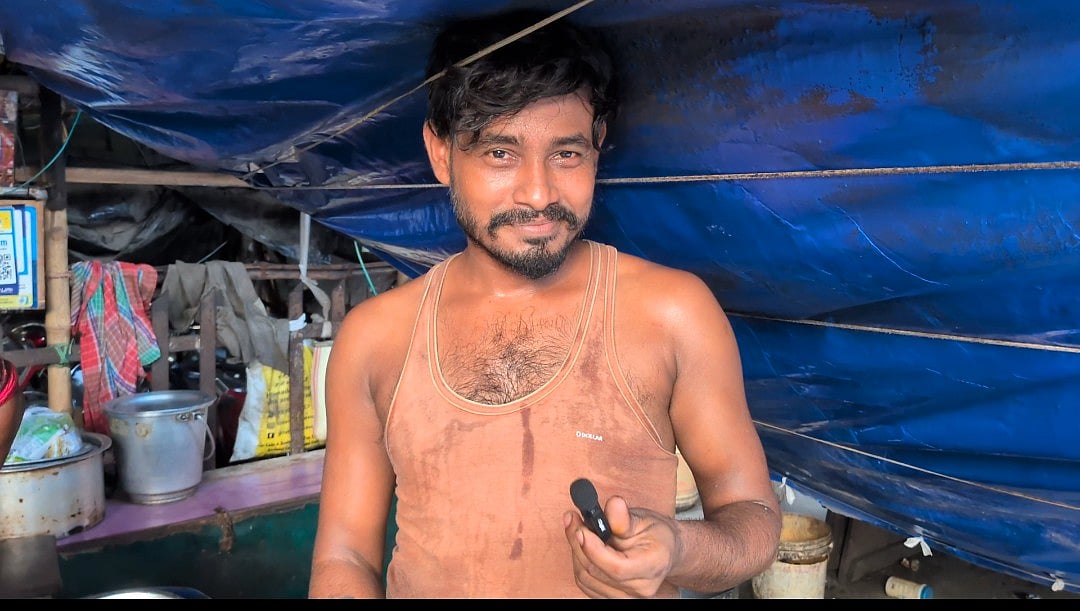
At Jadavpur railway station, on the left side of the platform stands Bappa Gure’s stall, its tarpaulin the original one his father bought three decades ago. His father is no more; Bappa only has this shop to remember him by. “The only thing left for us to do is beg now,” he says.
Anita Sau, who has run her shop of miscellaneous items since 1978, breaks down while talking about her ailing husband’s inability to work, the responsibility now hers alone. “How can we be asked to leave now? If this was illegal, why were we allowed for so long?”
Shankar Haldar, who sells dresses, says: “We are not aware of our own rights.”
“At this point, all we’re waiting for is an answer – be it a court order, a rehabilitation measure, or even the bulldozer. We’re tired of this constant apprehension,” says Bappa.
Newslaundry has reached out to Eastern Railway for a response to these evictions and will update this report if a response is received.
(Chenab Guha is an editorial intern with Newslaundry.)
Small teams can do great things. All it takes is a subscription. Subscribe now and power Newslaundry’s work.
 GK to Gurugram: A field guide to encroach like the rich (and never be called encroachers)