11 dailies, differing narratives: How front pages covered the CJP march on Parliament
From ‘crackdown’ in the English broadsheets to ‘rampage’ in the Hindi dailies and zero-photo tickers in the business press – how publications presented yesterday’s events.

Eleven newspapers, one Monday of chaos in central Delhi.
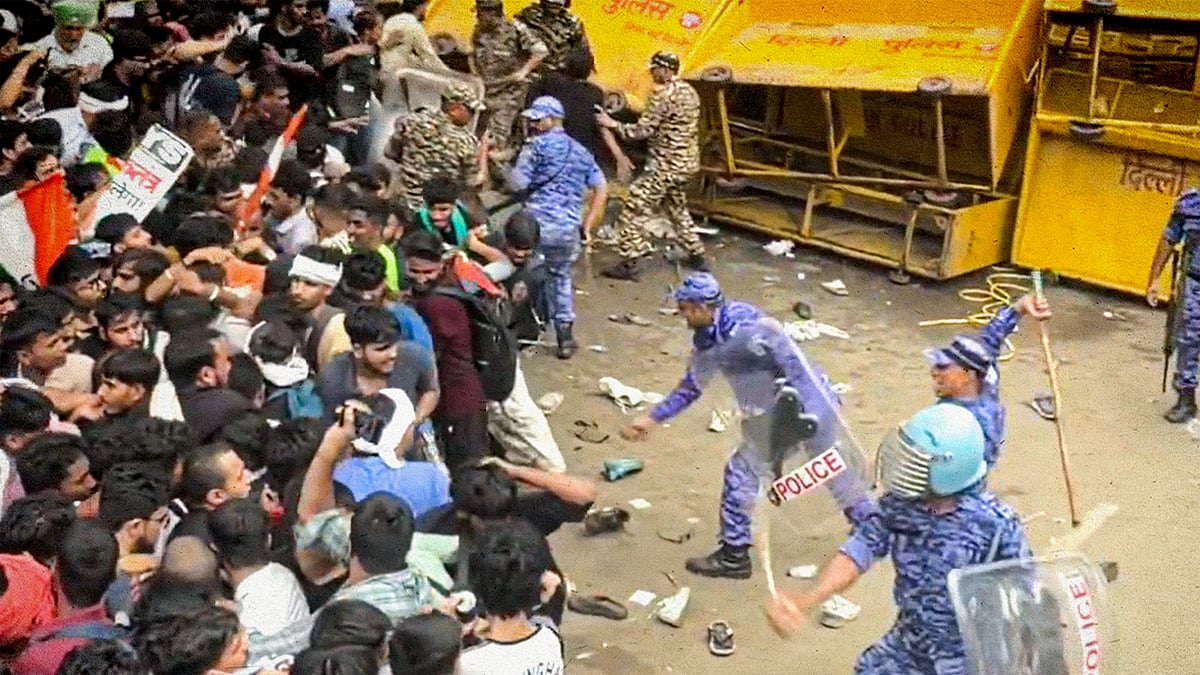
On July 21, the front pages of five English dailies, three business papers and three Hindi dailies tell strikingly different stories about the same afternoon – thousands of Cockroach Janta Party (CJP) supporters attempting to march on Parliament, police lathi-charges and tear gas, an internet shutdown, and differing injury figures. Whether that afternoon reads as a “crackdown” or a “rampage” depends entirely on which paper landed on your doorstep.
The English dailies
All five English papers – Times of India, The Tribune, The Indian Express, The Hindu and Hindustan Times – led with the story. But the verbs they chose to headline it tell you most of what you need to know.
The Hindu went furthest in centring police action, with “Several hurt in crackdown on CJP stir”, leading with harm before numbers and quoting activist Sonam Wangchuk’s “brutality” charge in a subhead. It was also the most granular paper on injuries, specifying that 38 people taken to Lady Hardinge Medical College suffered “fractures, swellings, and head and eye injuries,” and the only paper to quantify the internet shutdown precisely – mobile services cut “at 150 spots” rather than described in general terms. It also carried the police’s own counter-framing, quoting officials who called the crowd a “violent mob”.
The Indian Express was the only paper to name both lathis and tear gas directly in its main headline: “Protesters storm heart of Delhi, police use lathis and tear gas to stop march.” Its most distinctive front-page choice was a human-interest secondary story, “Sons injured, a mother breaks down: ‘Attack on country's children’” – the strongest victim-centred framing in the set – alongside a flagged edit-page line, “Can't have sabka vishwas with lathi and tear gas,” making its editorial position visible from page one itself.
Its lead photo showed Delhi Police personnel beating protesters with lathis – one protester notably wrapped in an Indian flag, another lying on the ground with his clothes torn. Its caption, however, merely noted that Delhi Police “disperse protesters.”
Notably, Express attributed its injury figures to the police, noting “118 personnel injured, 70 protesters detained, says Delhi Police” rather than presenting them as settled fact. But it carried no dedicated internet-shutdown box.
Hindustan Times took a both-sides approach. They led with “Chaos on streets echoes in House,” with “Capital turns into battlefield as cops, protesters clash”, the meeting between CJP leadership and union minister JP Nadda and Sonam Wangchuk’s decision to continue the fast as part of the paper’s top of the fold package. They framed the day as competing claims rather than an established narrative. Its internet-shutdown detail (10.30 am–6 pm) was specific but buried in body copy rather than flagged upfront.
Times of India and The Tribune, by contrast, led with police action as something done to protesters rather than by police. TOI’s “Police block protesters' march to Parl; Nadda meets CJP reps” and Tribune’s “Roach Rage Rattles Delhi” makes police the subject of a containment story, not the violence. Both papers cited cop injuries (118) ahead of protester injuries (60) in their headlines and kickers.
TOI’s lead photo caption, “Demonstrators hurl stones and a chair at cops”, foregrounded protester aggression in its visual package. The Tribune ran a standalone box, “Net disruption leaves commuters stranded", giving the shutdown dedicated display but framing it entirely around commuter inconvenience rather than as a civil liberties issue.
Across the five papers, the injury figures themselves (118 police, 60–70 protesters, 70–100 detained) were broadly consistent – all attributable to a Delhi Police statement.
The business press: a story pushed to the margins
None of the three business dailies led with the protest, and the contrast with the general dailies is stark. The Economic Times ran it as a brief item in a boxed “Pure Politics” column, headlined around the government’s outreach – “Nadda Meets CJP Leaders as Student Protest Sparks Clashes” – with clashes reduced to a subordinate clause and no photograph.
Financial Express gave the story its biggest business-press play, with a large photo captioned “CENTRE OF PROTEST,” but no separate headline or article. The caption attributed the force allegation explicitly to the CJP (“accused the Delhi Police of using excessive force”) rather than reporting it independently.
Business Standard gave it the lightest touch of all eleven papers surveyed – a single ticker line in its top promo strip, pointing to page 7, with no injury figures, no shutdown mention, and no independent headline treatment.
Across all three, the story competed for space with RBI swap data, Q1 earnings and oil-import bills, and none carried specific injury or shutdown detail on the front page itself.
The Hindi papers: A different set of omissions
The three Hindi dailies gave the story comparable front-page weight to the English press, but with a distinct tonal range. Dainik Jagran was the most protester-critical framing of any paper surveyed, putting “peaceful” in scare quotes — “‘शांतिपूर्ण' संसद मार्च में उत्पात, दिल्ली बंधक” (“‘Peaceful’ Parliament march turns to rampage, Delhi held hostage”) – and sequencing its sub-heads to lead with stone-pelting and vehicle damage before mentioning police lathi-charges and tear gas last. Its injury box (200 injured, including 100 police) again put a non-police-attributed figure into circulation without a shutdown box to match.
Dainik Bhaskar took a slightly different approach instead, framing the day as the “biggest protest at Parliament in 14 years” and drawing an explicit comparison to the 2012 Nirbhaya protests. Its sub-heads were more evenly balanced between barricade-breaking, clashes with “hundreds injured,” and lathi-charges, and it was the only Hindi paper to report government back-channel outreach to CJP in detail – a 6 am call preceding the Nadda meeting with CJP spokespersons Saurav Das and Ashutosh Ranka.
Amar Ujala was the most neutral in language, listing actions from both sides in sequence – stone-pelting, lathi-charge, Jantar Mantar cleared – without the loaded terms Jagran used, while still carrying a photograph of an injured protester on the ground.
None of the three Hindi front pages gave the internet shutdown dedicated treatment and where it appeared at all, it was folded into traffic-jam framing rather than reported as a communications blackout.
Small teams can do great things. All it takes is a subscription. Subscribe now and power Newslaundry’s work.
 Under shadow of lathis and barricades: The day the Modi govt finally engaged the CJP