Delhi HC allows Sonam Wangchuk’s shift to private hospital after medical advice
The courtroom on Tuesday was akin to a doctor’s cabin with medical professionals taking turns to explain lab reports.

The Delhi High Court has allowed Gitanjali Angmo to immediately shift her husband Sonam Wangchuk from government-run Safdarjung Hospital to the private Medanta Hospital in Gurugram. It allowed Angmo unfettered access to her husband at the hospital in accordance with medical protocol.
The court directed the private hospital’s director to form a team of doctors to constantly monitor Sonam Wangchuk’s medical condition and administer medication within accepted norms. The court said he shall abide by the medical advice.
The decision by the bench comprising Chief Justice DK Upadhyay and Justice Tejas Karia followed Angmo’s plea challenging Wangchuk’s continued admission at government-run Safdarjung Hospital.
Speaking to the press, Angmo said Wangchuk’s hospitalisation “wasn't needed” and was like “detention”. She further announced Wangchuk’s decision to extend his fast in solidarity with the students who were beaten yesterday.
Though the high court’s Tuesday decision relied on expert medical advice, it gained impetus after senior advocate Akhil Sibal, representing Angmo, drew the court’s attention to a letter handwritten by Wangchuk detailing his experience at Safdarjung Hospital.
In his letter, Wangchuk complained about continuous police presence, his confinement in the hospital room, surveillance, how his visitors were subjected to a search and how his phone was “snatched away” from him.
The doctors chambers in court
The courtroom on Tuesday was akin to a doctor’s cabin with medical professionals taking turns to explain lab reports, what it meant in terms of Wangchuk’s health and their opinion on the future course of medical action. The court had on Monday sought updated lab reports to understand the climate activist’s medical condition on the 21st day of his fast.
Doctors said the reports indicated normal weakness due to the stress of fasting but no intravenous intervention was required at this point.
The doctors further expounded on what happens to a body that is denied sustenance and nutrition to explain the elevated levels of uric acid or the low haemoglobin and platelet levels.
Dr Tandon from AIIMS said haemoglobin levels of a man from Ladakh are generally expected to be higher due to environmental factors. Doctors were unanimous in their opinion that Wangchuk would require constant medical monitoring, preferably in a hospital setting.
A doctor said Wangchuk’s white blood cell (WBC) count was low, resulting in compromised immunity and making him more prone to infection. The doctor said physical interaction with Wangchuk should be limited and if one were to meet him in person, they should be in a clinical gown, cap and mask.
State over everything else
Even as the Centre said it had no problems with Wangchuk’s shift to Medanta “a reputed hospital,” Solicitor General Tushar Mehta on Monday essentially said state security would trump any fundamental rights.
There is no right to bodily autonomy when the consequences of the deterioration of one’s health and loss of life has an impact on law and order, Mehta said on Wangchuk’s protest fast. “That is when the state steps in,” Mehta added to justify Delhi Police action taking Wangchuk away from the protest site.
“When someone says I will commit suicide if demands are not met, then in such cases the right doesn’t fly. It then becomes the state’s duty to ensure that the health does deteriorate in such cases,” Mehta said.
Police action has ‘chilling effect’
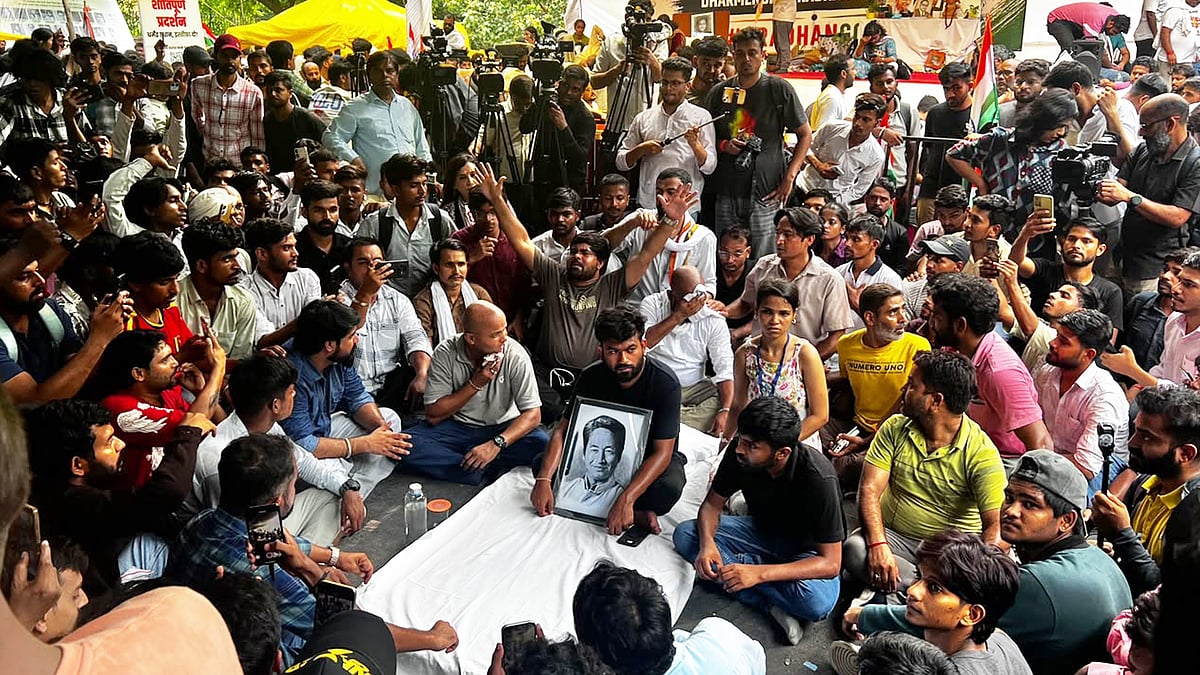
Gitanjali Angmo had on Sunday filed an urgent plea challenging the Delhi Police action carting Wangchuk away from Jantar Mantar where he was on a protest fast in support of the CJP campaign.
In her plea, Angmo said the manner in which Sonam Wangchuk was carried away by the Delhi Police in front of a crowd in Jantar Mantar was “aimed at thwarting his right to protest”. The plea suggested that the police action was evidently meant to send a “chilling effect within the entire community of supporters” who have been at the protest site for more than a month.
The July 16 order characterised this act as “not being arbitrary”.
The plea said that taking an individual away from his site of his choosing without his consent or any sign of deteriorating health in this case is one of the “most arbitrary” actions a State can take. This arbitrariness is compounded by the fact that he is not allowed to move out of a government-chosen place despite the next of kin as well as the individual asserting their constitutional rights, the petition read, adding that there was not an iota of evidence to show that Wangchuk was “not capable of giving his consent”.
Small teams can do great things. All it takes is a subscription. Subscribe now and power Newslaundry’s work.
 ‘With Wangchuk gone, cops thought hope would die’: The weekend that changed the CJP protest