Smokescreens, sneakers, and mass-reporting: Balen’s online machine against Nepal’s press
Part 2 of this two-part series explores a weaponised online ecosystem of Facebook groups, AI abuse, and narrative spins that keeps Balendra Shah’s administration largely immune to scrutiny.

Nepal Prime Minister Balendra Shah's asset disclosure, filed after his appointment in accordance with Section 50 of the Prevention of Corruption Act, 2002, listed social media — not his government salary — as his primary source of income.
Shah declared bank deposits of 14.6 million Nepali rupees (INR 91 lakh) and stated that a significant portion of his income is generated through social media, from his over 4 million Facebook followers, approximately 1.2 million YouTube subscribers, and nearly 500,000 followers on X.
The disclosure raises an unusual conflict: Nepal’s sitting prime minister is being paid by the same platforms he uses to communicate government policy directly to the public.
As Part 1 of this two-part series on Nepal’s press freedom crisis has documented, the Shah administration has enforced a strict institutional blackout on journalists: no press conferences, restricted access to ministries, and an economic blockade against mainstream media.
Alongside this official blackout is a less visible system of control: a vast digital ecosystem used for trolling and targeted harassment. At its centre are prominent social media pages with close ties to Shah’s inner circle.
The algorithmic shield and the inner circle
Most members of Shah’s cabinet are also highly active on social media, often using personal accounts rather than official government channels to communicate with the public. Analysts, politicians and civil society leaders see this as a deliberate strategy to divert attention from pressing national issues.
“The government is using social media strategically to create a positive image of themselves,” says Ujjawal Achary, a researcher at the Kathmandu-based Centre for Media Research Nepal.
This image management was on full display in the first week of May 2026, when Nepal’s Supreme Court stayed three major decisions taken by the Shah government: banning student unions at universities, abolishing civil servants’ trade unions, and forcibly evicting squatter settlements along Kathmandu’s rivers.
On May 9, amidst the legal setback, a photo of Shah sitting casually went viral. Instead of discussing the setback his administration had suffered, the internet in Nepal spent the week debating his outfit and the price of his sneakers.
In a May 2026 report, Mani Dahal, special correspondent with Nepal News and a member of its investigative unit, documented how social media accounts run by Shah and his associates played a key role in his electoral victories. Together, Dahal wrote, these accounts provided Shah with a powerful political base.
Many of Shah’s closest advisors are directly connected to influential social media pages. Kumar Byanjankar, Shah’s Chief Political Advisor popularly known as 'Kumar Ben', is the founder of Troll Nepal, boasting about 638,000 followers on his Facebook profile.
Victor Poudel, founder of Routine of Nepal Banda (RONB), which commands about 5.1 million followers on Facebook and 1.6 million on TikTok, has also been closely associated with Shah and his government. The page frequently posts in favour of Shah's work, and critics attribute his victory in the Kathmandu mayoral elections largely to the popularity of RONB.
Sudhanshu Dahal, a professor of media studies at Kathmandu University, says in this Kathmandu Post article that the relationship between RONB and Shah is an “open secret”.
Speaking to Newslaundry, Dahal noted that RONB, which is also a registered media organisation, has a commercial incentive to maximise engagement. It is, he claimed, “the highest bidding Facebook page” for sponsored content, meaning stories that perform well – including ones favourable to Shah – are also directly profitable for the page.
This dynamic was documented as far back as Shah’s mayoral tenure. A January 2026 Kathmandu Post report by Gaurav Pokharel and Lekhnath Pant noted that Shah rarely engaged traditional media, preferring Facebook posts that sometimes sparked controversy – several of which were reposted verbatim on pages like RONB, multiplying his reach.
Coverage of Shah on RONB was, at times, consistent enough that rival politicians accused the page of favouritism. Poudel did not dispute this.
“We used to post about every candidate and political party, but those on Balen always got us the most user engagement,” he told the Post.
This relationship has repeatedly been leveraged to control damage during controversies. Back in 2023, Shah controversially posted that he would burn down Singha Durbar after the police stopped his vehicle during a routine check of government vehicles on a public holiday. Singha Durbar is the historical palace serving as the political and administrative centre of the Nepal government.
Immediately after the post triggered severe backlash, RONB came to Shah’s defence, distorting the controversy. It posted a picture of Shah and his wife with a caption implying they had just become parents to a baby girl to turn the narrative back in Shah’s favour. However, the independent news outlet Setopati later reported that Shah’s wife had actually given birth a week earlier, exposing the post as a coordinated narrative pivot.
Newslaundry’s own review of RONB’s Facebook activity found at least 10 such coordinated posts since Shah became prime minister, suggesting this pattern has persisted. On July 21, for example, Shah posted about the government’s decision to scrap a 3 percent health and education tax; ten minutes later, an identical post appeared on RONB tagged with the hashtag #news. A similar pattern followed on June 20, when Shah posted an itinerary for the Makalu Base Camp trek, which RONB reposted the same day with credit to Shah.
RONB’s coverage of Shah has also taken on a celebratory, at times overtly promotional, tone, whether it’s a birthday post, a post marking his swearing-in as prime minister, or a post of Shah wearing the Nepali footwear brand Goldstar that reads closer to product promotion than political coverage. The page’s editorial choices have also drawn scrutiny.
Earlier last month, RONB posted a photograph of Home Minister Sudan Gurung visiting Ganesh Nepali in hospital after his self-immolation. This post was criticised in the comments for highlighting Gurung’s visit rather than the incident itself.
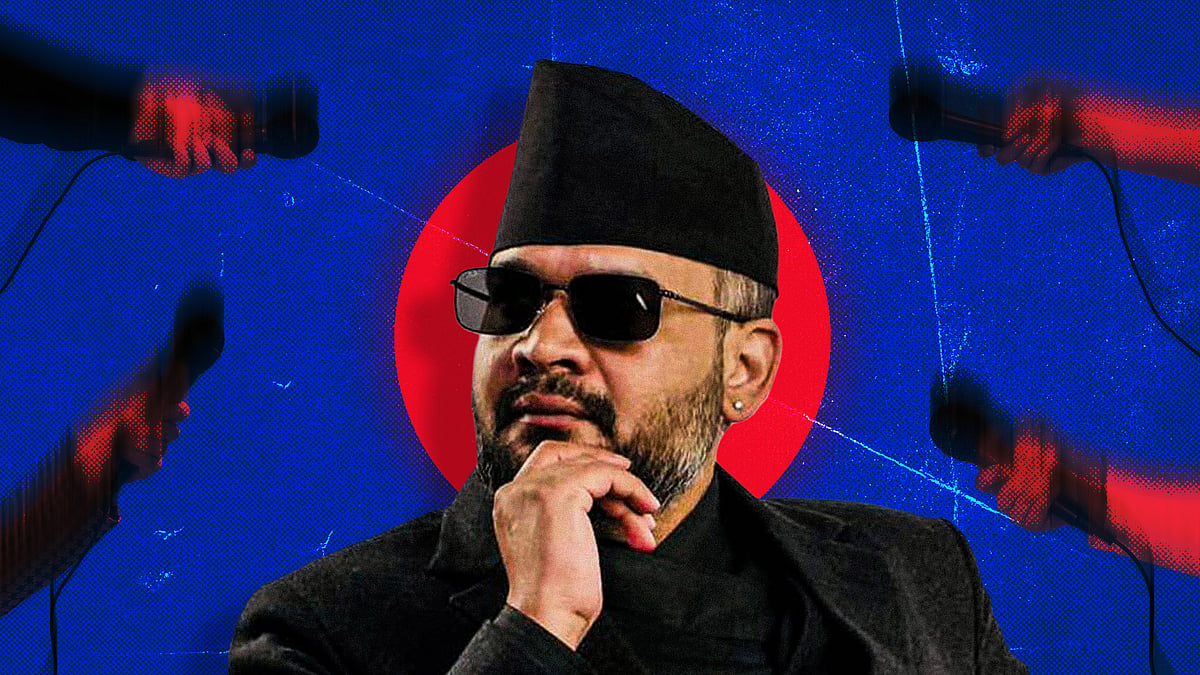
Sudhanshu Dahal argued that Shah has cultivated a quasi-cult image. The black cap and sunglasses have become instantly recognisable symbols, with lookalikes appearing across Nepal. “That cult aspiration is there, and it's very strong,” he said, though he also noted, “Social media is just a bubble... most of the time these bubbles burst.”
Indications that this bubble was bursting were visible after communal clashes recently broke out in southeastern Nepal, killing at least three people and injuring 25, in a dispute that arose over a religious flag and loud music played during a Hindu event. On July 30, Shah posted a statement on Facebook condemning the violence. Four days after that, he delivered his first national address from the Prime Minister’s Office since taking office.
The response to his own post and RONB’s coverage of the address was unusually critical. Commenters mocked his alleged reliance on a scripted speech and his decision to remove his trademark sunglasses for the broadcast.
“Finally without the silly looking sunglasses,” read one comment on RONB’s page.
Others pushed back on the substance of his response.
“The public does not expect empty appeals from the government, but rather timely security, fair handling, and responsible leadership,” one commenter wrote. “The public does not want speeches, but concrete work, fair handling, and accountability.” A sharper comment invoked Shah’s own history: “Those who burned Singha Durbar yesterday are in no position to preach a message of peace today... Your Facebook condolences will not bring back the sons and daughters who have lost their lives.”
Kanak Mani Dixit, founding editor of Himal Southasian, who has been critical of the government’s media policies, said this backlash was a rare bright spot.
“The reverse trolling has begun, as was natural, because social media users will certainly target those in power,” he told Newslaundry. “We can also say that social media is helping keep freedom of expression alive in Nepal today, given that independent users have actually come forward to speak openly, which has also given strength to mainstream media reporters and editors.” But he added that social media alone cannot substitute for a free press. Mainstream media remains weakened, he said, both by the same economic pressures reshaping journalism globally and by publishers’ fears of government targeting.
In a relief for the privately-owned press, however, the Supreme Court on July 14 ruled against Shah’s decision to cancel government advertising in private media.
A pattern of digital retaliation
While sympathetic platforms use carefully timed distractions to shield him, independent media outlets that refuse to fall in line face real consequences.
The earliest instance of this predates Shah's premiership by four years. Days before his mayoral election in May 2022, Onlinekhabar, a popular Nepali news portal, published a blog titled “The Viral Candidate and the Disrespect of the National Flag,” which examined the legal rules surrounding the use of Nepal’s flag using a campaign photograph of Shah as a case study.
“Following its publication, Shah’s supporters online launched an unfollow campaign targeting our Facebook page. Within a few hours, the page lost more than 10,000 followers," Binod Ghimire, Onlinekhabar’s news desk editor, told Newslaundry. “At the same time, our newsroom’s landline received threatening phone calls from unidentified individuals. Some callers even threatened to set our office on fire.”
Ghimire added that Onlinekhabar’s stance was that anyone who disagreed should seek legal recourse through the Press Council Nepal, though he is unaware if a formal complaint was ever filed. The campaign, he said, caused only a short-term loss of followers – the outlet’s “strong multi-platform presence” helped it attract new audiences, and its Facebook page now has nearly 2.5 million followers.
Once Shah became prime minister, this playbook was deployed with renewed intensity against media outlets scrutinising his government.
Ukeraa, an independent media house, bore the brunt of similar harassment after publishing a magazine with the cover headline “Democracy Under the Shadow of the Military” in May 2026. The investigative piece detailed Shah’s close ties with the Nepal Army and other security agencies, featuring an illustrated cover portrait of Shah wearing an army cap.
Immediately after the article’s release, Ukeraa’s Facebook page was heavily trolled. Speaking to Newslaundry, Editor-in-Chief KP Dhungana described the nature of these attacks.
“The trolling has become unbearable. Earlier, when we used to get comments in opposition to our story, we would engage with them. We come from a traditional media culture where editors received letters from readers. For us today, a social media comment is a letter to the editor. We would engage in discussions, respond and put our points forward. Now, how do you respond to 600-700 abusive, violent comments?”
Ukeraa was also one of the first outlets to report that Shah’s Chief Advisor, Kumar Ben, had been arrested by the Nepal Police in 2008 over alleged involvement in a telecom racket – a fact that had been kept from the public after Nepal’s Office of the Attorney General decided not to prosecute him. The outlet also investigated minister Dipak Kumar Shah’s decade-old fraud record, reporting that eventually led to his resignation.
These critical reports were met with massive backlash on Facebook. Dhungana added that when they posted the story about Kumar Ben’s arrest, it was taken down by Facebook due to mass reporting by users. Meta, which owns Facebook, WhatsApp and Instagram, cited copyright infringement, even though all of Ukeraa's reporting was original.
“We appealed to Meta, but the content still hasn’t been restored. They took it down, claiming it violated copyright. But who owns the copyright to confidential government documents that were used in the story? I didn’t even receive an email. I only got notifications that the content had been removed from my personal profile,” he added.
Naresh Gyawali, Op-Ed editor at online news portal Ratopati, said that such episodes have set the template for what was to come later on.
“Today, my colleagues are only trying to be careful not to get caught in such campaigns. But this was a clear indication that broader critical thinking, freedom of expression and press independence was narrowing in the country,” Gyawali said.
“To say it clearly, supporters who were encouraged by the state are using troll pages, meme pages and smear campaigns to attack and pressure independent media houses. In a country where journalists are afraid of speaking against the government, analysts are cautious about how they phrase their criticism, and displaced people fear imprisonment for venting their anger, one can only imagine the state of the independent press.”
Gyawali called it an age of “state-sponsored content,” where parody accounts now carry more weight than the news media.
Madhusudan Panthi, editor of Himalaya Television, argued that this coordinated online backlash has become a more potent tool of control than traditional political pressure.
“Compared to traditional forms of political pressure such as legal harassment, withdrawal of government advertising, or denial of access, coordinated social media backlash has become an even greater challenge for television media,” he said.
Earlier, Panthi notes that traditional pressure tactics made it possible to identify which individual or organisation was involved, allowing for legal recourse. “However, because online attacks are carried out under the guise of ‘fake accounts’ and algorithms, finding a legal remedy has become very difficult,” he added.
Organised troll groups, he added, “rarely debate the facts of a news story. Instead, they engage in character assassination of journalists, spread misinformation, and portray media organisations as being driven by hidden agendas.”
Men’s Room Reloaded (MRR)
At the centre of Shah's online support base is Men's Room Reloaded (MRR), a private Facebook group started in 2011 with membership strictly restricted to Nepali men above the age of 18. Dhanu Bishwakarma, a journalist at Himal Khabar, wrote an extensive investigative report on the group, finding that it contains approximately 55,200 active members. Shah was highly active in the group as mayor before officially stepping back.
Following the elections, the group has effectively transformed into an incubator for the current government. Seventeen members of Parliament, including Shah, were part of this private group, and five of them now serve directly in the cabinet.
According to the Himal Khabar report, these ministers include Sasmit Pokharel (Minister for Education, Science and Technology, Youth and Sports, and Government Spokesperson), Sunil Lamsal (Minister for Physical Infrastructure and Transport), Biraj Bhakta Shrestha (Minister for Energy, Water Resources and Irrigation), and Ganesh Poudel (Minister for Culture, Tourism and Civil Aviation).
Other MRR members in Parliament include Ganesh Karki, Rajiv Khatri, Sulav Kharel, Prashant Upreti, Sagar Dhakal, Badan Bhandari, KP Khanal, Som Sharma, Kamal Subedi, Manish Khanal, Bablu Gupta, and Pukar Bam.
Furthermore, Bishwakarma’s findings revealed that seven active MRR members now directly run the Prime Minister’s secretariat. This inner circle includes Chief Personal Secretary and MRR admin Suvas Sharma, who owns Chiyadani – the café where Shah was recently photographed meeting Home Minister Sudan Gurung. Shah’s political and policy core is anchored by Chief Political Advisor Kumar Byanjankar, personal secretary Naveen Bhandari, and policy coordinator Sudeep Dhakal, all of whom have been by Shah’s side since his mayoral era.
The administrative machinery is rounded out by long-time loyalists that include press facilitator Surendra Bajgain, personal photographer Binaya Shakya, and Bibek Mishra, an active member of the Routine of Nepal Banda (RONB), who also serves as the Prime Minister’s official ICT expert. Ultimately, Bishwakarma’s investigation suggests that this entire political nucleus – including Shah, Byanjankar, and Victor Poudel – originally traced its roots back to this single, private Facebook group.
The public-facing page of MRR, which had 81,000 followers as of July 2026, had previously become so aggressively one-sided during Shah’s mayoral campaign that it was deactivated by Meta and hauled up by the Election Commission for violating Nepal’s election code and spreading misinformation. Journalists who attempt to investigate this network face severe, coordinated retaliation.
Speaking to Newslaundry, Bishwakarma shared the personal toll of her reporting: “After I reported on MRR, there have been offensive comments and abuse in our media’s social media profile from RSP supporters. I also get attacked for my caste. In my piece, I had written about a Bhajan program that MRR recently organised in different parts of Nepal. Some comments mention I am a Dalit; hence I must be Christian, therefore criticising the Bhajan programme organised.”
‘Balen must take responsibility’
With the vast number of online supporters backing Shah and the RSP, severe online trolling and bullying have become systemic.
An activist, who wishes to remain anonymous, told Newslaundry about the psychological impact of these attacks: “I went through an overwhelming amount of mass coordinated attacks for an opinion I expressed on the arrest of the opposition leader KP Oli. I received rape threats, sexually explicit abuse, and fake AI videos of me circulated. After this incident, I became severely depressed and suicidal. Every time I opened my phone, there was a new rape threat, a sexual comment and edited images of me. To me, it wasn’t just online trolling; it was sustained psychological abuse. I went to the cyber investigation bureau to file my case, but I did not get enough institutional support from them.”
Smriti Timalsina, a political activist and a journalist, experienced this firsthand after she criticised Home Minister Sudan Gurung on social media over an unofficial Chinese blockade at the Tatopani border. She was briefly detained by police in what she described as an “abduction-style operation” in late March, and made to sign a document pledging that she would not release statements on sensitive government issues – a description of the events that local police have denied. She was then subjected to a barrage of online harassment including AI-generated images depicting her in compromising situations with a senior political figure, and fake profiles created in her name on TikTok.
“My character was assassinated,” she told Newslaundry. She filed a case with the Nepal Police’s Cyber Bureau, but said she had no way of knowing whether the attacks were coordinated by government sympathisers, party members, or an IT cell.
Senior journalist and Reporters Without Borders correspondent Binod Dhungel remarked that Shah must be held accountable for the behaviour of his base.
“Even if the activity is driven by the Prime Minister's supporters, he should encourage them to refrain from hate speech, bullying, and trolling," Dhungel observes. “As the Prime Minister, he should make a public appeal urging his supporters to refrain from such conduct. Otherwise, it appears organised and intentional. The same principle applies to leaders of other political parties, who also have a responsibility to discourage such behaviour among their supporters.”
Newslaundry sent Dipa Dahal, a press and research expert with the PMO, questions via email on Balendra Shah’s personal ties to social media pages and the online harassment his critics face from his supporters. In response to our email, she said she is “currently unable to provide any quote or comment” at this time. We also sent questions to the admins of the Routine of Nepal Banda (RONB) and MRR to ascertain their ties with the Balendra Shah administration. We will update the report when they respond.
Read part one of this investigation here.
(The author is an editorial intern with Newslaundry.)
 ‘It feels like mass silencing’: Balendra Shah’s war on Nepal’s free press
 ‘New Nepal’, old anxieties: Will a Gen Z mandate trigger a new playbook for South Block?
 Meet the ‘brain rot’ generation that toppled the government in Nepal