‘Bid to eliminate the messenger’: Social media takedowns leaving users in the dark
Leveraging Section 79(3)(b) of the IT Act, government officials are forcing platforms like Meta and X to take down posts with little transparency and legal recourse.

Posts by journalists, political parties, activists and media organisations are increasingly being restricted or taken down on platforms such as Meta and X, following government notices issued under Section 79(3)(b) of the Information Technology Act. This trend has raised concerns over transparency, due process and press freedom in India.
The stakes are particularly high for journalists and creators who don’t have institutional backing, according to freelance journalist Sachin Gupta. “When we share hate speech or violence on social media, the government should take cognisance of those posts and take action against the people making the hate speech, rather than against those who are posting or sharing it. This is, in a way, an attempt to eliminate the messenger so that such things do not come out.”
Between July and December 2025, Meta restricted over 41,000 pieces of content in India, which is nearly triple the number recorded a year earlier, according to its report on content restrictions in India. More recent figures will be published at the end of this month, according to a Meta employee Newslaundry spoke to. In light of a police drive to weed out abusive Jantar Mantar videos, there are accusations of a surge in restrictions.

Sachin Gupta pointed to a lack of clarity around such restrictions and said, “Independent and freelance journalists and social media creators who do not have a platform to publish their news or information use social media to post it. If you get such posts deleted or removed, where will these people go?”
X sent Sachin Gupta two takedown notices
Sachin Gupta received two notices from X seeking the removal of two of his posts. One notice was from Saharanpur Police and the second was from Muzaffarnagar Police.
Gupta said inspector-rank officers sent both notices. He claimed that when he contacted senior officers in both districts, they said they had no information about the inspector-level officers having issued instructions to remove his posts. One of the posts contained a video of Hindutva activist Pinki Chaudhary, in which he is seen announcing that he’ll perform a Hindu ritual at Darul Uloom Deoband, an Islamic seminary. The second video was about the recent Kanwar Yatra, in which Kanwariyas had blocked the Delhi-Haridwar highway. The Muzaffarnagar Police claimed that the video was promoting violence.
On Meta’s platforms, posts by journalist Santosh Pathak, Alt News co-founder and fact-checker Mohammad Zubair, media organisations Scroll and The Hindu, the Indian Youth Congress, Arvind Kejriwal, the Aam Aadmi Party, Ashutosh Ranka and Saurav Das of the CJP and Rofl Gandhi (Parody) have also been flagged in the context of the ongoing restrictions and takedowns.
Scroll said one of its posts on Instagram had been made unavailable in India. According to it, the report was about how most pellet gun victims in Kashmir had not received compensation even a decade after they were injured. A second post with a photograph in which pellet injuries were not visible, published later that day, was also restricted. Instagram did not provide a specific reason for the actions. Scroll said the post remained available on Facebook and Threads, but was restricted on Instagram.
Similarly, an Instagram post by The Hindu was restricted in India. The post was about Kashmir pellet victim Insha Mushtaq, whom security forces blinded by firing pellet guns during the 2016 Kashmir protests.
In response to the removal of the posts from both organisations, the platform said it had “restricted access to the content pursuant to India’s IT Rules” without providing further information.
On the restriction of a post by Arvind Kejriwal and the Aam Aadmi Party’s official account, AAP national spokesperson Priyanka Kakkar told Newslaundry, “GenZ protest has shown how much public anger exists against the Modi government. Now they want to suppress social media to stop the narrative against them, but it will blow up more.”
Several CJP leaders’ posts have also been taken down. CJP Co-Convenor Ashutosh Ranka said, “I think there is a crackdown on pro-CJP content and pro-CJP content creators, and it cannot happen without the government wanting to do so.”
On his posts that have been made unavailable in India, Ranka said, “I have no clue why some of those posts were restricted. One of them was about food and one of them was about Sonam’s detention SOS call immediately after it. I am pretty sure it has something to do with the content of these videos, but no such justification has been shared with me. Four videos of mine were restricted.”
He added, “Our East & North East (India) zone head Ankit Bhardwaj's Instagram and Facebook account got suspended randomly after his name was announced for the position. So, there is definitely the government behind these restrictions, number one. I have never had any similar restriction in terms of content.”
Meta cites safe harbour, sharp rise in takedowns
A Meta employee, speaking on condition of anonymity, told Newslaundry, “Notices issued under section 79(3)(b) are legally bound for the platform. We have to comply with the notices otherwise the safe harbour protection will be removed which is provided to us as an intermediary.”
Section 79 of the IT Act grants intermediaries like Meta and X immunity from liability for content posted by their users, provided they comply with government takedown directions. Losing this “safe harbour” protection would expose platforms to legal liability for any unlawful content on their platforms, which is why compliance with Section 79(3)(b) notices, even when the process is contested, remains high.
The Meta employee said posts that have been restricted or made unavailable in India were based on notices and did not involve violations of Meta’s Community Guidelines. “If it was a violation of the community we have given other notices to users which clearly define which guidelines violate,” they said.
“We are transparent in working, and we have nothing to hide. We are doing everything as per law.”
Of the 41,400 restrictions highlighted earlier, 23,000 were on posts, 3,200 on profiles, 935 on comments and 261 on pages and groups on Facebook – a significant increase from the January-June 2025 period. On Instagram, the restrictions included 10,500 on media and 3,540 on accounts.
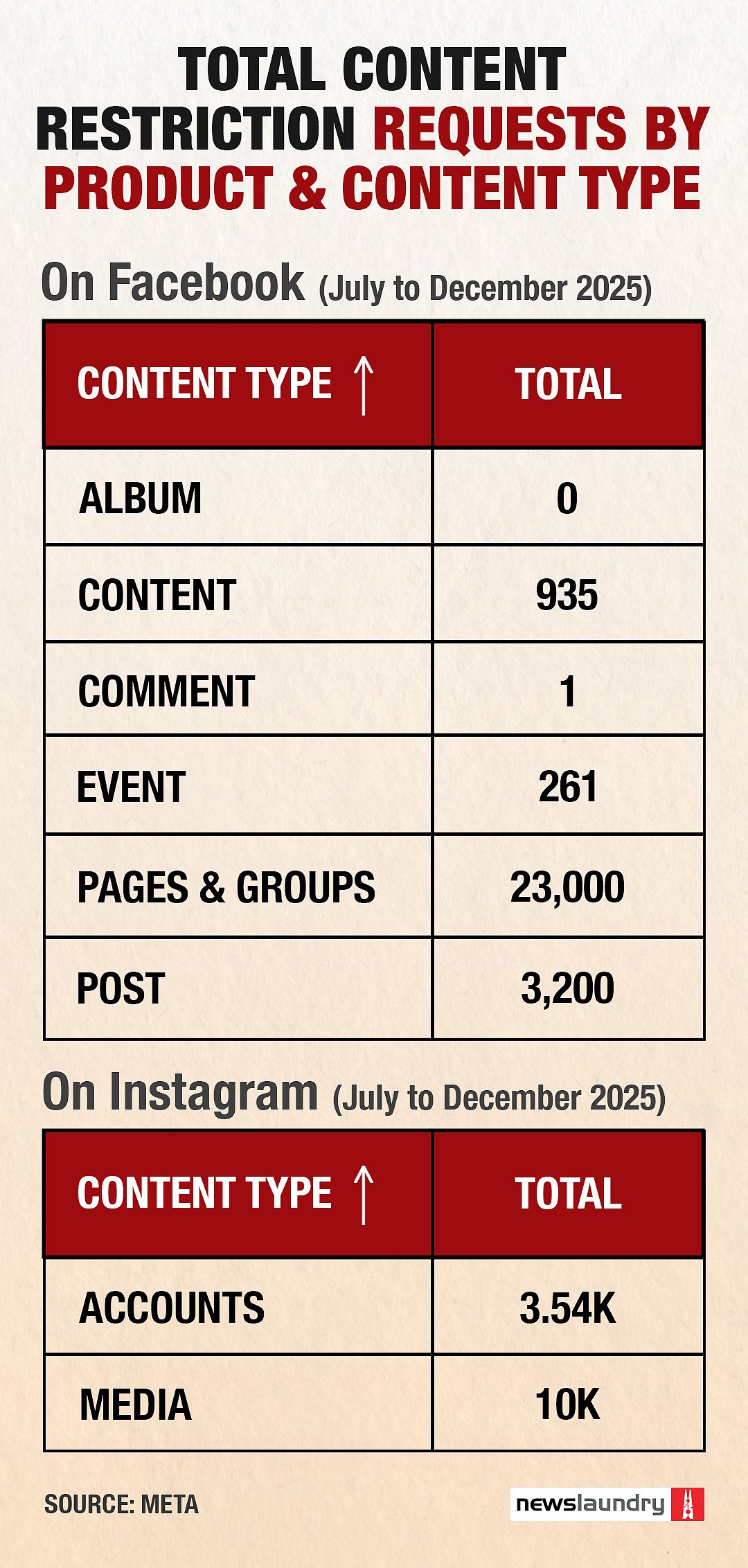
Meta also said it had restricted access to more than 9,000 posts in India in response to directions from the Ministry of Electronics and Information Technology (MeitY), the Ministry of Information and Broadcasting (MIB) and the Indian Cybercrime Coordination Centre (I4C).
Content restricted under I4C-issued reports pursuant to Section 79(3)(b) of the Information Technology Act, 2000, included content allegedly related to generated AI and manipulated content, defamation, hate speech, violence and incitement, religious extremism and sectarian content, and alleged fraud and scams.
The platform also said it restricted access to more than 22,000 posts in response to court orders submitted by local law-enforcement agencies to restrict content relating to generated AI content about local politicians. The remaining posts were restricted due to alleged violations of other local laws.
Asked whether there had been a spike in takedown requests on Meta’s platforms in India after a recent meeting of top Meta officials with Union minister Ashwini Vaishnaw following the brief takedown of Prime Minister Narendra Modi’s post from Facebook, the employee said this year’s data would be updated by the end of the month and that only then could a conclusion be drawn.
SFLC: Sahyog bypasses safeguards under Section 69A
The Software Freedom Law Centre (SFLC), India, has raised concerns over the takedown drive, saying it is contrary to the rule of law and India’s constitutional commitment to freedom of speech under Article 19(1)(a) of the Constitution.
“While private platforms are not directly bound by the Constitution in the same manner as the State, their content moderation decisions increasingly influence the digital spaces in which democratic participation takes place,” SFLC.in said in a statement on August 6.
SFLC.in pointed to a specific legal contrast to make its case.
“The Supreme Court of India upheld the constitutionality of Section 69A of the Information Technology Act, 2000, on the basis that the statutory framework required that blocking orders be reasoned, necessary, and proportionate,” it said.
“By contrast, Sahyog Portal puts in place a parallel system to take down content online, without any of the safeguards present under Section 69A. Notices sent to social media intermediaries through the Sahyog Portal leave users in the dark, with no recourse to meaningfully challenge takedowns and leave affected parties without legal redressal,” it added.
Launched in 2024, the Sahyog portal lets the government and its agencies send takedown notices to intermediaries under the IT Act, 2000, to remove or block access to unlawful online content. Furthermore, the IT (Intermediary Guidelines and Digital Media Ethics Code) Rules, 2021 were amended with effect from February 20, 2026, requiring social media platforms to remove unlawful information within three hours of receiving a government notice or court order.
The organisation said platforms should ensure that their moderation processes are transparent and accompanied by safeguards, including notice, reasons for enforcement actions and effective mechanisms for review.
SFLC.in has called for the disclosure of takedown orders, including the reasons and legal justifications, and for notices received by intermediaries to be sent to affected users. It has also sought greater transparency from platforms regarding the number, nature, source and outcome of government requests or orders for content removal and account restrictions.
X’s Sahyog challenge dismissed, appeal underway
The issue of government notices under Section 79(3)(b) has also been the subject of a legal challenge by X.
X Corp challenged the Centre’s Sahyog portal and the use of Section 79(3)(b) for issuing content takedown notices, arguing that the process could bypass the safeguards prescribed under Section 69A of the IT Act. X also argued before the Karnataka High Court that government officials were not following uniform standards while issuing takedown orders.
The Karnataka High Court dismissed X Corp’s petition in September 2025, upholding the Centre’s position on the Sahyog portal and the takedown mechanism. The court held that social media platforms operating in India are subject to the country’s regulatory framework.
X subsequently appealed against the judgment. In its appeal, X maintained that the takedown process under Section 79(3)(b) allowed a large number of officials to take down content they considered unlawful and argued that blocking orders should follow the safeguards under Section 69A. X had earlier said it would appeal the judgment “to defend free expression.”
For independent and freelance journalists and social media creators, the issue is particularly significant because social media remains a platform to publish reports and information when they do not have a traditional media organisation behind them.
Newslaundry has reached out to X, the Ministry of Home Affairs, the Ministry of Electronics and Information Technology and Meta for their responses. The story will be updated if and when responses are received.
Small teams can do great things. All it takes is a subscription. Subscribe now and power Newslaundry’s work.
 Hafta 601: Meta, Modi and the battle for India’s internet
 Meta pushes child sexual abuse material on Instagram, finds BBC investigation