Anatomy of a ‘conspiracy’: How UP cops turned a wage protest into a national security case
The workers got their wage hike. The activists accused of instigating the unrest are still in jail.
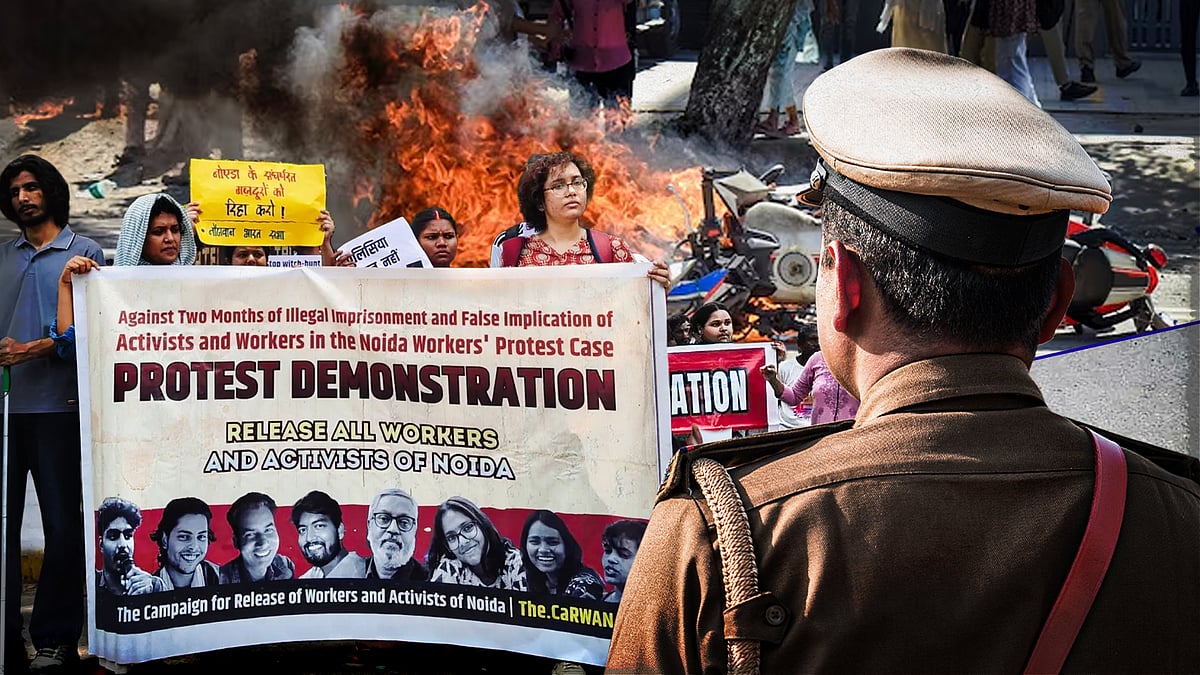
When the Uttar Pradesh government invoked the National Security Act against Aakriti Chaudhary and journalist Satyam Verma following the Noida workers’ protests, it raised a question that went far beyond the two individuals in jail: how had a labour protest become a matter of national security?
The protests had begun over minimum wages in Noida’s industrial belt. They later turned violent, with incidents of stone-pelting, arson and attacks on private property and the police. The violence led to mass arrests, but the police’s case went much further than identifying those allegedly involved in it.
According to the chargesheets, the violence was the result of a pre-planned conspiracy involving a network of activists, students and workers who had allegedly mobilised the protests and incited the protestors to turn violent.
The prosecution’s narrative rests partly on the idea that these people were not random participants in a spontaneous labour agitation. They were politically organised, connected to one another and had been involved in activism before the protests.
That, by itself, is not a crime.
Yet the chargesheets spend considerable space documenting this history: demonstrations organised by Rupesh Roy, the activities of the Revolutionary Workers Party of India, the publication of the Mazdoor Bigul newspaper, libraries and cultural programmes run in working-class neighbourhoods, and the accused's political beliefs.
At one point, the police describe Satyam Verma as being accused of “Marxist ideology” and of wanting to strengthen the RWPI.
The question is not whether these people were politically active. They clearly were. The question is what connects that activism to the specific acts of violence that took place in Noida. This becomes particularly important when looking at the evidence the police cite for the alleged conspiracy.
A WhatsApp group called Richa Global, for instance, was used to mobilise workers around the wage demand. Messages discussed strikes, protest updates and support for arrested workers. The police allege that such groups were also used to incite violence.
But the case diaries reveal something more complicated. Much of the material presented as evidence of mobilisation is, on its face, exactly that: mobilisation. The investigation does not simply have to establish that the accused wanted workers to protest. It has to establish that they intended, encouraged or participated in the violence that followed.
The same tension appears elsewhere in the case.
Police allege that the conspiracy was planned at a library inauguration on March 22. The event was organised by activists associated with the Bharat Naujawan Sabha and involved the inauguration of a library, distribution of literature and activities for children and young people. The date had been announced weeks in advance.
The chargesheet nevertheless relies on call-detail records placing some of the accused at the same location to support the allegation of a conspiracy meeting.
Libraries appear repeatedly in this story. So do newspapers, books, student organisations and neighbourhood campaigns. What looks like a network of political and social organising to its participants is presented by the police as evidence of a coordinated conspiracy.
There is, of course, another side to the story: the violence was real. Any serious examination of the case cannot erase that. Nor does the fact that several accused have remained in custody automatically establish that the police allegations are false.
But courts have raised serious questions about the breadth of the arrests.
An Indian Express investigation into 106 arrests found that protesters spent an average of 53 days in custody. Across seven FIRs, courts passed 222 bail orders, granting relief in 188 cases. Judges repeatedly emphasised that simply being part of a protest was not enough to establish participation in the violence.
The distinction matters, and it points to something larger than the individual cases against Aakriti Chaudhary and Satyam Verma.
On April 14, a day after the violence, the government raised the minimum wage: unskilled workers’ pay rose from Rs 11,313 to Rs 13,690; semi-skilled workers’ from Rs 12,445 to Rs 15,059; and skilled workers’ from Rs 13,940 to Rs 16,868.
The demand at the centre of the agitation was, therefore, not some imaginary grievance. It produced a tangible policy change.
Yet while workers returned to factories and the protests disappeared from the headlines, those accused of turning the agitation violent remained behind bars.
The central question of this case is whether the evidence demonstrates a conspiracy to cause that violence – or whether a broad network of political activism has been retrospectively assembled into one.
Watch our documentary.
Our new project visits the landscape described in Vande Mataram as it stands today, to ask what has become of the country the national song sings about. Support it here.
 Accused of ‘Marxist ideology’: Inside UP Police’s Noida protest conspiracy case