How deficient rainfall is affecting ragi farmers in Karnataka’s Mandya
The district received 45% less rainfall compared to the normal, and ragi has been sown in 1,213 hectare against a target of 63,385 hectare.

Shiva Shekhar, a 40-year-old farmer from Padavalapatna village in Mandya district's Nagamangala taluk, could not sow ragi this kharif. “I kept waiting for the rain but it never came, so I sowed cowpea instead, which is more drought-tolerant,” he said on September 16.
Karnataka is the largest ragi-producing state in the country. In 2025-26, India produced 2 million tonnes of ragi, of which 1.47 million tonnes came from Karnataka, according to the Third Advance Estimates for the year from the Department of Agriculture and Farmers Welfare. The state also accounted for about 73% of the area under ragi that year, at 979,000 hectares. Of that, Mandya—located about 40 km north of Mysuru—accounted for about 53,300 hectares.
Broadly, ragi sowing at the national and state levels has kept pace with last year. But in Mandya, against a target of 63,385 hectare for this year, ragi was sown in 1,213 hectare (1.91%) by September 11, data shared by Jayaswamy, joint director of agriculture for Mandya, show.
By September 11, Karnataka had an overall decline of 1.5 million hectares in kharif sowing area compared to last year. Of this, roughly a third each was in paddy, and the broad category of millets and coarse cereals.
“The seasonal decline in Kharif millet acreage during low-rainfall years reflects practical, farm level adaptation rather than a loss of confidence in the crop,” said C. Tara Satyavathi, director of ICAR’s Indian Institute Of Millet Research.
“When monsoon showers are delayed or substantially deficient, topsoil moisture drops below the threshold required for seed emergence,” explained Satyavathi. “If the mid-August window passes, sowing full-duration varieties can expose the crop to terminal moisture stress later in October-November.”
For Shekhar, shifting to cowpea did not help either. “Due to the lack of rainfall and soil moisture, this crop [cowpea] is also drying up. There seems to be no chance of yield,” he said.
“July had an 83% rainfall deficit and August a 70% deficit. In the last two months, we have hardly had even one rainy day in the district,” said Jayaswamy.
The rainfall deficit
On August 27, the state government had declared drought in 101 taluks, with assessments continuing in other areas. All seven taluks in Mandya were in the list. The district had also submitted a proposal covering around 48,000 hectares of crop loss, Jayaswamy said.
As of September 16, Mandya received 130 mm of rainfall, 45% less than normal, data from the India Meteorological Department show. The state, as a whole, had a 30% deficit. Only four districts recorded normal rainfall. This week, Chief Minister D.K. Shivakumar said more than 200 of the state’s 239 taluks were facing drought conditions.
In May 2026, ISignal had explained the concerns about this year experiencing a ‘super El Niño’ event beginning in the second half and stretching on to early next year. El Niño and La Niña are opposite phases of the global ocean atmospheric phenomenon El Niño–Southern Oscillation (ENSO), a powerful atmospheric-ocean phenomenon.
The National Oceanic and Atmospheric Administration describes the phenomenon as follows: “During normal conditions in the Pacific ocean, trade winds blow west along the equator, taking warm water from South America towards Asia. To replace that warm water, cold water rises from the depths…. During El Niño, trade winds weaken. Warm water is pushed back east, toward the west coast of the Americas.”
El Niño is associated with increased rainfall and flooding in parts of South America, East Africa, and the southern United States; drought conditions in eastern and northern Australia, Indonesia, southern Africa, and parts of South Asia due to suppressed monsoon activity; and reduced Atlantic hurricane activity, according to the World Meteorological Organization (WMO).
Karnataka’s drought, however, cannot be explained by El Niño alone, and other oceanic and atmospheric factors also influencing the monsoon, Raghu Murtugudde, emeritus professor at the University of Maryland and visiting professor at the Indian Institute of Technology, Kanpur, explained.
While the monsoon onset was delayed only slightly, rainfall became highly erratic and unevenly distributed. Murtugudde said global warming is further complicating these patterns: rapid warming over the Middle East and Europe has shifted Arabian Sea winds northward, which can alter the tracks of cyclonic low-pressure systems and leave peninsular India, including Karnataka, with less rain. “How the weather shifts is now a very complicated mix of El Niño and global warming, and it is not easy to separate,” he said.
“Our farming depends entirely on rainwater. The groundwater level in our area is quite low. We have to dig up to 1,000 feet for a borewell. The land in the region is rocky. We have no means of irrigation,” Shekhar said.
Ragi Is climate-resilient, but not drought-proof
“Karnataka’s Southern Dry Zone (Tumakuru, Hassan, Mandya, Ramanagara, Kolar, and Chikkaballapura) is predominantly rainfed, with ragi serving as the traditional nutritional and economic backbone,” Satyavathi explained.
Thirty-five-year-old Rudresh, a resident of Melehalli village in Tumakuru, relies entirely on rainfall for his farming. Tumakuru is a major ragi-producing district, where nine out of 10 taluks have been declared drought-affected.
First, he transplanted ragi at the end of June, but it dried up. A second attempt in August did not help. “It is drying again; there is no yield this time,” he said. Rudresh spent Rs 60,000 on the two attempts. He borrowed Rs 20,000 from a fellow villager to prepare ragi nursery and for transplantation, and owes Rs 1.5 lakh against the Kisan Credit Card.
Rudresh approached the Grama One Centre—a village-level state government chain providing access to services—for crop insurance, but said that the personnel told him “there's no guarantee” that his claim will be processed due to his KCC loan. Tumakuru Joint Director of Agriculture Laxman S.K. said no such rule exists.
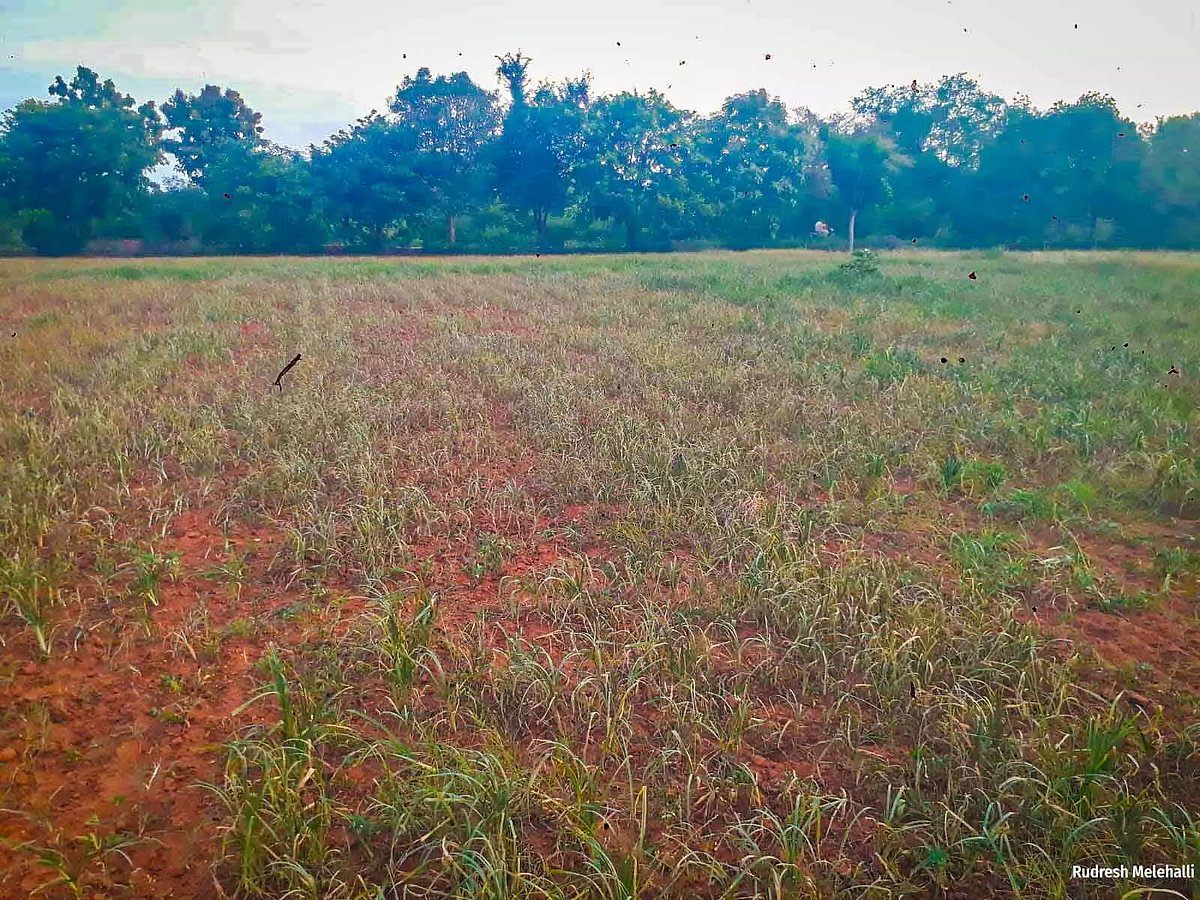
Agricultural crops account for around 45% of Tumakuru’s cultivated area, according to Laxman. Of this, around 95% is rain-fed and only 5% irrigated.
“We received very little rain in the last week of July and the first week of August, and farmers sowed around 152,000 hectares of ragi. After sowing, we have not received any rain. Without rain, it cannot yield,” added Laxman.
“In July, the rainfall deficit was around 80%. Even horse gram is a very hardy crop, but to sow it and get at least some yield, we have to receive rain,” said Laxman.
While finger millet (ragi) is “exceptionally drought-resilient once established”, Satyavathi explained, it requires adequate topsoil moisture during the June-July window to germinate. “When early rains fail, farmers prudently adopt institutional contingency plans, shifting land to ultra-short-duration pulses (such as horse gram or cowpea) or fodder crops to prevent seed loss.”
“Ragi requires only 350–450 mm of water across its entire life cycle—roughly one-third of the water needed for paddy (1,200–1,500 mm) and significantly less than maize (550–650 mm).” said Satyavathi.
A six-year field study in south interior Karnataka found that relatively small differences in available soil moisture could translate into steep yield losses in ragi. At 58% available soil moisture, ragi produced only half its normal yield—about 1,500 kg per hectare. When moisture fell to 40%, farmers could expect just a quarter of the normal yield.
Satyavathi explained how ragi’s sensitivity to rainfall changes as the crop matures. In the first 35 days, during establishment and tillering, ragi has “high natural resilience”, she explained, pointing to measures such as inter-cultivation to create dust-mulch and conserve moisture.
The next phase—panicle initiation to flowering—is critical: Severe stress can affect spikelet fertility, Satyavathi explained. During this phase, life-saving protective irrigation (40–50 mm) via farm ponds or sprinklers can help. But in times of drought, as Shekhar explained, this is difficult in areas with no irrigation and low groundwater levels.
“While prolonged drought during the flowering stage does impact yield, ragi exhibits a remarkable vegetative recovery capacity: once rains resume, dormant tillers revive quickly, a physiological trait rarely seen in commercial cereals,” Satyavathi said.
“State convergence with initiatives like the Krishi Bhagya scheme—deploying polythene-lined farm ponds paired with micro-sprinklers—is actively bridging this by providing the 1–2 protective irrigations needed during critical flowering stages to secure yields,” she added.
During the 70-85 day period after sowing, the crop is in the grain filling stage, and “water deficit can lead to lower test weight”, she explained.
Lagging adaptation among changing rainfall patterns
Ankappa, a 53-year-old farmer from Anigere village in Ramanagara district, prepared ragi saplings in a nursery and later transplanted them into the field instead of sowing directly.
“Ragi can be raised in a nursery while farmers wait for the rains,” explained G. Krishna Prasad, advisor to Devadhanya Farmer Producer Company. “When the rain arrives, they can transplant seedlings that are already around 25 days old, rather than starting the crop from seed at that point. This principle is at the heart of the traditional Ragi Guli system, an indigenous method of intensifying finger millet cultivation.”
Ramanagara district received 34 mm rainfall as of September 16, which is 91% less than normal.
For Tumakuru’s Rudresh, even this transplantation method did not help.
According to Prasad, the problem is also about how rainfall is distributed through the season. As ISignal has explained earlier, even in places or years with ‘normal’ rainfall in the season, extended dry spells and short bursts of extreme rainfall events have become increasingly frequent.
As a result, the sowing season has also gradually shifted, Prasad explained. Farmers who traditionally sowed around May increasingly moved to June and July. This year, he said, there was inadequate rain even by the end of July in some areas.
Prasad questioned what the government is doing to help farmers cope with climate change and whether agriculture departments are doing enough to learn from these practices. He said the response to climate change often revolves around workshops and seminars, while more attention should be paid to farmers’ indigenous knowledge.
He suggested studying how rainfall has changed over the past few decades and using local rain gauges and weather forecasts at the panchayat level to guide farmers. Traditional knowledge, he argued, should be adapted to present conditions rather than simply abandoned.
IIMR is addressing this, Satyavathi said. It has helped establish decentralised millet seed hubs that supply short-to-medium duration, drought-tolerant varieties tailored to specific rainfall cut-off windows.
“The promotion of any crop by ICAR institutes is about distributing high yield varieties, making fertilizer, pesticide and irrigation recommendations,” said Ramanjaneyulu G.V., executive director of Center For Sustainable Agriculture, a non-profit, independent research organisation. “Farmers choose millets only if they have better cooking quality and taste or grow without water and chemicals. If they can afford all these they go for rice or cotton or other commercial crops which give better yield or price.”
Many of the drought-resistant varieties do not have better cooking quality, he explained. “Many varieties popular now are 50 to 60 years old,” Ramanjaneyulu said. “The seed system for these varieties should be very different. We need participatory breeding and varietal selection. Breeder seeds should be given away to FPOs and farmers to multiply and distribute locally. Contingency plans for seed supply are a must in rained areas. So the more local, the better.”
ISignal reached out to the Secretary and Director of Karnataka’s Agriculture Department on September 15, seeking responses on the sharp decline in ragi and millet sowing, its link with deficient rainfall, drought mitigation measures, climate adaptation, and support available to farmers. We will update this report if we receive a response.
This report is republished with permission from ISignal, formerly IndiaSpend, a data-driven, public-interest journalism non-profit. It has been lightly edited for style and clarity.