Srinagar’s Smart City project is 98% done. But locals say it’s beautification without the basics
The Centre's Smart Cities Mission ended in March 2025, leaving the city's flood defences, sewage, and lake much as they were. A few hours of rain in July 2026 made that plain.

In the second week of September, a cinema screen floated on the Dal. Srinagar was hosting the first International Film Festival of Jammu and Kashmir, with Chief Minister Omar Abdullah opening it against the Zabarwan hills. It was the city’s biggest international event since the G20 tourism meeting of 2023 and, like that one, mostly an argument made in pictures.
Seven weeks earlier, on July 20, an hour of rain had put the same city under water.
Lal Chowk, Polo View, Residency Road, the Boulevard, Khanyar, Sada Kadal, Nalamar, Bemina, Dalgate. Water got into the Civil Secretariat, of all places. By evening the valley’s papers had their verdict – so much for the Smart City – and the next day Abdullah called the Secretariat flooding a matter of shame. His cabinet, he said, had already ordered a third-party audit of the Srinagar Smart City project.
What the audit will find is anyone’s guess. But what residents describe is fairly consistent. They point to roads raised over drains that still choke, a landfill that keeps growing, a lake that got new decks and cycle tracks but kept its sewage, and beautification in place of the basics.
That may be a little unfair to a project that did build some things that work. But it’s hard to argue with people facing these problems, considering that the project is 98 percent finished on paper.
Done and dusted?
On paper, 157 of 161 sanctioned projects had been completed by March 31, 2026, the Union government told Parliament in July. The completed works cost around Rs 3,530 crore against a sanctioned Rs 3,633 crore. The Smart Cities Mission itself formally ended on March 31, 2025, and the Ministry said no proposal to expand it is under consideration. Four projects are still underway, among them a SCADA-based water management system and water transport on the Jhelum and Dal Lake.
Srinagar MP Aga Syed Ruhullah Mehdi had asked in the Lok Sabha whether the government had taken cognisance of the flooding despite the Smart City Mission, and whether the project included storm-water or flood-mitigation works. The Lok Sabha reply named no such project and didn’t explain the flooding.
Though drainage was never meant to be optional. The mission’s own guidelines count sanitation and storm-water management among the basics a smart city must deliver.
But Srinagar Smart City Limited (SSCL), which ran the project, says it is being blamed for things it didn’t build – and on some counts, it has a point. An official told the news agency KNO that Khanyar and Sada Kadal were not its roads, and that Nalamar was done by the Roads and Buildings department. On the stretches it did rebuild – Dalgate–Gojwara, M A Road, Residency Road, Karan Nagar – it says it only touched the surface. “The drainage and sewerage network already existed. We only carried out road redevelopment.”
That defence is also the problem.
Shops still counting losses
In Rajouri Kadal, in the old city’s copperware lanes, Nabeel Ahmed* has spent two months sorting what can be saved. He sells traam, the hand-beaten copper Kashmiris serve meals in.
“What Smart City! Nothing has changed here. The July floods washed away all pretense of smartness,” he said. Copper can at least be re-tinned. “With copper vessels, you have a provision for kalaai. My kaarigars can fix my damaged pieces, though that will take time. But it isn’t the same for others in this market who have to throw away what is damaged.”
Next door, Waqar Qadri*, who sells electronics, now carries his stock upstairs every evening and back down every morning. “Rain can come anytime and damage the goods again. I can’t take that risk. I have suffered losses worth several lakhs due to flooding this year.”
Both men watched their street being rebuilt – the road raised, drainage space, as they tell it, squeezed. “It looked good,” Qadri said. Both say they could see what was coming. Neither said anything at the time, claiming they feared punitive action. (More on why later in this report.)
About a kilometre away in Kawdara, the 16th-century shrine of Hazrat Syed Muhammad Habibullah Surkhabi has been shut since July. Next to it, a pool of rainwater that hasn’t drained in two months is, predictably, breeding mosquitoes. “Those of us who could afford it have contributed Rs 5,000 per person to clean the dargah and change the furnishings,” Nabeel said. “We don’t know when the dargah will be operational.”
SSCL took up Rajouri Kadal in 2022-23, as part of a plan to conserve downtown’s old streets. “The focus is more on functionality than on beautification,” Iftikhar Kakroo, then SSCL’s chief engineer, told Asian Mail that November. Suhaib Naqshbandi, an SSCL planner, was broadly satisfied. “The execution was done rather well, with a few delays here and there.” He didn’t accept that the new streets had anything to do with the waterlogging.
What Smart City! Nothing has changed here. The July floods washed away all pretense of smartness.
Nabeel Ahmed*, a traam seller in Srinagar
No one to ask
Had Qadri and Nabeel wanted to complain, the obvious person was their ward corporator. There isn’t one. The Srinagar Municipal Corporation’s term ran out in November 2023, and Jammu and Kashmir hasn’t had elected urban local bodies since.
On August 14, Abdullah said local body elections would happen at “an appropriate time” – repeating the words the BJP uses when asked about the restoration of statehood.
SSCL’s board, for its part, is all officials, answering to a committee chaired by the chief secretary. And then in Kashmir, the question is whether to ask any question at all.
In January, Kupwara-based freelance journalist Kushal Khwaja was detained for several hours after reporting on administrative lapses during a medical emergency in snowbound Karnah. The Kashmir Press Club at Polo View, once the reporters’ main forum, was shut by the government in 2022. “Journalists say the Indian government is trying to shut down reporting… even on day-to-day civic issues,” the BBC reported in 2023.
A flaw beneath the streets
In August, municipal commissioner Fazlul Haseeb told Abdullah that Srinagar has about 680 km of storm-water drains. Master Plan 2035 says it needs roughly 2,500 km more. About 15 per cent of what exists runs below capacity.
Underneath that is something worse, a design flaw. The CAG found that Srinagar has no separate networks for sewage and storm water. In October 2023, three dewatering stations discharged 7.47 crore litres over 11 days without rain. Which can only mean they were pumping household waste. In September, Greater Kashmir found sewage in the pipes of a Rs 12.80-crore storm-water scheme at Nadroo–Hyderpora. Forty-nine pumping stations, built with Rs 124 crore, spend much of the year doing the same thing: lifting sewage into the city’s water bodies.
None of this started with the Smart City, to be fair. But it’s hard to see what the Smart City did about it. And that brings us, more or less inevitably, to the Dal.
‘Where did the money go?’
A sustainable environment is one of the mission’s core elements. In Srinagar, it seems to have been read as decking.
A CAG audit for 2023-24 didn’t think much of the Lakes Conservation and Management Authority (LCMA), which runs the lake. The Dal’s open water shrank from 15.40 sq km in 2007 to 12.91 sq km in 2020. Treatment plants malfunctioned; conservation work was late or badly done, or both. A study in the journal Water estimates that of the 201 million litres of sewage Srinagar produces every day, about 147 million go into the Dal and the Jhelum untreated.
The Smart City’s share of the lake was mostly its edge – Foreshore Road, or the viewing decks towards Naseem Bagh. In January 2025, the Anti-Corruption Bureau registered preliminary enquiries into the alleged use of substandard material in those works, and the alleged misappropriation of Devari stones, tiles and iron grills during the revamp. None of it has been tested in court.
At Ghat No. 2 in Nigeen, Showkat Ahmed, 35, waits by his shikara for fares. “The Dal looks picturesque from afar; come near it, and you see the sludge. The overflowing public toilet near the ghat, the unbearable stench and mosquitoes are our daily reality. Where did the money to beautify the Dal go?”
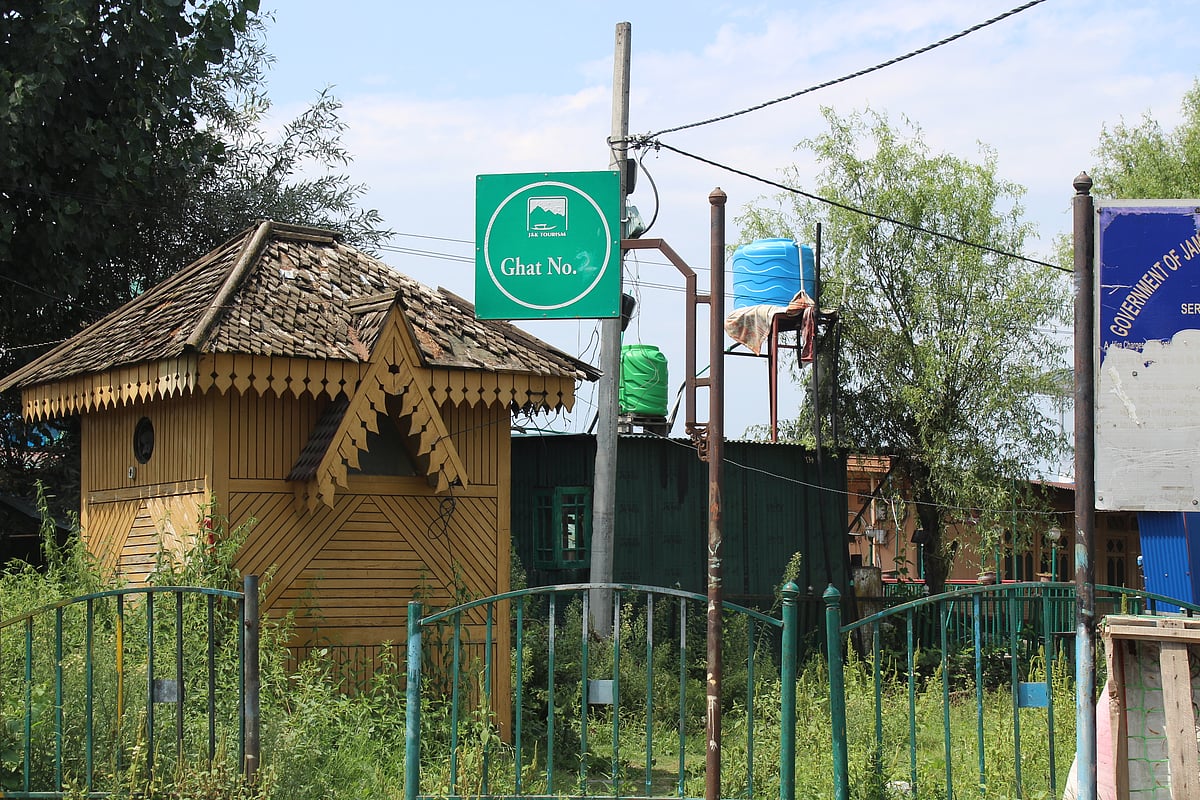
Raja Muzaffar Bhat, an activist who has litigated on the valley’s water bodies before the National Green Tribunal, says that “Smart Srinagar is letting its most prized possession, the Dal Lake, die a slow but sure death.”
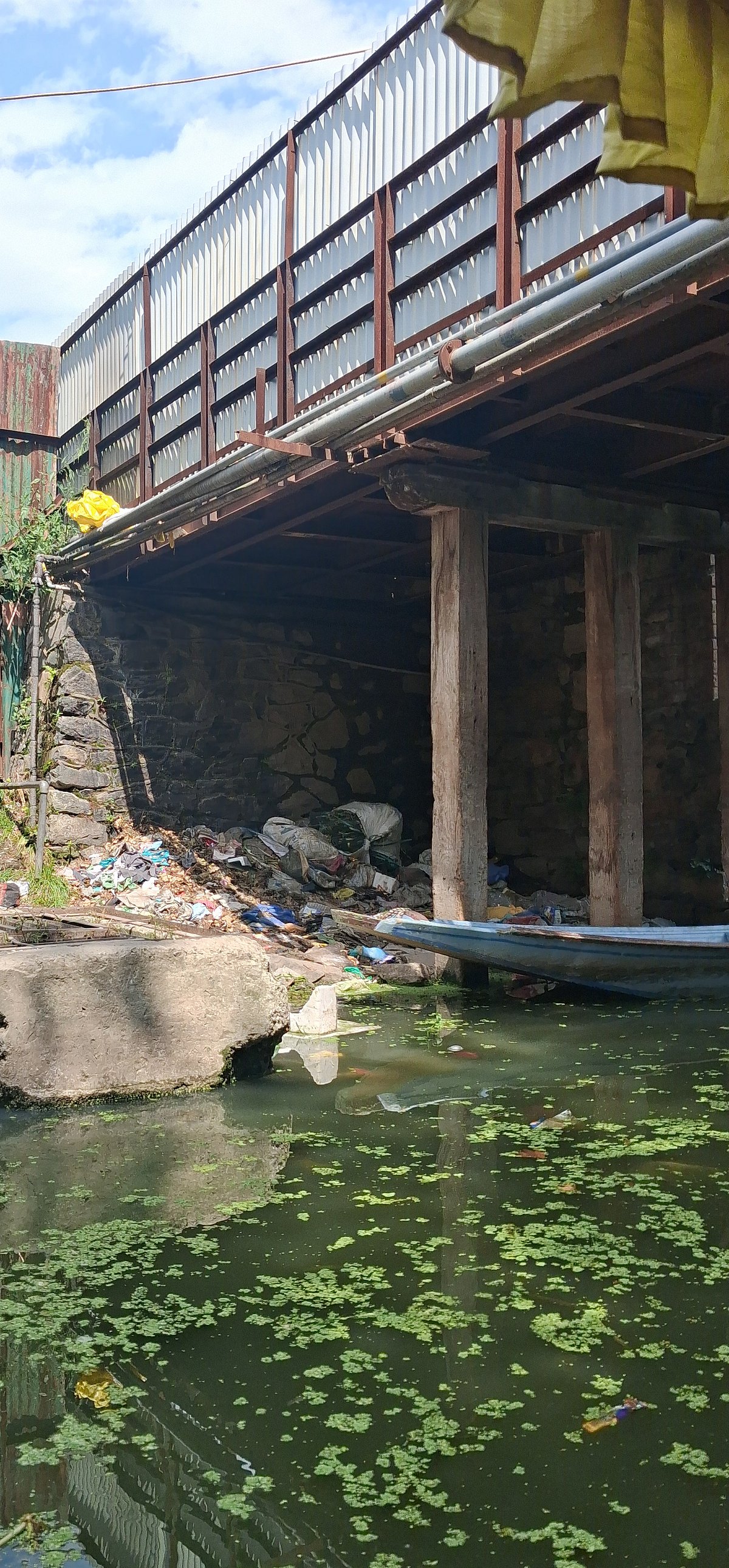
Showkat rowed me into Sofi Mohalla, the lake’s interior. Families live on islands here, linked by creeks too narrow for two boats. You can’t see any of it from the Boulevard. People drink this water and wash in it, and they’re increasingly scared of it.
Abdul Khaliq Bhat, 75, says doctors have advised surgery for his grandson’s eye. “He caught a severe infection from the water after washing his face one day,” he said. “The mohallah at Dal Lake has been my family home for the past 500 years… But now the lake is slowly killing us.”
Dr Siraj-ud-Din Ahmad, a paediatrician who once ran the nearby JLNM Hospital, said children here are likely to suffer from Hepatitis A. “The contamination of water and the increased pollution in the lake are the obvious reasons behind such diagnosis.” Whether the water explains every case is hard to say.
Researchers have found lead, cadmium and arsenic in the lake well above permissible limits, Free Press Kashmir reported last year.
Then there are the toilets. Officially, there aren’t any. “There is no record of public toilets at the ghats,” said Niyaz Ahmad Ganai, an LCMA executive engineer. I asked about the one at Nigeen, the overflowing one. “We will have to look into it.” His counterpart, Irfan Ahmad Dar, said: “This does not come under my jurisdiction and pertains to Mr Ganai.”
My grandson caught a severe infection from the water after washing his face one day. The mohallah at Dal Lake has been my family home for the past 500 years… But now the lake is slowly killing us.
Abdul Khaliq Bhat, a resident
The flagship
Srinagar joined in 2017, with Rs 2,869.24 crore for the downtown, the commercial core and tourist stretches, and Rs 765.03 crore for city-wide systems – a command centre, traffic, fibre, buses.
The brand was city-wide. The accountability, it seems, wasn’t quite. Kakroo told Kashmir Life in 2022 that of roughly Rs 3,000 crore then in play, SSCL held around Rs 1,000 crore. The rest sat with other departments – which may explain some of the finger-pointing.
Polo View was meant to be the showpiece. In June 2023, Athar Aamir Khan, then SSCL’s chief executive, called it the city’s first fully pedestrianised market, with separate underground sewerage and drainage. The Rs 27-crore makeover of Lal Chowk and Residency Road next door was supposed to end years of flooding.
On July 20, people waded through many of these parts.
The traders here have a different complaint. They have written to Lieutenant Governor Manoj Sinha, they say, asking for the road to be reopened to cars – the cobbled lane photographs beautifully but is terrible for business. They showed me drain lids already loose in the new surface. One rocked underfoot.
On Residency Road, Ghulam Qadir was less patient. “There is no maintenance. They have installed a fountain but it remains dysfunctional most days. They have turned regular roads into cobbled stone pavements to make them look good but have done nothing to stop waterlogging when it rains.”
Insha Karim*, a 32-year-old dentist, alleges she was overcharged at SSCL’s parking lots. “Attendants… are not present when you want to exit. This leads to the meter running. I managed to gather a few faulty parking receipts with exorbitant charges. I will take this matter to court.”
Polo View was meant to be the showpiece. In June 2023, Athar Aamir Khan, then SSCL’s chief executive, called it the city’s first fully pedestrianised market, with separate underground sewerage and drainage. The Rs 27-crore makeover of Lal Chowk and Residency Road next door was supposed to end years of flooding. On July 20, people waded through many of these parts.
The garbage keeps piling up
In 2023, the municipal corporation promised a garbage-free city, with 150 new vehicles. Three years later, the Achan landfill holds over 1.1 million tonnes of old waste and takes in hundreds of tonnes more each day. The SKIMS hospital, under three kilometres away, has complained repeatedly about the smell, the Kashmir Observer reported in August.
Garbage sits outside homes on the Dal and in markets across the city. “There are no designated places in the areas to dump garbage. If you miss the morning SMC garbage collection van, you have nowhere to take the garbage. This has not changed in the past twenty years,” said Amin Beigh, 47, of Jawahar Nagar.
But Khan sees it differently. “Earlier, 260 tonnes of waste would be collected daily. We took it to 620 tonnes.” Both things can probably be true – more is collected, and there is still nowhere for it to go. The landfill, he said, is under review.
What worked
Some of it did work, and it would be dishonest to skip that. In November 2023, 75 of 100 electric buses started running on 17 routes. Hardly anyone has a bad word for them. “It has made life easier for commuters,” said Wazir Ahmed*, who works at the Pantha Chowk depot. Nabila Wani, a student, put it simply: “This is a boon for us women.”
The battery autorickshaws have fans too. “The blue autorickshaws are cost-effective… Water transport was promised when the smart city project was announced,” said Andleeb Wani*, a teacher in Lal Chowk.
Traffic is another matter. Chanapora, Barzullah, Hyderpora – they jam every day. “People don’t follow traffic lights on the roads, and at some crossings the lights are not even functional,” Andleeb said.
Srinagar’s air didn’t rate ‘Good’ in a single month of the past year, DownToEarth reported; transport causes over half the pollution.
Khan, now Budgam’s divisional commissioner, says the project did what it set out to do, citing the command centre and fibre network work. “Flooding happens as drains get clogged with solid waste… It is the regular maintenance of underground drains that requires more attention.”
Naqshbandi, for his part, pointed at geography. “Srinagar has a saucer-like topography that makes draining rainwater more tedious,” he said.
In 2023, the municipal corporation promised a garbage-free city, with 150 new vehicles. Three years later, the Achan landfill holds over 1.1 million tonnes of old waste and takes in hundreds of tonnes more each day.
What’s pending
When an RTI application asked how many jobs the project had created, SSCL said it doesn’t keep those figures.
For some younger Kashmiris, the project stands in for the politics that went missing after August 2019. “There used to be a democratic process in the election of members of the Srinagar Municipal Corporation, but members of the Srinagar Smart City Limited Corporation were mostly bureaucrats representing the central government,” said Anees Riyaz*, 22, a political science postgraduate.
Umar Nabi*, 26, a law graduate, said officials became “difficult” to reach. “The threat of FIRs being slapped on all and sundry felt too real.”
Work sped up before the G20 meeting. An engineer in the public health engineering department alleged, anonymously, that the tender for one flagship work was rushed. SSCL chief engineer Abdul Qayoom Kirmani denied it. “Nothing like this happened. Nobody was rushed… The work we have delivered is world-class.”
Waheed Ur Rehman Para of the Peoples Democratic Party – whose government, it’s worth remembering, brought Srinagar into the mission – alleged that what got built wasn’t what was approved. “Only big bills were generated, but the quality of work was heavily compromised. The results are there for all to see.”
Newslaundry emailed Chief Secretary Atal Dulloo for comment. His response will be added to this report once received.
*Names have been changed on request.
A quarter-century of Modi governance calls for questions and a hamper. To mark the occasion, we have offers for subscribers and other readers.