Spectacle isn’t the story: What the SIR protests are drowning out
While protests over the SIR and demands for Gyanesh Kumar’s resignation dominate the headlines, ground reports reveal voter deletions, broken election systems, coerced polling, and a deepening rural crisis.

Much to the discomfiture of the Modi government and Chief Election Commissioner Gyanesh Kumar, the apparent irregularities in the special intensive revision (SIR) of voter rolls refuses to die down. In fact, it has escalated, and the media is digging out more dirt.
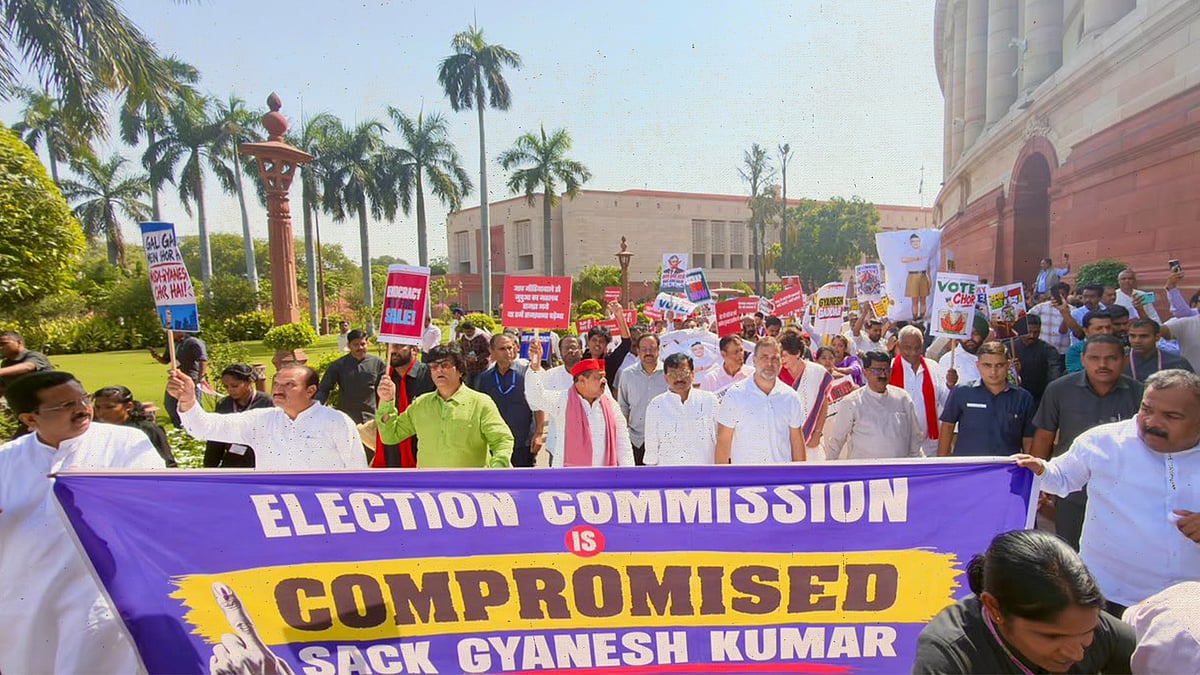
You would not know this unless you take time to read newspapers and digital news platforms. Predictably, mainstream media continues to obsess over events. And events that cannot be ignored are the large-scale demonstrations by opposition political parties, as well as the pressure group, the Cockroach Janta Party, demanding Kumar’s resignation.
The drama is eye-catching no doubt. The Leader of the Opposition Rahul Gandhi scaling barricades and being dragged into a bus. Member of Parliament Priyanka Gandhi lying on the road holding a copy of the Constitution in her hand as the police drag her away. And the fun and games that now seem to be the hallmark of the protests called by the CJP as young people make full use of social media to register their presence.
But spectacle is not the story. It is what’s happening on the ground. Often, the media space occupied by the spectacle obscures the stories we need to read to understand the extent of the chaos caused by SIR across India.
Let me draw your attention to a few.
The Reporters’ Collective has followed up in detail on the situation in Delhi after the SIR exercise. Following the Election Commission’s recent directive that Booth Level Officers (BLOs) visit the homes of voters whose names have been left out, it found that, on average, each BLO would have to visit 215 voters in Delhi within two months. Given that BLOs are also otherwise employed, as teachers and in other jobs, this would be impossible.
Reporters also found that in 661 polling booths in Delhi, an estimated 30-70 percent of registered voters had been declared doubtful. For instance, in Ballimaran in Old Delhi, out of 635 registered voters, as many as 609 were marked doubtful, leaving only 26 who escaped unscathed by the verification exercise. Reading the long report gives you some inkling of the chaos left behind in the wake of the SIR exercise in the country’s capital city.
Then take Bengal, where bye-elections have just been held in two Assembly constituencies, Rejinagar and Nandigram. According to a report in Indian Express, even the tribunals headed by retired judges established after the Supreme Court took note of the inexplicably large number of voter deletions, are unable to work. For example, one of the many points in the minutes of the meeting of the tribunal judges, dated August 11 and accessed by the paper, states: “There is no mechanism…till date in spite of several requests and reminders to develop a common and proper mechanism on the portal to serve notice to the parties directly or through proper channel. Sometime in the month of May 2026 some of us even approved a format of notice to be issued to the parties but it has not seen the light of the day till date.”
In other words, even those assigned by the highest court in the country are apparently unable to impress on the Election Commission that its web portal has serious problems. This point also emerged in the September 25 Indian Express investigative report on objections raised by two Election Commissioners about the software used in the Election Commission’s web portal.
Furthermore, the problem is not just deletions of voters’ names. In UP, which will go to the polls next year, according to this story by the Reporters’ Collective, 12.92 lakh voters were added with no logical explanation.
To quote from the story, “With help of independent tech experts we downloaded, collated and analysed all Form 6 applications made public by Uttar Pradesh CEO in a disaggregated form. We found ECI had displayed details of 71.38 lakh applications from people for inclusion in the voter list. Most of these are people who had been deleted by ECI from the draft list. Against this, the ECI had added 84.3 lakh voters into the final list. An extra 12.92 lakh voters had been added than those who applied and whose details ECI put out.”
Even more mystifying, according to the Reporters’ Collective story, “It's only once the draft list is drawn up under the SIR that people come to know if they have been deleted, declared missing, dead, shifted or duplicate. But the ECI said 16.18 lakh voters had applied through Form 6 before this draft was made public.”
The result of all this is already emerging in the way the recent bye-elections were conducted in Bengal. This report in Scroll illustrates what could follow in future elections, where voters are not only left out but physically prevented from voting.
In Rejinagar, where 60-70 percent of the population is reportedly Muslim, the reporters found that many Muslims were being turned away and not being allowed to go and vote.
What is even more worrying is that the social media handles of local reporters were blocked on polling day, ostensibly to prevent any record of these actions. According to the story, “In addition to turning away Muslim voters and intimidating Opposition workers, the third tactic the police used in Rejinagar was to block the social media pages of several prominent local journalists for the week leading up to the bye-poll. Many of them were unblocked only after voting concluded on Tuesday evening.”
Given that so much ground reporting today is done by such journalists, this appears to be a deliberate strategy to ensure there is no record of these actions.
Read together, the reports on deletions, the problems with the ECI web portal that remain unaddressed, the mysterious additions in Uttar Pradesh, and the conduct of the recent bye-elections in Bengal, there is little doubt that this is a story that will determine the future of electoral democracy in India.
But the spectacle of street protests, and the details now emerging of the SIR mess, are not the only stories that need to be told and heeded.
Away from the spotlight, deep distress is unfolding in Maharashtra, for instance, where 265 out of 358 talukas in the state’s 32 districts have been declared drought-affected.
These special reports in Indian Express tell us the seriousness of the situation on the ground, where the tragic but now familiar story of farmers choosing to die by suicide because they cannot face the future is unfolding. Farmers are selling their cattle to survive. Distress migration has already begun, as agricultural workers who don’t own land are migrating to other states to find work because nothing is available where they live.
It is this kind of ground reporting that is so essential to remind us that India still lives in its villages, its forests, in mountainous areas, and not just in the cities that the media can access with ease.
A quarter-century of Modi governance calls for questions and a hamper. To mark the occasion, we have offers for subscribers and other readers.
 No entry, no answers, just ‘get lost’: The Opposition’s battle to be heard by Gyanesh Kumar
 ‘Gyanesh Kumar must go’: Opposition MPs march to Election Commission, meet barricades instead