The curious case of protesters’ missing phones: Neither FIR for ‘snatching’, nor memo for ‘seizure’
Lawyers claim the police refused to lodge an FIR. The Connaught Place police station SHO denied all the allegations.

Amid the recent protests and thousands of detentions in Delhi, at least 24 mobile phones belonging to detainees remain unaccounted for.
Their owners were detained around 4 pm on October 11 in Connaught Place. A complaint was sent to the police accusing four policemen of snatching the phones the same day. But lawyers who helped the detainees filed the complaint claimed the police refused to register a regular FIR. They say they were compelled to opt for an e-FIR – lodged on October 16 at the Connaught Place police station on theft charges despite the alleged snatching.
Connaught Place police station SHO Sukhbir Malik denied the allegations and said the police are probing the matter. “We did not take anyone’s phones. These people misplace their phones themselves or leave them at home. They then put pressure on the police,” Malik said.
The complaint, filed on behalf of one Pankaj Sahu, claims the police had collected phones from detainees inside a blue van and told them the devices would be returned on release. When the van reached a detention centre in Pandwala Khurd at about 7:35 pm, the phones were not in it. No officer there took responsibility for them and no seizure memo was given despite procedural norms, the detainees claim.
Newslaundry reviewed location records for at least four of the phones. They show the devices last transmitting between 6:27 pm and 7:09 pm from Dwarka and southwest Delhi, some near canals and a bridge, while the detainees were possibly still in transit or just arriving. Though the records do not establish who disabled or moved the phones, or whether they followed the van’s route.
The transit: ‘They told us to approach cops in CP’
The detainees claimed they were told to unlock their phones and clean up their galleries, before being told at the end of the journey that their devices were not in the van.
Hemansh Kashyap, a 28-year-old corporate employee who was detained that day and whose phone is among the 24 that remain missing, claimed they were first taken in a DTC bus from near Chili’s restaurant on Connaught Place’s Outer Circle to a barricaded area near Pind Balluchi. “We were subsequently taken individually into a blue police van, where a policeman collected our phones and placed them in a black bag near the van door. In some cases, the policemen were forcing the detainees to delete photographs and videos from October 10 and 11. They also checked the recently deleted folders.”
Tarang Balani, another detainee who is 23 and lives in east Delhi, alleged the detainees were asked to unlock phones and “delete photographs and videos from our galleries. All of us (detainees) were told that our devices would be returned upon our release.”
The detainees claimed the van stopped outside Chhawla police station at around 6:45 pm and waited there for 10 minutes. It reached the Pandwala Khurd community centre being used as a detention centre around 7.35 pm. After getting off the van, the detainees asked for their phones, but they were told the devices were not in the van.
S Singh, a 30-year-old singer, claimed, “No officer at the detention centre accepted responsibility for the devices. They told us to approach the police personnel in Connaught Place who had taken our phones in the first place. They did not tell us which officers had taken the phones or which police station in Connaught Place we should approach.”
Lawyers Gaurav Jain and Fahad Khan arrived at the detention centre around 8.45 pm, and helped the detainees file a complaint. The detainees continued seeking answers until around 11 pm before leaving for their homes.
‘There could be more incidents’
The complaint, listing the names and details of 24 people, was first emailed to the Chhawla SHO and Dwarka DCP on October 11. It was then emailed to the Connaught Place SHO and the DCP on October 14, and then mailed via demand draft at the Connaught Place police station on October 15. The e-FIR, filed under Section 303(2) of the Bharatiya Nyaya Sanhita (BNS), 2023, points to the alleged theft of phones and other belongings near Regal Building, between 4 pm and 5 pm on October 11. The list of stolen items includes mobile phones of various models, Rs 1,800 in cash and a microphone.
On October 17, Advocate Gaurav Jain, representing the detainees, submitted an application to the Connaught Place SHO providing the names and photographs of police personnel whom the complainants had identified as suspects.
“If these suspects/proposed accused-persons are properly inquired, they may hand-over the snatched phones (if they are still holding them) or provide valuable leads which could take us close to the mobile phones.”
The application mentions four personnel: Harsh and Deepak, both from the 3rd Battalion and belonging to the 2022 batch; an inspector with the Delhi Police whose name is not known; and one Saurabh, also with the Delhi Police. According to the detainees, “Harsh was collecting the phones inside the van, while Deepak was threatening detainees when they refused to hand over their phones. The unidentified inspector appeared to be overseeing the detention process near Pind Balluchi.”
Advocate Jain is now preparing to file a petition in Patiala House Court. “We have a list of at least 24 missing phones and one missing microphone, but there could be more people whose names were not recorded in the complaint. We are in the process of preparing the cases.”
Where did the phones go?
Newslaundry examined location records for four of the missing phones, obtained by their owners through Google Find Hub, Google Maps Live Location and WhatsApp Live Location, with timestamps.
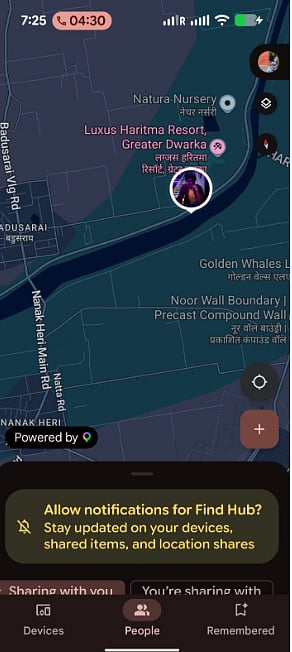
Kashyap found his phone’s last known location near Luxus Haritma Resort in Greater Dwarka, close to Badusarai village. The device stopped transmitting its location at around 6.50 pm, though Kashyap said it had 41 percent battery remaining, which he checked using Find Hub.
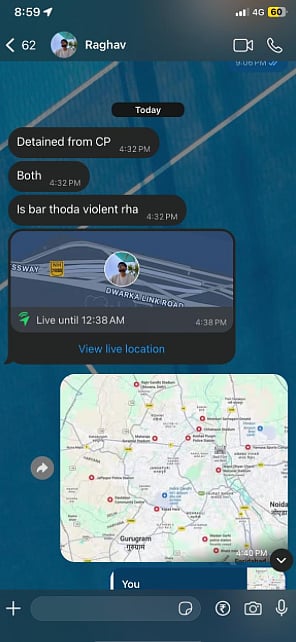
A Google live location screenshot shared by Raghav Aggarwal, a 29-year-old corporate employee who was also detained, showed his phone’s last location on Dwarka Expressway around 6.27 pm.
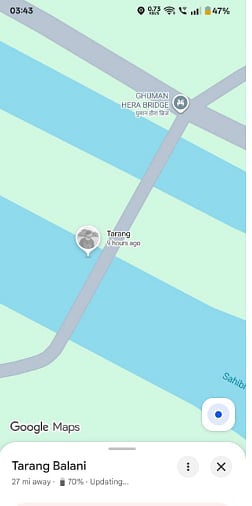
The Find Hub App showed the last location of Tarang Balani’s phone near Ghuman Hera Bridge, beside the Sahibi River in southwest Delhi. The screenshot, taken at 3:43 am, showed the location marker labelled “9 hours ago”. The screenshot also displayed the phone’s battery level at 70 percent. According to Balani, “The last location of the phone is about 20 minutes from the detention centre. My device stopped transmitting its location after 7.08 pm.”
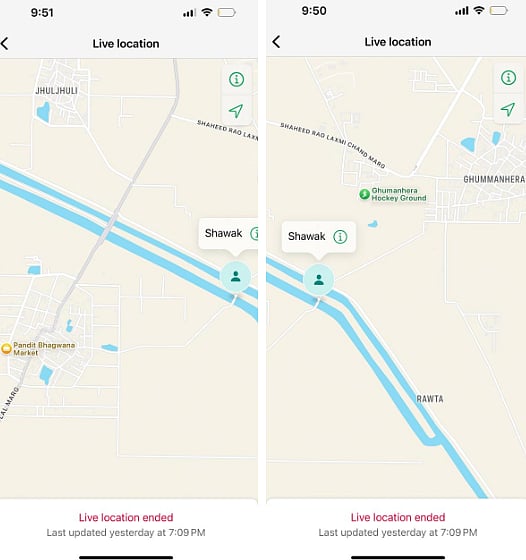
Google Maps live-location screenshots provided by S Singh show his phone’s last recorded location at 7:09 pm in the Jhuljhuli–Ghumanhera–Rawta area of southwest Delhi, along a canal.
Google says Find Hub estimates a device’s location using available sources, which can include GPS, nearby Wi-Fi networks and mobile towers. The accuracy can vary: Google says GPS can locate a device to within around 20 metres under suitable conditions, while mobile-tower-based estimates can be accurate only to within a few thousand metres. The radius shown around a location pin indicates the app’s confidence in the estimate.
What does the law say?
The seizure of mobile phones depends on the circumstances, the legal grounds for the seizure and whether the prescribed procedures have been followed.
The Bharatiya Nagarik Suraksha Sanhita (BNSS), 2023, sets out the procedures governing searches and seizures of mobile phones. Section 106 permits a police officer to seize property alleged or suspected to have been stolen, or found in circumstances that create suspicion of an offence. The officer must report the seizure to the officer in charge of the police station, and where required, to the jurisdictional magistrate.
Section 185, meanwhile, governs searches conducted by police during an investigation. It requires reasonable grounds to believe that something necessary for an investigation will be found and cannot otherwise be obtained without undue delay. The officer must record the grounds for the search in the case diary and specify, as far as possible, the item being sought. Section 185 is not a blanket power to search every detained person’s phone.
Section 105 of the BNSS requires audio-video recording of specified search and seizure processes, including the preparation of a list of items seized and its signing by witnesses. The recording must be forwarded without delay to the appropriate magistrate. It applies to the processes covered by the provision, including searches under Section 185.
Senior Advocate Suroor Mander told Newslaundry, “The fact that the protesters were detained did not, by itself, authorise the police to seize their phones. If they seize them, they have to record the seizure in a memo and state the reasons for it…Even if a person is detained or arrested under a kalandra, the police have to follow the procedure. But in this case, there is no record of the phones being taken away, and the police are denying that they took them.”
Mander raised another question, “The more dangerous thing is that these mobile phones are now missing…These devices and numbers could be used for any kind of malicious activity. Who is stopping anyone from doing that?”
Small teams can do great things. All it takes is a subscription. Subscribe now and power Newslaundry’s work.