People’s tribunal indicts Delhi Police over handling of July protest
Parts of the media have called recent protests anarchy, and the police called them unlawful. The tribunal explored several broad questions around the legality of the police response and the denial of permissions.

A report by a people’s tribunal has concluded that the Delhi Police and paramilitary forces used force that was neither necessary nor proportionate against the July 20 student march to Parliament.
The Constitutional Conduct Group, an informal collective of former bureaucrats, released the report at the Press Club of India on Friday.
The report argues that the state treated a constitutionally protected assembly as a threat to pre-empt, skipping the dialogue, warning and graded force that law and police orders require. It also warns that the pattern is repeating, citing reported detentions during the October anti-SIR protests, and says the law on protest policing, not just individual officers, needs to change.
The tribunal was chaired by Justice Anjana Prakash, a senior advocate and former Patna High Court judge. Its members were former Union Home Secretary Gopal Krishna Pillai, former civil servant Aditi Mehta, former National Judicial Academy director Mohan Gopal, academic Radha Kumar and historian Tanika Sarkar. Harsh Mander convened it.
The tribunal heard 25 people, including injured protesters, lawyers, doctors, journalists and retired police officers. The Delhi Police and the Rapid Action Force were invited but did not respond.
“Ultimately, the events examined in this report raise a fundamental question for Indian democracy: whether the State will treat peaceful protest as a constitutionally protected form of public participation or increasingly approach dissent as a threat to be suppressed. The protection of democratic rights requires more than the formal recognition of constitutional freedoms. It requires law enforcement agencies to respect those freedoms in practice, to exercise coercive powers within clearly defined legal limits, and to ensure that violations are investigated transparently and remedied effectively. Democratic policing must preserve public order without extinguishing the right to dissent,” it notes.
The report explored several broad questions before arriving at its conclusions with testimonies. Was the police correct in deeming the peaceful assembly as unlawful assembly? Did the police leadership attempt to negotiate with the leaders of the protesters before the protests or before the actual use of force? Did the police give due warning to the protesters before using force? When the police decided to use force, did they follow a graded response, using less-lethal methods first, and was the force proportional? Are allegations of excessive and non-legal use of force justified?
Failures on multiple counts
The tribunal found no evidence that police leadership tried to negotiate with organisers before using force. The only talks it heard of were a morning meeting between two protest leaders and Union Minister J P Nadda, with no police present. It also found no proof of the repeated, recorded announcements that Standing Order No. 309 requires.
Lack of permission, it said, does not make a gathering unlawful, and the prohibitory order was published about 15 hours before the march. It accepted that barricades were breached and over 240 police personnel hurt, but noted that could justify action against those responsible, not everyone. The state, it noted, did not separate the violent from the peaceful.
Witnesses described lathi charges and tear gas on people who were walking in order, sitting, forming human chains, helping the injured or leaving. With gates, roads and public transport access shut, the tribunal found, people could not disperse, creating stampede-like conditions. It said medical aid was not given at the earliest moment, and that senior officers directed the force.
It found a nail-fitted baton was held by a police official, and that witness testimony showed such batons were used. It rejected the police claim that this was a single incident involving a protester. It also found electric batons were used, and that tear gas, including expired shells, was fired repeatedly, in confined spaces and at people moving away.
Four witnesses reported pellet injuries, backed by medical records, and an RTI reply recorded at least 10 people injured. The RAF’s General Diary records two rounds of plastic-pellet cartridges fired on the orders of the DCP, Zone 1. A CRPF inquiry, as reported, found at least seven rounds with metal pellets. The tribunal made no finding on the exact number or type of rounds but said the RAF’s own condition, grave danger to life, was not shown to be met.
Men without visible identification were seen beating protesters. Plain-clothes deployment is not itself unlawful, the tribunal said, but missing identification obstructs accountability. It did not conclude why they were there.
Women RAF personnel were deployed against women protesters, who described sexually explicit threats and physical contact beyond what dispersal needed. Following the rule on deploying women personnel does not make their conduct lawful, the tribunal said.
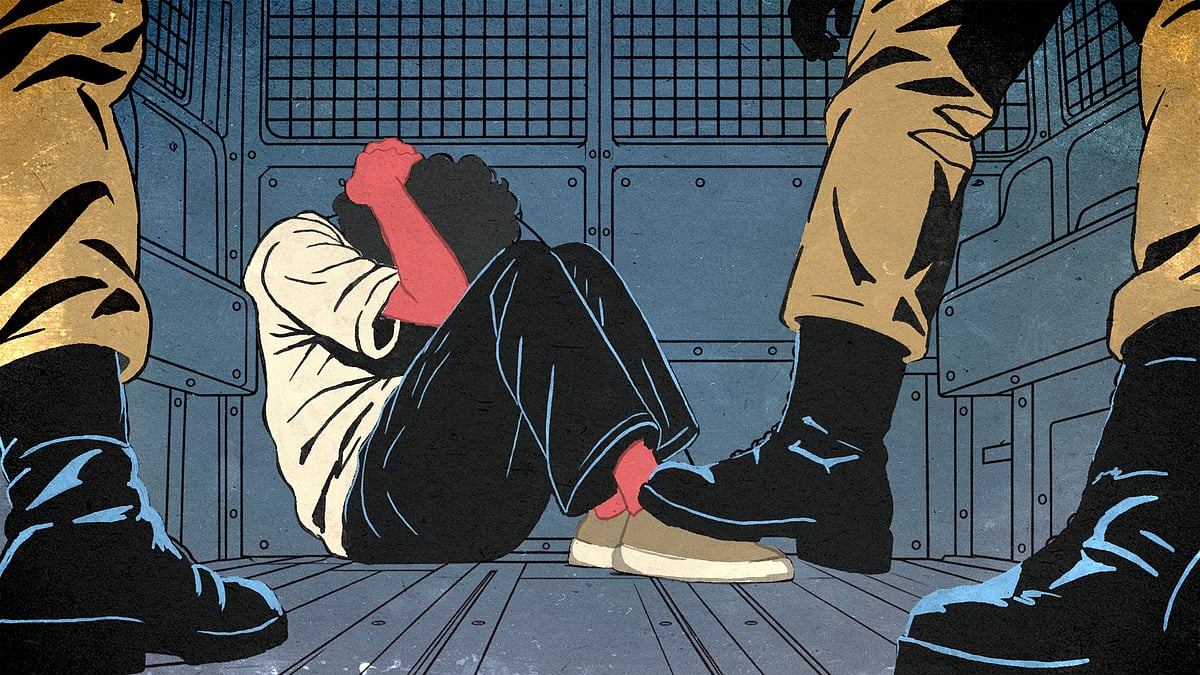
Based on lawyers’ testimonies, the tribunal found an organised effort to detain people to stop them reaching Jantar Mantar, arbitrary detentions that ignored safeguards, attempts to hide detainees’ locations, and disproportionate targeting of students and Muslims.
Witnesses also reported networks going down near the site. The report calls it the most heavily surveilled protest in the country’s history, and notes the police affidavit does not say what law authorises facial recognition.
Findings on the October 10 protests and the anti-SIR demonstrations rest on published reports. They describe vehicles intercepted en route to Delhi, journalists detained, lawyers denied access and allegations of sexual assault in custody.
Recommendations
The National Police Commission (NPC), in its second report, placed the protection of constitutional rights at the centre of what it viewed as the objectives of law enforcement by police, the tribunal noted.
“The policing of peaceful protests in India is one of the sharpest illustrations of the dominance of a punitive, ‘law and order’ approach which serves to curb, criminalise, and demonise public protests. The development of policing in independent India has led to police controlled by the executive, immune to accountability, and as in the case of the July 2026 protests, the prime state institution violating constitutional rights.”
The report makes several recommendations
It suggests to replace police permission for assemblies with a system of prior notification. “In a joint report by the United Nations Special Rapporteur (SR) on the rights to freedom of peaceful assembly and of association and the Special Rapporteur on extrajudicial, summary or arbitrary executions on the proper management of assemblies, the SRs reinforced that as freedom of public assembly is a right, ‘its exercise should not be subject to prior authorisation by the authorities’.”
The reports suggests that dispersal of assembly should be allowed on stricter grounds than a “likely disturbance of public peace”. “Notably, the legal ingredients that constitute when an assembly can be deemed ‘unlawful’ also do not contain strict grounds of imminent threat to life or property, but focus on security-centric concerns.”
The tribunal suggests to bar firearms against non-violent assemblies, even those declared unlawful, and prohibit pellet guns against civilian gatherings.
It also recommends to cut the list of permitted crowd-control weapons, publish weapon-specific protocols and train officers on the harm each causes. The government must shift police training from weapons towards communication, de-escalation and negotiation, it suggests.
The report also suggests to ban facial recognition, drones and similar surveillance at public assemblies. “We note that the use of such instruments in a roving manner to identify persons and conduct surveillance is absolutely illegal. In the context of public assemblies, we recommend that the use of any kind of technology for surveillance, intelligence- gathering or identification is banned for use by police or any security force, particularly as the legal position already disallows this.”
The tribunal seeks an end to police impunity. Prior sanction under Section 218 of the BNSS, it said, cannot shield excesses, and it urged strict action over sexual assault allegations.
The report has four annexures. Annexure I is a dossier by filmmaker Varrun Sukhraj, who collected about 920 videos of the July 20 protest and presented 25 geotagged exhibits. They cover alleged pellet and tear-gas use, electric and nail-fitted batons, assaults on women and minors, unidentified men in civilian clothes, missing name badges and a stone-laden truck.
Annexure II sets out the legal framework, from UN use-of-force principles to Delhi Police standing orders and the chain of command. It notes that senior Delhi officers hold magistrate-like powers, and it sets each prescribed step against what witnesses described. Annexure III has two medico-legal certificates of injured protesters, whose names were changed, and the list of those who testified. Annexure IV reproduces the police circulars and standing orders, including No. 309 on demonstrations.
The tribunal also referred to Newslaundry’s report on the mystery of the stone-laden truck found near the protest site. Newslaundry reporter Avdhesh Kumar, whose investigation traced the stone-laden truck seen near the protest site on the morning of 20 July, testified in person and was cross-questioned by the jury.
The report found it was no stray vehicle. Police had seized the dumper after a pre-dawn crash on July 16 that injured seven people, and it was held at the Parliament Street station’s malkhana before moving at least four times, including to the protest site and outside the Indian Youth Congress office. Police gave him conflicting explanations. Delhi Police later said it was emptied and shifted in the early hours of July 20. The tribunal noted that the police affidavit in the Supreme Court did not mention the truck. The report also cited Newslaundry’s October coverage of detentions.
If you’re reading this story, you’re not seeing a single advertisement. That’s because Newslaundry powers ad-free journalism that’s truly in public interest. Support our work and subscribe today.
 What happens after Delhi Police detains you? I saw it first hand