Shrinking reach, silent bans: Inside Instagram’s surge in content restrictions
Data from the Software Freedom Law Centre points to a sharp rise in October. Affected users say they get little explanation.

Eight Instagram posts in 48 hours. For independent journalist and educator Raghav Trivedi, who has 772,000 followers, the takedowns came in quick succession, leaving him questioning why his content was being removed.
“I have had eight videos taken down. Whenever I upload a video, it gets blocked in India within 30 to 35 minutes. I uploaded six videos yesterday and tried uploading two more, but those were blocked as well,” Trivedi told Newslaundry.
He is among several independent journalists, content creators and media organisations who have reported their posts being taken down and accounts restricted on Meta platforms, often without a clear explanation. In this report, a post described as “restricted” or “blocked in India” cannot be viewed by users in India.
Data compiled by the Software Freedom Law Centre (SFLC.in) records 268 instances of content restrictions and 83 instances of account restrictions across Meta platforms, X, Reddit and YouTube in October. Instagram accounted for the highest number of content restrictions among these platforms with 174 posts and 59 accounts restricted, according to SFLC.in.
Newslaundry spoke to affected journalists, creators and media organisations, examined the content that was taken down and sought to understand the reasons cited by the platforms, the impact on their work and the remedies available to them.
Meta takedowns happened in July too. So what changed in October?
Angela Thomas, Volunteer Legal Counsel with SFLC.in told Newslaundry, “Takedowns happened in July after the first Cockroach Janta Party (CJP) protest was over, but the wave of takedowns has risen manifold this month. We noticed that even instances of protest calls given on social media were taken down.”
The October wave coincides with the protests against Chief Election Commissioner Gyanesh Kumar and the Special Intensive Revision (SIR) of electoral rolls.
SFLC.in data shared with Newslaundry shows 51 posts were taken down across Instagram, Facebook and X, between July 1 and July 31. Instagram alone accounted for 174 posts in October, more than three times July’s total across all three platforms.
Thomas said SFLC.in had also noticed takedowns involving other current affairs topics, including Union Minister Hardeep Singh Puri, the Epstein files, and the murder of Ankita Bhandari.
Accounts restricted, audiences lost
Molitics, a digital media platform with 566,000 Instagram followers, has faced repeated restrictions on Meta platforms this year. Its Facebook page was restricted in March. On October 10, its Instagram page was restricted in India.

The page was restored after a few days, Geetanjali Dubey, a reporter with Molitics, said. But the restrictions have also affected individual journalists working with the organisation.
Dubey’s personal Instagram account was restricted in India this month. Over the past eighteen months, she worked as a video journalist and built up an audience of 112,000 followers.
“I am a video journalist. My work is broadcast on social media platforms, with the most viewership on Instagram. Now I am showcasing my work on a backup account with only 2,500 followers. The way my work would reach a larger audience is gone,” she said, adding that it’s difficult to regain the audience's trust.
She is now working with the Internet Freedom Foundation to get her main Instagram account reinstated.
Raghav Trivedi, whose videos are blocked in India shortly after upload, the impact on audience growth has been stark – his Instagram reach plummeted from 100 million to 30 million in October.
Beyond immediate blocks, he suspects repeated takedowns affect how the platform distributes subsequent content.
“When your account receives strikes and videos are repeatedly taken down, your reach is affected. The algorithm does not necessarily account for the fact that your videos were removed. Instead, it checks that your last eight videos received only 20,000, 30,000 or 40,000 views within an hour. Usually, my videos get six lakh, seven lakh, one million or even two million views,” he said.

What is getting taken down?
Content creator Alpha Vishal, who began making videos on Instagram during the first CJP protest, said six of his videos have been deleted. “It seems videos with PM Modi’s name are being deleted,” he said.
Vishal shared two videos with Newslaundry that are no longer available on his Instagram page. In one, he discussed Jantar Mantar being de-notified as a protest site. The video opened with: “PM Modi and Amit Shah are so scared that they have removed Jantar Mantar as a protest site.”

In the other, he discussed former cricketer and Trinamool Congress MP Yusuf Pathan after the Gujarat government approved a special allotment to resolve his longstanding dispute over a 978-square-metre plot in Vadodara.
His account, which has 13,500 followers, has not seen a decline in reach, he said. But re-uploading is risky.
“Say I upload these deleted videos again on my page, Instagram applies restrictions such as disabling the messaging feature and live,” he added.
The takedowns have also affected content that is not critical of the government.
Amit Kilhor, a content creator, said a reel he had posted on January 31 was taken down this month. The video explained the context in which Prime Minister Narendra Modi’s name had come up in discussions surrounding the Epstein files, despite explicitly stating that it does not appear in them.
“We know anti-government content is being targeted. I am surprised that even my pro-government reels are being deleted,” Kilhor said.
Kilhor also cited two videos about a woman allegedly hitting another woman with a car on a golf course in Gurugram, which he said were taken down despite having no connection to government criticism.

Are keywords triggering takedowns?
“Meta has automated the process of taking down content,” alleged Thomas. She added that SFLC.in has analysed a pattern where posts with words such as ‘ECI’, ‘protest’, ‘SIR’, and ‘Rahul Gandhi’ were being taken down.
Kilhor believes certain keywords may be triggering bulk removals and that they are not necessarily targeting individual videos or creators.
Trivedi also alleged that Meta’s moderation system was flagging content based on specific keywords, which he suggested could include ‘Modi’, ‘government’, ‘Constitution’, ‘Jantar Mantar’, ‘protest’, ‘accountability’ and ‘Rahul Gandhi’. He identified videos that had been removed, including reports on government health schemes, students selling blood to fund their education, and political commentary.
One video concerned alleged irregularities involving government health cards that provide coverage of up to Rs 5 lakh. Another discussed reports of students in Uttar Pradesh selling their blood to pay college fees and rent.
“I explained this issue in my report that we should be asking why students cannot afford the cost of preparing for examinations,” he said.
He added that he had been posting similar reports on Instagram for about a year but had not experienced consecutive takedowns on this scale before.
Are legal requests behind some takedowns?
On October 27, legal news website LiveLaw's Instagram post about the Election Commission of India's response to the Supreme Court on SIR, Form 6 and appeals in West Bengal was restricted. The post was restored after a few hours.
LiveLaw editor Manu Sebastian told Newslaundry the organisation had not filed an appeal with Meta.
“I don’t know if they did it because of the social media outrage. There was no explanation given why it was taken down or why it was restored, except their standard response: it was done on legal request,” he said.
On October 29, Newslaundry learnt that another LiveLaw post on Instagram had been removed. LiveLaw said on X that Instagram had blocked another video explaining the pending legal challenges against the SIR, and that the reason given was “We received a legal request to restrict this content.”
Deputy Commissioner of Police for Intelligence Fusion and Strategic Operations (IFSO), Gaurav Tyagi, acknowledged that Delhi Police had sent notices to remove content on social media. He said, “Several requests have been sent by the Delhi Police to Meta for removing content which was illegal under the BNSS in the last month.”
What legal remedies do affected users have?
Advocate Krishnesh Bapat of the Delhi High Court said users whose content is removed through Meta’s internal mechanisms can approach the platform’s grievance officer under the Information Technology Rules, 2021. And if they are dissatisfied with the decision, they can appeal to the government’s Grievance Appellate Committee (GAC).
However, Bapat questioned the independence of these mechanisms.
“Initially, you are approaching the very entity that took down your content. Then, at the appellate stage, you may be approaching a body constituted by the government, which you might have been criticising in the first place. So, there is no truly independent redressal mechanism under this statutory process,” he said.
Recourse through the courts is also limited. On October 29, the Delhi High Court ruled that Meta’s suspension of Instagram accounts cannot be challenged through a writ petition under Article 226 of the Constitution, observing that merely providing a social media platform does not amount to performing a public duty.
The ruling came in a petition filed by Sarthak Bhagat, whose Instagram accounts had been disabled without prior notice. The court directed the GAC to decide his pending appeal expeditiously, rather than intervening.
Bapat said, “Reasonable restrictions on speech, as envisaged under Article 19, require the application of mind. There must be a human being assessing the content before imposing any restriction, even when the restriction is being imposed by a private entity on its platform.”
Despite acknowledging the need for automated moderation, particularly in cases involving child sexual abuse material, he alleges recent takedowns and restrictions enforced by Meta happened without adequate consideration of context.
Bapat said, “When you are taking down or restricting an entire account, you are not merely restricting one particular piece of speech that you have an issue with. You are taking down everything the person has ever said and restricting their ability to express themselves in the future.”
Newslaundry has reached out to Meta for a response on the content restrictions and takedowns, and the story will be updated once a response is received.
If you’re reading this story, you’re not seeing a single advertisement. That’s because Newslaundry powers ad-free journalism that’s truly in public interest. Support our work and subscribe today.
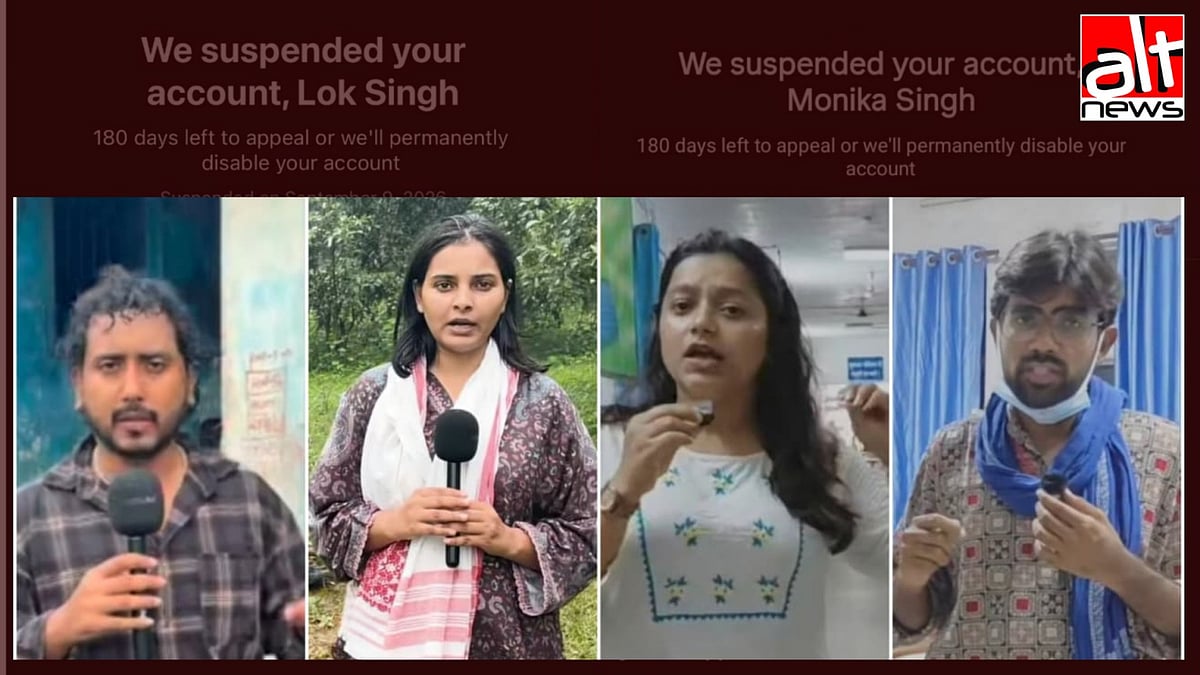 Independent journalists reporting on MP child deaths face surveillance, have Instagram accounts disabled
 Your Instagram reel is now ‘news’ — and the Govt wants to censor it