#DataViz: Where does India shut down the internet?
Jammu and Kashmir accounts for nearly half of the 935 recorded shutdowns since 2012.

India saw more than 900 internet shutdowns in 15 years, which translates to a shutdown order every six days, on average, according to our analysis of data compiled by the Software Freedom Law Center (SFLC). Two in three of these were in Jammu and Kashmir, Rajasthan and Manipur.
Preventive shutdowns, imposed in anticipation of an event, accounted for 70% (654) recorded incidents, while the rest were categorised as ‘reactive’.
The longest shutdown in the tracker lasted 552 days in Jammu and Kashmir, where internet access was restricted from August 4, 2019, after the abrogation of Article 370, until 4G services were restored on February 6, 2021. Manipur’s statewide shutdown, imposed after violence broke out in May 2023, lasted 200 days.
Recorded shutdowns fell from a peak of 136 in 2018 to 33 so far in 2026. Delhi recorded 11 internet shutdowns in 15 years, seven of them in 2026—as many as in Manipur and more than in any other state or Union territory this year.
Globally, India had the most internet shutdowns of any country since 2019, according to the Internet Society’s Pulse shutdown tracker. Iraq had the second highest, followed by Syria and Sudan. (Note: The two trackers have different coverage and methodologies and are not directly comparable.)
“It’s shameful that we have among the highest number of internet shutdowns in the world historically,” Nikhil Pahwa, founder of MediaNama, a publication covering technology policy and digital regulation in India, told ISignal. “We may have the highest number of people in the world, but then that means we should also have the largest capacity to maintain law and order.”
India’s shutdowns are mostly limited to districts and smaller administrative areas rather than entire states, the Internet Society noted in an August 2026 report on shutdown trends between 2019 and 2025.
Shutdowns peaked in 2018
SFLC’s tracker documented three internet shutdowns in 2012, a number which rose to 136 in 2018, the highest during the 15-years period. This year, as of November 9, the country recorded 33 shutdowns, the lowest in a decade.
SFLC’s annual report recorded 3,381 hours of restricted access in 2024, about half the 6,841 hours recorded in 2023.
“The current legal framework uses broad terms such as ‘public emergency', ‘public safety', or ‘public order’ as grounds for suspending internet services, but these terms are not clearly defined,” SFLC said in a response to ISignal. “This leaves a lot of room for interpretation and creates the risk of the law being misused.”
Pahwa said an internet shutdown is “essentially a state’s acknowledgement that it is incapable for that period of time to maintain law and order and maintain fundamental rights. So it is effectively a state’s acknowledgement of the failure of the state’s machinery.”
Jammu and Kashmir accounts for nearly half the shutdowns
Jammu and Kashmir recorded 454 shutdowns, or 48.6% of the 935 incidents in the dataset. Rajasthan accounted for 12.3% and Manipur for 6.6%.
These shutdowns have far-reaching impacts. For instance, students in Manipur were unable to receive financial support from their parents or access study materials during shutdowns, SFLC told ISignal. And restrictions on prepaid mobile data and SMS services in Jammu and Kashmir in March 2026 made it difficult for students to receive the one-time passwords required to complete NEET application forms near the deadline, the statement added.
Pahwa cited the example of a shutdown in West Bengal’s Darjeeling and said students had to climb up on a hill to get a signal from across the border to submit college applications. “The fact is that you cannot have Digital India and at the same time have the highest number of internet shutdowns in the world. It renders Digital India just a slogan.”
Within Jammu and Kashmir, shutdowns were concentrated in the Kashmir valley. Pulwama district was affected by 175 shutdowns, including 64 imposed on Pulwama alone. One shutdown order can cover several districts.
Seven in 10 shutdowns were preventive
The SFLC tracker classifies 654 shutdowns as preventive and 281 as reactive. The classification describes whether a restriction was imposed in anticipation of an event or in response to one.
Shutdowns affect access to services and information
Internet access is used for education, livelihoods, banking, public services and communication. SFLC said shutdowns can affect students, gig workers, job seekers, small businesses and people seeking emergency assistance.
“Internet shutdowns have far reaching consequences for people’s everyday lives, affecting everything from education and livelihoods to access to essential services and the ability to stay informed,” SFLC said in a response to a questionnaire from ISignal.
They can also affect access to healthcare, food, shelter and emergency assistance. “Internet restrictions can make it difficult to contact emergency services, coordinate medical assistance or arrange timely transportation to hospitals,” it said, adding that prolonged shutdowns in Manipur complicated access to essential services and humanitarian aid.
Journalists can also face difficulties communicating with newsrooms, verifying information and reporting developments during shutdowns, SFLC said. It said disruptions can create information gaps in which rumours and misinformation spread through offline networks.
A June 2023 Human Rights Watch report documented the effects of shutdowns on vulnerable communities, including access to public services, banking and wages under the Mahatma Gandhi National Rural Employment Guarantee Act.
Internet shutdowns cost the Indian economy an estimated $3.04 billion between 2012 and 2017, according to the Indian Council for Research on International Economic Relations, as ISignal reported in February 2020. The Cellular Operators Association of India estimated that telecom operators lost about Rs 2.45 crore in revenue for every hour of shutdown.
“Another concern is that the review committees responsible for overseeing these suspensions are largely dominated by the executive, which raises questions about how independent and credible the oversight mechanisms are,” SFLC said. “There are also no cumulative limits on how long internet suspensions can continue.”
Reasons cited for shutdowns
Of 434 internet shutdown incidents recorded for India by the Internet Society, about 14% attributed ‘protests’ as the cause, while about 6% each listed exams or elections as the cause. Nearly three in four simply listed the cause as ‘government action’, which included orders such as this April 2026 incident from Manipur which cited the “prevailing law and order situation”, and this March 2025 shutdown in parts of West Bengal’s Birbhum district “in view of recent events in some areas”.
SFLC said its tracker had recorded at least 10 shutdowns since July 2026, most of them during protests and demolition drives. Authorities cited reasons such as maintaining public order and preventing the incitement of offences, the organisation said. SFLC said it considered blanket restrictions in such circumstances disproportionate because they affect rights including freedom of speech and expression, peaceful assembly and access to information under Article 19 of the Constitution.
“There have been attempts in the past, especially in case of J&K, to try and block access to certain platforms instead of trying to shut down the entire internet,” Pahwa said. “The suspension of these platforms, like it was done nationwide for Telegram during the NEET exams, was again a failure of the Indian state to enable fundamental rights.”
In Anuradha Bhasin v. Union of India, decided on January 10, 2020, the Supreme Court addressed restrictions on internet access in Jammu and Kashmir. The judgement said suspension orders must be published and are subject to judicial review. It also held that restrictions on speech and trade carried out through the internet must meet constitutional requirements, including proportionality.
The Court held that an indefinite suspension of internet services is impermissible and that suspension orders must be temporary and subject to periodic review. It also recognised that freedom of speech and expression and the freedom to carry on trade or business through the internet are protected under Articles 19(1)(a) and 19(1)(g) of the Constitution.
The legal framework for suspending telecommunications services has since changed. The Telecommunications (Temporary Suspension of Services) Rules, 2024, set out requirements for suspension orders, including the reasons, area and duration of a restriction.
In August 2026, the government told Parliament that the Department of Telecommunications (DoT) does not centrally maintain details of orders issued by states and Union territories for “temporary suspension of internet”. It also said the 2024 rules require authorities to consider reasonable alternatives and that suspension should be used as a last resort in the interest of public emergency or public safety.
On October 15, 2026, in a judgement on online child safety, the Supreme Court held that access to and use of the internet is a fundamental right, and that children also have this right.
ISignal reached out to the Department of Telecommunications for comment on the use of internet shutdowns in India, the safeguards governing their imposition, and the availability of shutdown data. We will update this report when we receive a response.
This report is republished with permission from ISignal, formerly IndiaSpend, a data-driven, public-interest journalism non-profit. It has been lightly edited for style and clarity.
 Shrinking reach, silent bans: Inside Instagram’s surge in content restrictions
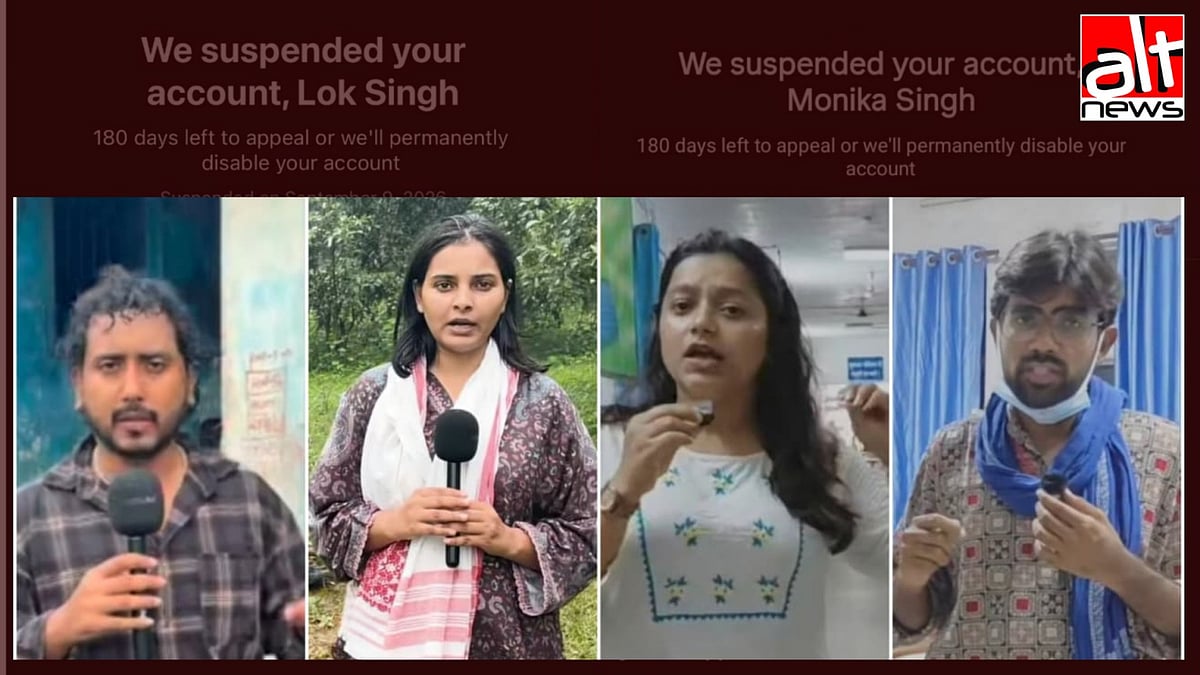 Independent journalists reporting on MP child deaths face surveillance, have Instagram accounts disabled