Lakhs spent on removing the foam on Yamuna. Here’s why that won’t clean the river
Froth continued to surface on the Yamuna during Chhath Puja, despite a defoaming drive and thousands of crores spent on the river’s rejuvenation.

Another Chhath Puja, another familiar image from the Yamuna: women taking a dip in water blanketed by thick white foam.
The promise of a cleaner river returns every year too. This time, the Delhi Jal Board (DJB) had planned to procure an estimated 30,000 kg of defoaming agent, Rs 91 lakh was cleared for a study on river frothing, and Rs 6,485 crore was allocated to the Delhi Jal Board under the 2026-27 Green Budget for river rejuvenation, sewage treatment upgrades and riverfront maintenance.
Yet the foam remains.
When Newslaundry visited the Kalindi stretch of the Yamuna weeks before Diwali on November 4, a DJB tent had been set up. A board official said the spraying of the defoamer had begun only two to three days earlier, and the schedule for spraying the agent was decided by “bigger officials”. Between October and December 2025, the DJB spent Rs 79.62 lakh to procure 48,000 kg of defoaming chemicals for a 63-to-66-day drive near Kalindi Kunj.
But does the defoamer work? Does it offer a lasting solution to the Yamuna’s frothing problem?
“The defoamer is being used so that the public does not see the foam. People get the impression that pollution has reduced, but the pollution in the river has not actually decreased,” said Pankaj Kumar, an environment and climate activist.
Concerns over prolonged defoamer use were raised in 2025
In November 2025, The Indian Express reported that Earth Warrior, a nonprofit, had written to Lieutenant Governor VK Saxena, Chief Minister Rekha Gupta and other officials, raising concerns over the prolonged use of defoaming chemicals in the Yamuna.
In its letter, the organisation claimed that the spraying had continued for “more than 40 days till date (November 23, 2025)” and had “commenced in the second week of October 2025”, unlike the shorter duration associated with the Chhath Puja period in previous years.
According to the letter, the group maintained that “for the last three years (2022-2024), the Delhi Jal Board (DJB) restricted the spraying… to only 7–10 days immediately before and during Chhath Puja”. It said the extended timeline in 2025 marked a significant departure from this pattern.
A senior DJB official, speaking anonymously to The Indian Express, acknowledged that excessive defoaming could potentially pose ecological risks. The official said international research had documented instances in which silicone-based defoamers could settle on fish gills or form thin films on the water’s surface, potentially interfering with oxygen transfer.
The official also said the dosage of a defoamer was generally determined by factors such as the thickness of the foam, bubble size, and whether the foam was compact or loose.
Speaking to Newslaundry, Kumar said the chemical was not a solution to the underlying problem.
“This is a silicon-based defoamer, and it is not a solution to the problem. It is only a temporary measure. Applying it to the foam makes the foam disappear, but it does not improve the water quality.”
He added, “This chemical can accumulate in the river, posing a threat to aquatic life and plants. If fish consume it, their skin could deteriorate. This is one of the problems associated with using defoamers.”
Bhim Singh Rawat, associate coordinator of the South Asia Network on Dams, Rivers and People (SANDRP), also described defoaming as a temporary intervention.
“The defoamer is essentially a temporary intervention. It may disperse the foam on the river's surface, but it does not address the underlying pollution or improve the water quality of the Yamuna. It makes the foam disappear from public view, but the pollution remains in the river,” he said.
Rawat pointed to how briefly the chemical works after being sprayed.
“The chemical has some effect on the frothing immediately after it is applied or sprayed. There may be other, less harmful liquids that could be sprayed on the froth to suppress its quantity and achieve a similar effect. However, the effect is only temporary and lasts as long as the spraying continues. Once they stop spraying, the froth begins to reappear within half an hour to an hour, with small particles or ‘seeds’ of froth floating on the river’s surface.”
He also raised concerns about the chemicals persisting in the river.
“There are concerns about the persistence of these chemicals in the river. If they take a long time to biodegrade, they could accumulate in the aquatic environment. We need proper scientific assessment of their impact on aquatic organisms, plants and fish rather than assuming that dispersing the foam is a harmless intervention.”
FIR lodged over dead fish, but questions remain about defoamer impact
Days before Chhath Puja, visuals of a large number of dead fish floating in the Yamuna near Sonia Vihar surfaced on social media on November 12, raising concerns about water pollution and possible toxic discharges into the river.
On November 13, Delhi Water Minister Parvesh Sahib Singh accused the Aam Aadmi Party (AAP) of dumping dead fish into the river to “defame the BJP government and its efforts to clean the Yamuna”.
The AAP rejected the allegation, questioned the government's claims about cleaning the river and demanded an investigation into whether chemical discharges had caused the fish deaths.
Separately, the Delhi Jal Board submitted a complaint to the police, seeking an FIR against unidentified persons for allegedly spreading misinformation on social media about chemical discharges into the river. The Delhi Police subsequently registered an FIR against a person in connection with the matter.
The cause of the fish deaths is yet to be established.
Both Rawat and Kumar raised concerns about the use of this chemical and the impact on aquatic ecosystems.
Rawat said, “There are concerns about the persistence of these chemicals in the river. If they take a long time to biodegrade, they could accumulate in the aquatic environment. We need proper scientific assessment of their impact on aquatic organisms, plants and fish rather than assuming that dispersing the foam is a harmless intervention.”
Kumar claimed, “It takes about 10 years for the defoamer to biodegrade naturally. Until then, it can accumulate in the river, posing a threat to aquatic life and plants. If fish consume it, their skin could deteriorate. This is one of the problems associated with using defoamers.”
How was Yamuna’s water quality before the defoaming drive?
The concerns over frothing come against the backdrop of deteriorating water quality in the Yamuna, even before the start of the festival season and the use of defoamers.
A Delhi Pollution Control Committee (DPCC) water-quality assessment, based on samples collected on September 7 and released on September 30, recorded a sharp deterioration in the river’s water quality as it flows through Delhi.
At Palla, the river recorded a Biological Oxygen Demand (BOD) of 2 mg/L, within the prescribed Class C criterion of 3 mg/L or less. However, at ISBT Bridge, the BOD level rose to 30 mg/L - 10 times the prescribed limit.
The report also recorded a decline in dissolved oxygen (DO), from 6.5 mg/L at Palla to 2.9 mg/L at ISBT Bridge, against the prescribed minimum of 5 mg/L.
Faecal coliform levels at ISBT stood at 35,000 MPN/200 ml, significantly exceeding the maximum permissible criterion of 2,500 MPN/200 ml.
The deterioration was also reflected in phosphate and ammoniacal nitrogen concentrations, which rose from 0.07 mg/L and 0.12 mg/L at Palla to 0.98 mg/L and 1.12 mg/L, respectively, at ISBT Bridge.
For Kumar, the frothing is a symptom of the larger problem of untreated wastewater entering the river. “There is froth in the river because there is pollution in the river. The reason is that wastewater from Delhi-NCR, whether sewage or industrial effluents, is neither being properly intercepted nor adequately treated. Until we properly intercept and treat our wastewater, we cannot save the Yamuna,” he said.
He said the government needed to set realistic targets for improving the river's water quality.
“We need to look at what is realistically achievable. Our goal should be to ensure that the water meets the prescribed quality standards after treatment. We should work towards gradually improving the Yamuna’s water quality, moving it from Priority Class I towards Priority Class II and beyond. Not making it fit to drink or bathe.”
Newslaundry has reached out to the Delhi Jal Board for its comments and this report will be updated if a response is received.
Small teams can do great things. All it takes is a subscription. Subscribe now and power Newslaundry’s work.
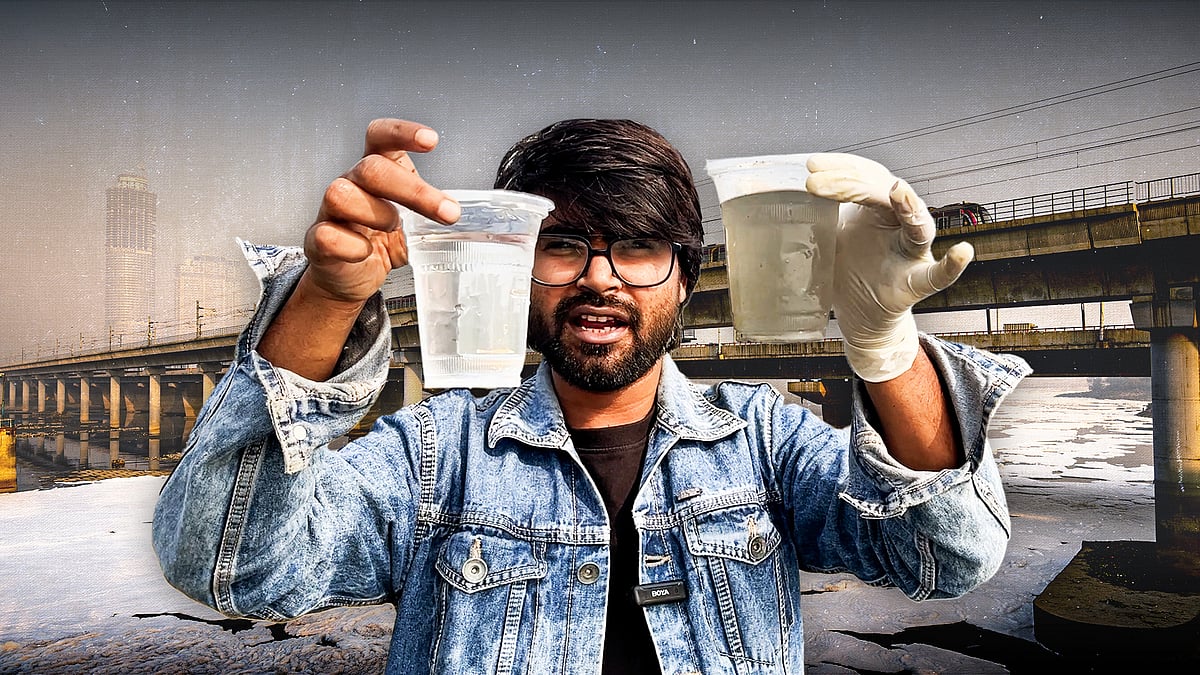 Delhi govt’s ‘clean Yamuna’ PR stunt exposed: Fake ghats, photo ops, filthy water