The price of Delhi’s deshbhakti: Giant flags to be replaced every month, a bigger bill with new tender
Delhi’s 500 giant flags are estimated to cost around Rs 200 crore to install and maintain. We went through three PWD tenders to find out why the estimates have climbed, even though each flag now costs less.

It began in 2021 under the Aam Aadmi Party’s Deshbhakti initiative: 500 tricolour flags were to be installed across the national capital. The installations were completed in 2022, but “deshbhakti” comes at a cost.
The installations and maintenance are estimated to cost nearly Rs 200 crore. Since the installations began, Delhi’s Public Works Department (PWD) has issued three tenders for their maintenance and upkeep, the latest of which was released on September 29.
This latest tender came months after a change in direction. In June this year, after several dust storms swept through Delhi, PWD received complaints about torn flags. Following this, PWD minister Parvesh Verma hinted at an overhaul. “These are huge flags and, after repeated washings, the fabric weakens,” he had said.
According to a report by the Hindustan Times, the washing cycles were to be reduced, replacements increased and the fabric quality improved to preserve the dignity of the national flag. The latest tender released by the department, however, signals a more substantial overhaul of the maintenance policy.
The new life of Delhi’s giant flags
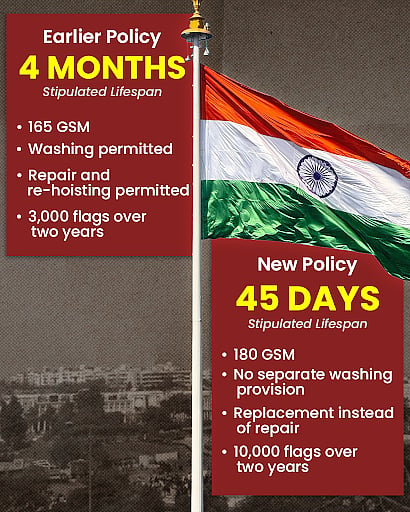
The earlier maintenance arrangements allowed flags to remain hoisted for an estimated four months. During this four-month period, damaged flags could be repaired and re-hoisted or replaced, subject to the approval of the engineer-in-charge. The tenders also provided for wet-cleaning or washing flags whenever required.
The 2023 and 2025 tenders each provided for 3,000 new flags over a two-year period: 2,880 flags for 35-metre masts and 120 for 50-metre masts. The 2025 tender estimated the cost of procuring these flags at approximately Rs 12.15 crore. It also provided for 21,000 wet-cleaning operations over the contract period, estimated to cost another Rs 9.34 crore.
The latest tender takes a different approach.
It provides for 9,600 flags for 35-metre masts and 400 for 50-metre masts, taking the total to 10,000 over two years, almost 3.3 times the previous procurement.
It also stipulates that new flags must be hoisted at all 500 locations within the first two to three days of each month. If a flag is torn or damaged within 45 days, the contractor must replace it with a new one.
The tender no longer has a separate provision for wet-cleaning. It also does away with the earlier arrangement of repairing damaged flags and re-hoisting them. The Flag Code of India stipulates that a damaged or soiled national flag must be destroyed as a whole in private, preferably by burning or by another method consistent with its dignity.
On each of these flag poles, a phone number is displayed for filing complaints. When Newslaundry called the number, Vishal Kumar, an engineer with BL Infra Projects Pvt Ltd, answered. The company had installed all 500 flagpoles, including their lighting and cabling, but after their contract ended, the next flag procurement and maintenance tender was awarded to another contractor.
Kumar described an alternating system in which flags were temporarily replaced for washing every 15 days, before being completely replaced every four months. According to him, the department had issued around five to six flags per pole, replacing those that had become dirty. He said the company no longer held the maintenance contract. The phone number, however, continues to be displayed on the poles, and he still receives complaints, which he forwards to PWD officials.
Ravish Arya, the assistant engineer handling the work, said the decision to discontinue washing was linked to concerns about the appearance of flags after they were cleaned.
“Earlier, we used to wash the flags. That is why the lifespan was four months. But some people felt that after washing, the flags did not look that nice and also faded. That's why washing has been refused. And of course, if we don't wash them, we'll need to replace them more,” he said.
The department has also changed the fabric specification. While the earlier tenders specified 165 GSM (grams per square metre) polyester flags, the latest one specifies 180 GSM fabric. GSM measures the weight of fabric per unit area. The higher specification indicates that the new flags will use heavier fabric, although this alone does not establish how durable they will be.
The dimensions have also been reduced. For 35-metre masts, the specified flag size has changed from 36 ft by 24 ft to 30 ft by 20 ft. For 50-metre masts, it has been reduced from 60 ft by 40 ft to 48 ft by 32 ft.
“We are seeing if this works better,” Arya said, referring to the change in fabric.
The department's stated objective is to reduce the number of torn flags and complaints. Arya said the condition of a flag depends on several factors, including its location and exposure to wind. Some installations are at busy road junctions, while others are in government buildings, colleges and along major roads.
More flags, more money, more eyes on the poles
As per tender documents viewed by Newslaundry, Rounak India Projects Pvt Ltd was the lowest bidder (L1) for the 2023 tender, quoting approximately Rs 17.5 crore against the estimated cost of Rs 22.31 crore.
For the 2025 tender, S L Electromech Pvt Ltd emerged as the lowest bidder, quoting approximately Rs 14.3 crore against an estimated cost of Rs 26.53 crore. The same company was the lowest bidder for the latest tender, quoting approximately Rs 25.31 crore against an estimated cost of Rs 33.48 crore. PWD officials told Newslaundry that the 2026 tender is yet to be awarded.
The L1 bids do not, by themselves, establish the final contract values or amounts paid. Arya said that the 2025 contract would be foreclosed after being decided on by senior PWD officials.
But the shift towards replacing flags rather than washing and repairing them comes with a substantial increase in the estimated cost of procurement.
A comparison of the detailed bills of quantities (BOQs) for the 2025 and 2026 tenders shows a sharp increase in the estimated cost of procuring flags. In 2025, the department had estimated Rs 12.15 crore for 3,000 flags. In the latest tender, the estimated cost of procuring 10,000 flags is approximately Rs 27.32 crore.
The estimated cost per flag has, however, come down. A 35-metre flag, which was priced at Rs 37,837 in the 2025 tender, has been estimated at Rs 25,244 in the latest one. For 50-metre masts, the rate has fallen from approximately Rs 1.05 lakh to Rs 77,229. Though the new flags are also smaller in size.
The earlier tender had separately earmarked approximately Rs 9.34 crore for 21,000 wet-cleaning operations. The latest BOQ has no separate provision for washing, with the department instead relying on the procurement and replacement of new flags.
The latest tender also provides for 20 motorcycle-borne inspection teams to monitor all 500 installations and submit daily reports on their condition. The provision covers 480 person-months and is estimated to cost approximately Rs 2.65 crore. Another Rs 11.04 lakh has been earmarked for a centralised complaint centre.
Arya said inspection requirements existed earlier as well, but the manpower available for supervision was limited.
The 2025 tender had already required 10 mobile teams, GPS monitoring of flag installations and complaint-tracking mechanisms. The latest tender, however, expands the provision for dedicated inspection manpower. “Now, manpower for supervision is higher so that the inspection can be done quickly, within a day. Right now, that is not the case,” he said. He added that PWD officials monitor the work and record the materials used during the billing process, with payments made accordingly.
The Rs 200-crore question
Across the three tenders, the estimated value of the maintenance contracts has risen from Rs 22.31 crore in 2023 to Rs 26.53 crore in 2025 and to Rs 33.48 crore in 2026. Along with the roughly Rs 130 crore reported cost of installing the 500 flagpoles, these other expenditures and estimated contracts take the estimated total to approximately Rs 200 crore.
The figures should not, however, be read as a statement of actual expenditure.
Now look at the scale of this estimated spending in comparison to other public projects. The roughly Rs 200 crore involved in this initiative is equivalent to the Delhi government's proposed cost of constructing a trauma centre at GTB Hospital. It is also equal to the entire allocation for constructing new government school buildings in the 2026-27 budget.
The latest tender also raises questions about the department’s estimates.
It provides for 10,000 flags over two years, while stipulating that new flags must be hoisted at all 500 locations within the first two to three days of each month. If a new flag is required at every location every month, the requirement would amount to 12,000 flags over two years. To understand how PWD arrived at the estimated quantity of 10,000, Newslaundry reached out to Superintending Engineer Pankaj Rawal, South West Maintenance Circle, but did not receive a response.
Newslaundry also sought responses from senior PWD officials on the revised maintenance policy, the increase in flag procurement and the estimated costs. This report will be updated if a response is received.
Complaining about the media is easy. Why not do something to make it better? Support independent media and subscribe to Newslaundry today.
 Delhi govt’s ‘clean Yamuna’ PR stunt exposed: Fake ghats, photo ops, filthy water